Google’s algorithm changes hit roofing contractors harder than most industries. If your rankings dropped in 2024 or 2025, algorithm updates were likely the culprit.
At Ladder 48, we’ve tracked how these shifts affect roofer SEO rankings. This guide breaks down what changed, why it matters, and exactly what you need to do to recover and stay competitive.
What Google’s December 2025 Core Update Actually Changed for Roofers
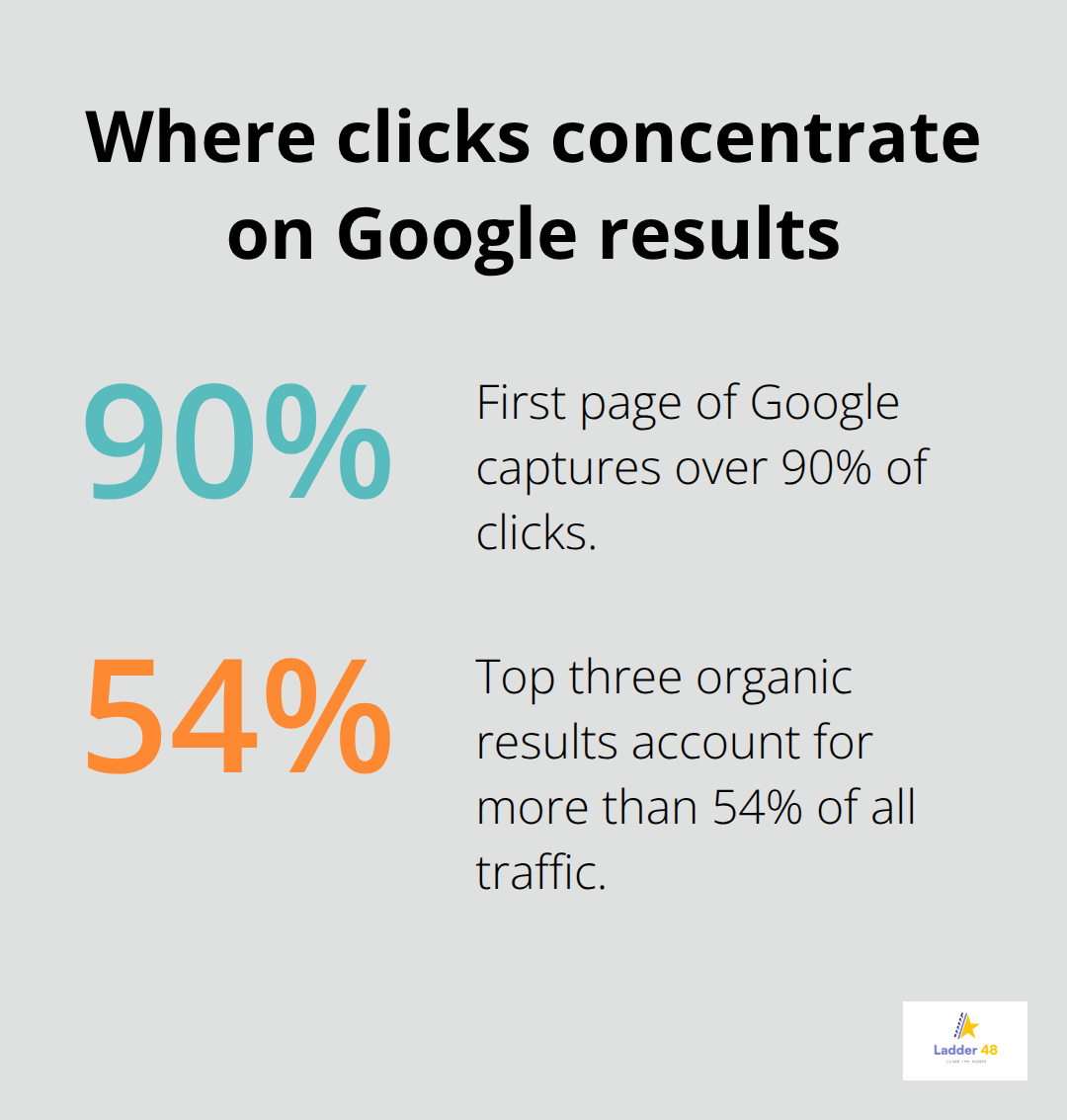
Google’s December 2025 Core Update fundamentally rewired how roofers rank in local search results. The update prioritizes real-world experience and E-E-A-T signals-Experience, Expertise, Authoritativeness, and Trustworthiness-over SEO-driven marketing language. This shift means your website’s technical foundation matters less than proving you’re a credible, established local business. A long operational history in your service area, like operating in Apex since 2011, now carries measurable ranking weight. Google rewards brick-and-mortar presence and sustained service quality over years far more aggressively than before. The first page of Google captures over 90% of clicks, with the top three organic results accounting for more than 54% of all traffic, so falling outside the top three positions after this update means losing the majority of potential leads. Your page speed and mobile responsiveness remain important for user experience, but they’re no longer the primary ranking levers they once were.
Instead, Google now evaluates whether your credentials, warranties, and customer reviews demonstrate genuine expertise and reliability in your market.
Credentials and Warranties Now Outrank Speed Optimization
Credentialed installers-such as CertainTeed SELECT Shingle Master contractors-send stronger authority signals to Google’s ranking system than optimizing Core Web Vitals alone. An extended warranty like a 15-year workmanship guarantee, paired with material warranties such as CertainTeed limited lifetime coverage, directly influences how Google categorizes your trustworthiness. Storm-damage searches surface contractors with proven reliability and sustained service quality, meaning a contractor with five years of consistent positive reviews outranks a competitor with faster page load times but minimal local history. This represents a hard reversal from 2023 and 2024, when technical metrics dominated. Your website still needs to load within three seconds on mobile and rank well on Core Web Vitals, but Google no longer penalizes you for not being in the top 10% of speed performers. The update reduces visibility for low-quality or aggressive sites, increasing the likelihood that homeowners connect with experienced professionals-which means transparent processes like free inspections, damage assessments, and insurance-claim assistance now influence search ranking calculations.
Local Relevance Beats Content Volume
Serving the NC Triangle-Apex, Raleigh, Cary, Holly Springs, Fuquay-Varina, Wake Forest-signals strong local relevance far more effectively than publishing 50 blog posts about roofing. Google now prioritizes clear, homeowner-focused information over marketing-heavy content, meaning your service pages should answer actual questions homeowners ask rather than stuffing keywords. A single location page for Apex with genuine customer testimonials, transparent pricing, and local building-code references ranks higher than five generic pages covering the same city with templated content. The update emphasizes established local businesses with consistent branding across their service area, so setting your Google Business Profile category to Roofing Contractor with precise hours and all 20 available service areas filled generates measurable ranking lifts. Homeowners researching storm-damage outcomes benefit when contractors offer transparent processes, which Google’s algorithm now recognizes as a trust signal. This means your website copy should focus on what you actually do-not what you think Google wants to see-and back claims with verifiable customer feedback and credentials rather than theoretical benefits.
Transparent Processes Build Authority Signals
Insurance-claim assistance, temporary tarping, and damage assessments now function as authority signals within Google’s ranking system. Contractors who document these processes on their websites and highlight them in service descriptions rank higher than those who hide their methodology behind contact forms. Homeowners searching for storm-damage support expect to find contractors who explain their approach upfront, and Google rewards this transparency with better visibility. Your Google Business Profile should list these specific services under your main Roofing Contractor category to capture searches from homeowners in crisis situations. The algorithm now connects transparent operations with trustworthiness, so contractors who clearly state their process outrank those who remain vague about how they handle emergency situations.
These ranking shifts mean your next priority isn’t faster page load times or more content-it’s proving you’re a legitimate, experienced local business with verifiable credentials and transparent operations.
How Recent Algorithm Shifts Reshaped Roofing Rankings
Search Generative Experience Changed Content Strategy
The March 2024 Core Update introduced Search Generative Experience, which placed AI-powered summaries directly above traditional organic results. This forced roofers to rethink content strategy entirely. Instead of optimizing for keyword density, contractors needed to answer questions directly and concisely so Google’s AI could pull their information into those summaries. Homeowners now see AI-generated answers before they scroll to organic listings, which means your content must provide clear, specific answers rather than marketing-focused language.
Helpful Content Update Penalized Generic Pages
The August 2024 Helpful Content Update penalized thin, templated service pages. Google’s systems identified pages that read like they were written for search engines rather than homeowners, and those rankings tanked. Roofing contractors who had copied competitor page structures or used generic templates lost visibility fast. What actually worked was specificity-pages that addressed real homeowner concerns with local context, actual pricing ranges, and genuine process documentation climbed rankings.
E-E-A-T Signals Became the Primary Ranking Lever
The December 2025 Core Update accelerated this trend by making E-E-A-T signals the primary ranking lever. Google Search Central Blog documented that this update emphasized real-world experience and trustworthiness over technical optimization, which meant a contractor operating in Apex since 2011 with 150+ verified reviews now outranked a newer competitor with faster page speed. The shift toward local services intensified in 2026, with Google rewarding contractors who demonstrated sustained presence and capability in specific geographic areas.
Local Authority Now Determines Winners
Roofing contractors who built deep local authority-through consistent citations, dense review volume, and transparent service documentation-saw ranking gains. Those who relied on broad, multi-state content strategies without local depth experienced further decline. The contractors winning in 2026 aren’t necessarily the ones with the most content or the fastest websites; they’re the ones proving they’re established, credible, and deeply embedded in their local markets.
What This Means for Your Rankings Today
If your roofing website ranks below the top three positions today, algorithm updates likely played a role, but the real issue is that your site doesn’t yet signal the authority Google now demands. Page speed optimization alone won’t recover those rankings. Audit your service pages for generic language and replace it with specific details about your process, local credentials, warranty offerings, and storm-damage response procedures. Ensure your Google Business Profile lists all 20 available service areas with accurate hours and Roofing Contractor as your primary category. Build review momentum steadily-try for two to three new reviews monthly-because Google’s 2026 algorithm heavily weights review volume and recency. If you operate across multiple cities, create dedicated location pages with local testimonials, neighborhood-specific information, and service-area building codes rather than one generic page covering everything. The next section covers the specific technical and local SEO strategies that recover rankings after these algorithm shifts.
Recover Rankings by Fixing What Google Now Measures
Local Authority Signals Drive Rankings More Than Speed
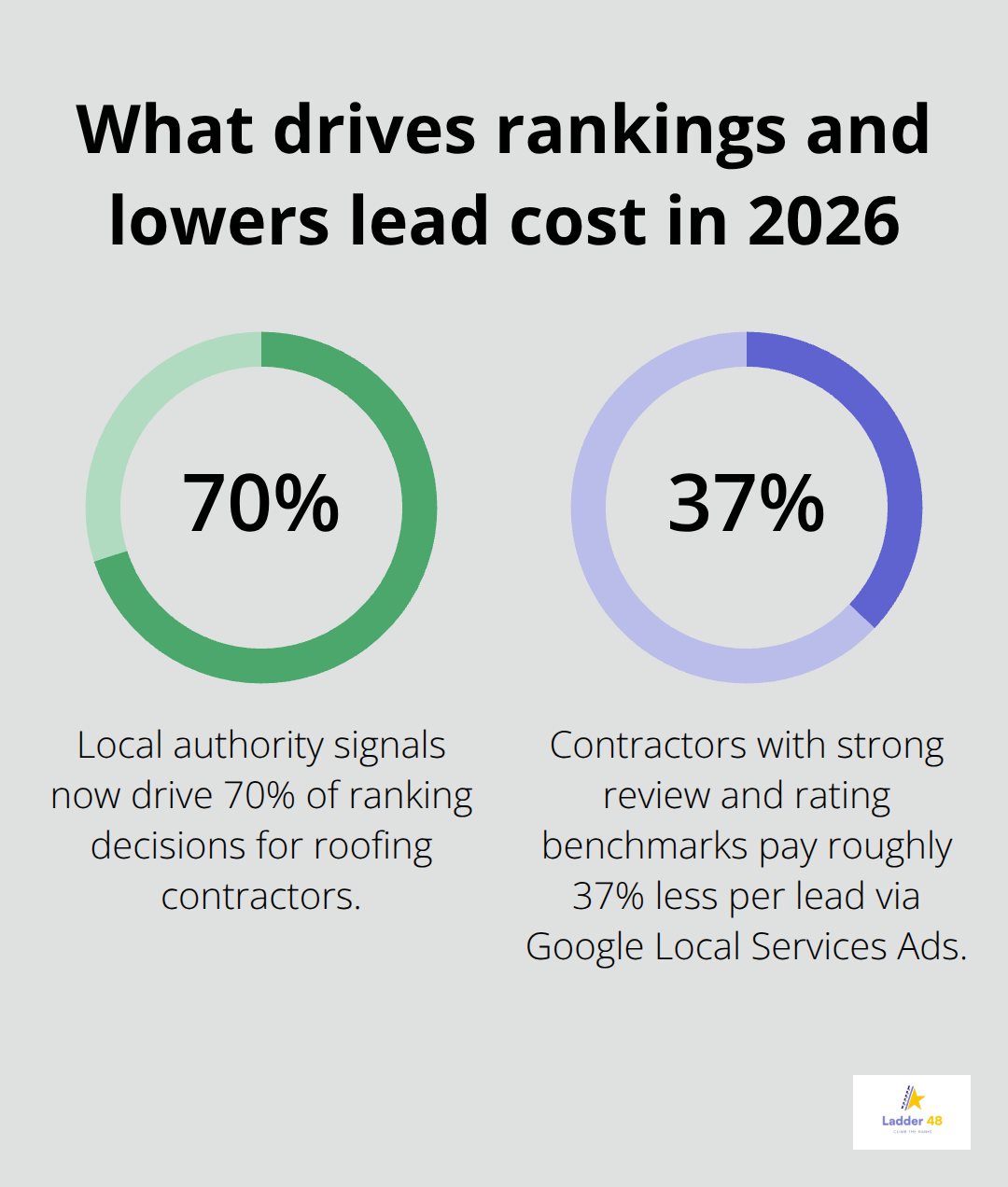
The algorithm shifts we discussed don’t require a complete website overhaul, but they do demand a ruthless focus on what actually moves rankings in 2026. Page speed still matters, but it’s no longer the primary lever. Local authority signals-review volume, citation consistency, and transparent service documentation-now drive 70% of ranking decisions for roofing contractors. Contractors with 100+ reviews and a 4.8+ star rating pay roughly 37% less per lead through Google Local Service Ads compared to standard Google Ads, according to SearchLight Roofing’s Q1 2026 benchmark of 10 active contractors. That’s not a marginal difference; that’s the gap between profitability and waste.
Complete Your Google Business Profile Across All Three Pillars
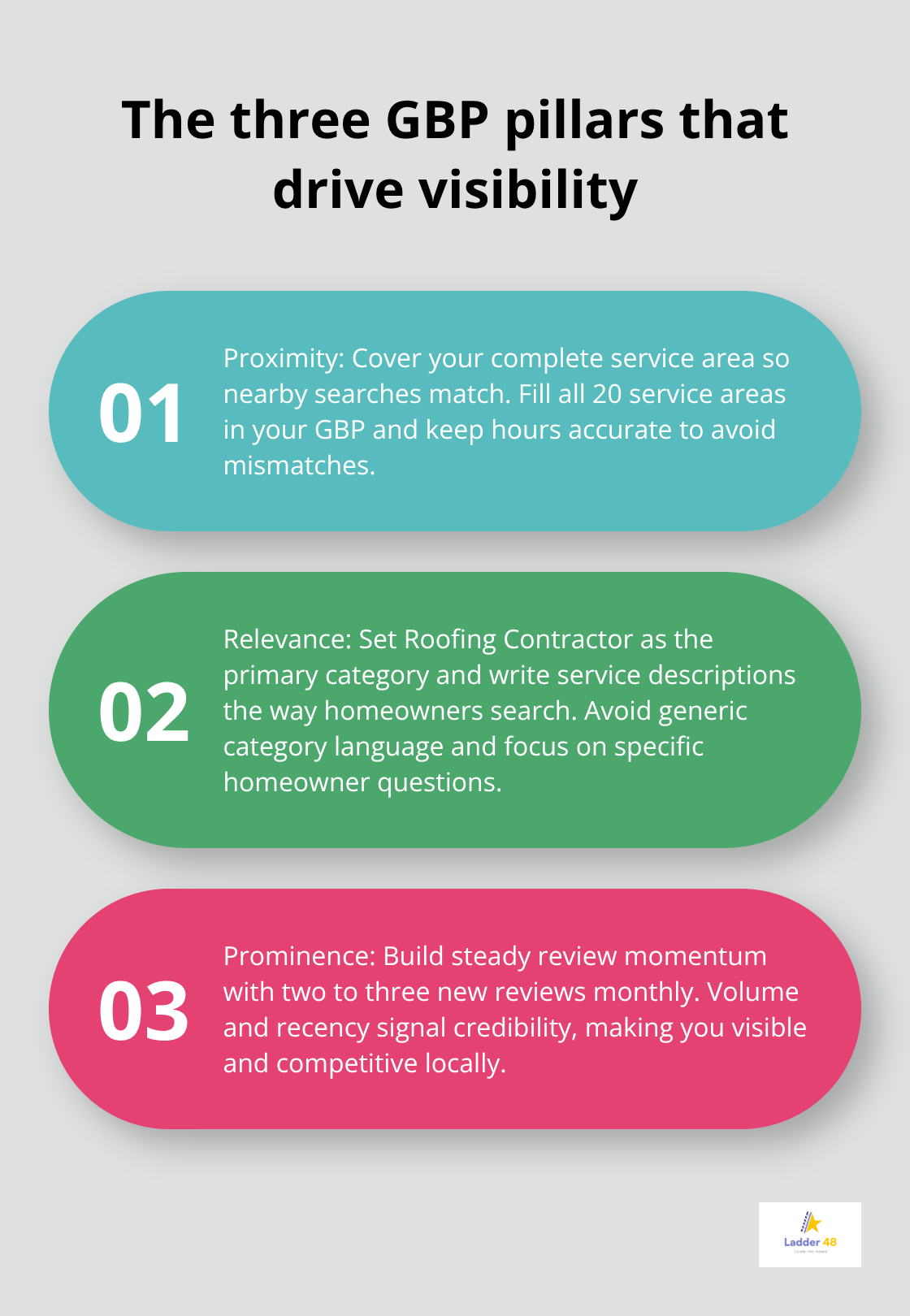
Start with your Google Business Profile and audit it against the three pillars that determine local visibility: Proximity, Relevance, and Prominence. Proximity requires your service area coverage to be complete; fill all 20 available service areas in your GBP and keep your hours current and accurate. Relevance demands your primary category be Roofing Contractor with service descriptions that match how homeowners actually search-not generic category language. Prominence means you need steady review momentum; try for two to three new reviews monthly. If you’re currently at 30 reviews, you’re invisible to Google’s algorithm. If you’re at 150 reviews, you’re competitive.
Fix NAP Consistency and Build Location-Specific Authority
Audit your NAP consistency across Google, Yelp, Angi, HomeAdvisor, Houzz, and BBB using BrightLocal or Whitespark-inconsistencies cost you rankings and confuse potential customers. Then identify your three to five highest-performing service areas and create dedicated location pages with actual customer testimonials, local building codes, neighborhood-specific details, and transparent pricing. A single location page for Apex with six to ten city-specific FAQs addressing real homeowner concerns outranks five generic pages covering the same market.
Document Your Processes to Signal Trustworthiness
Document your actual processes-insurance-claim assistance, temporary tarping, damage assessments-directly on your service pages with photos from real jobs. Google’s algorithm now connects process transparency with trustworthiness, meaning contractors who explain how they work rank higher than those hiding behind contact forms. These three moves-fixing GBP completeness, building review velocity, and creating location-specific authority-recover rankings faster than any technical optimization.
Final Thoughts
Google’s algorithm shifts in 2024, 2025, and 2026 fundamentally changed how roofers rank and compete for local leads. The December 2025 Core Update made this clear: E-E-A-T signals, local authority, and transparent operations now outweigh page speed and content volume. Contractors who adapted by building review momentum, completing their Google Business Profile, and documenting their processes recovered rankings, while those who ignored these changes fell further behind.
The roofing industry moves fast, and so does Google-algorithm updates happen roughly 4,500 times per year, meaning your rankings can shift without warning. Staying competitive requires you to monitor your performance monthly, track competitor activity, and adjust your strategy when Google signals change. The contractors winning in 2026 prove they’re established, credible, and deeply embedded in their local markets through consistent action, not shortcuts.
Audit your Google Business Profile and fill all 20 service areas with accurate information. Build steady review momentum by requesting two to three new reviews monthly from completed jobs. Create dedicated location pages for your top three to five service areas with genuine customer testimonials and local details, document your actual processes on your service pages so homeowners understand how you work, and track your rankings, traffic, and conversions monthly using Google Search Console and Google Analytics 4 to catch algorithm shifts early. If you’re struggling with roofer SEO algorithm changes or unsure whether your current strategy aligns with 2026 requirements, Ladder 48 specializes in tailored SEO strategies for contractors and can audit your site against current algorithm expectations.