
Most general contractors lose potential clients because homeowners can’t find them online. Local search is where your future projects live, and general contractor site optimization is how you capture them.
At Ladder 48, we’ve seen contractors dominate their markets by focusing on local discovery first. This guide shows you exactly how to do it.
Local SEO Fundamentals for General Contractors
Google processes about 5 trillion searches annually, and roughly 46% of those include near-me queries. For general contractors, this means homeowners in your service area are actively searching for someone exactly like you right now. The difference between landing those projects and losing them to competitors comes down to whether Google can find you first.
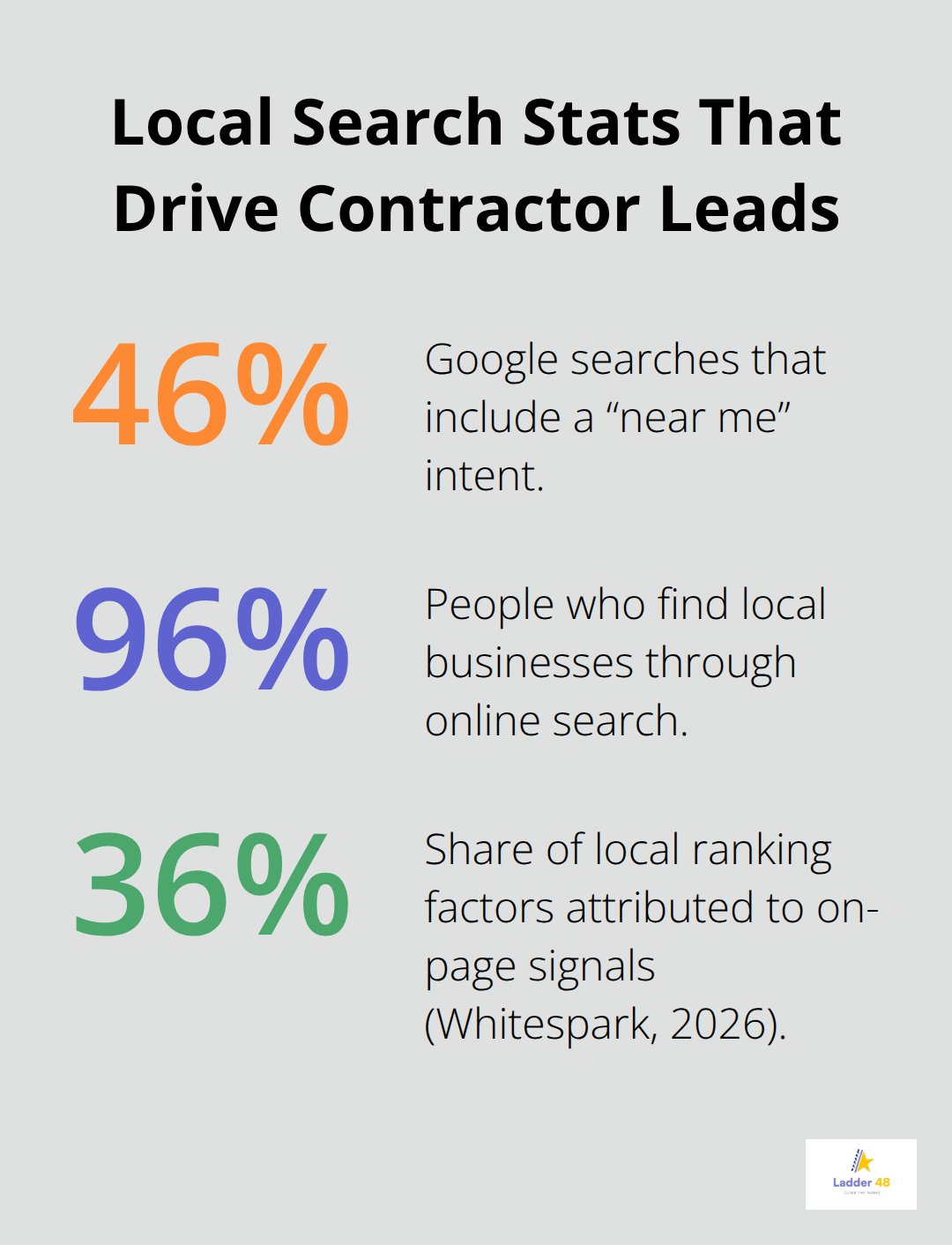
Local search works differently than general SEO because Google prioritizes proximity, relevance, and authority when a homeowner searches for a contractor nearby. Your website needs to signal all three of these factors clearly, and the foundation starts with your Google Business Profile. This tool directly controls how you appear in the Map Pack, which is where most local searches convert. About 96% of people find local businesses through online searches, but those searches are pointless if your business information is incomplete, outdated, or scattered across different directories with conflicting details.
Your Google Business Profile Drives Map Pack Visibility
Your Google Business Profile is not a nice-to-have. It is the single most important local SEO tool you own. The profile directly influences whether homeowners see you in the Map Pack, and the Map Pack is where high-intent customers live. To win here, you need accurate NAP consistency-that means your Name, Address, and Phone number must match exactly on your website, GBP, and every directory where you appear. Even a single character difference or an outdated phone number signals unreliability to Google and damages your rankings.
On your GBP, choose a primary category that matches your exact service, such as Custom Home Builder rather than something vague like Contractor. Add secondary categories to cover your full range of services. Upload high-quality, geotagged project photos regularly and post updates weekly using the GBP Posts feature. These posts act as mini-announcements that tell Google your business is active and current.
Reviews Build Trust and Signal Legitimacy
Respond to every review, whether positive or negative. Negative reviews handled professionally can actually win future business (showing you take accountability seriously matters to potential clients). Actively encourage customers to leave reviews after project completion. Send them a direct GBP review link to make the process frictionless. This consistent review activity strengthens your local authority and converts more homeowners into clients.
Citations Require Consistency Across All Directories
Citations are mentions of your business on other websites, and they matter far more than most contractors realize. Inconsistent information across directories creates confusion and erodes trust signals that Google uses to rank you locally. Maintain consistent NAP across Houzz, Angi, Yelp, HomeAdvisor, and BBB. A single inconsistency can trigger warnings or even suspension of your GBP.
Use tools like BrightLocal to audit your citations quarterly and catch errors before they damage your rankings. High-quality local backlinks from community sources, local media, or sponsorships strengthen your authority in a way that mass-produced links never will. Focus on earning a few strong links from trusted local sources rather than chasing volume. With your GBP optimized and citations locked in, your on-site SEO strategy determines whether homeowners actually convert once they find you.
How to Structure Your Website for Local Search Success
Your website converts local search into actual leads, but only if it speaks the language your customers use when searching. General contractors typically waste their on-site SEO efforts on broad, national keywords that generate zero local intent. Instead, focus your content on the specific services you offer in the exact cities where you operate. When homeowners search for bathroom remodeling in Denver or kitchen renovation in Boulder, your pages need to rank for those precise combinations. Use Google’s Autocomplete feature and the People Also Ask section to see exactly how homeowners phrase their searches in your market. These aren’t guesses-they’re real search behavior from your potential clients.
Build Dedicated Service Pages for Each Location
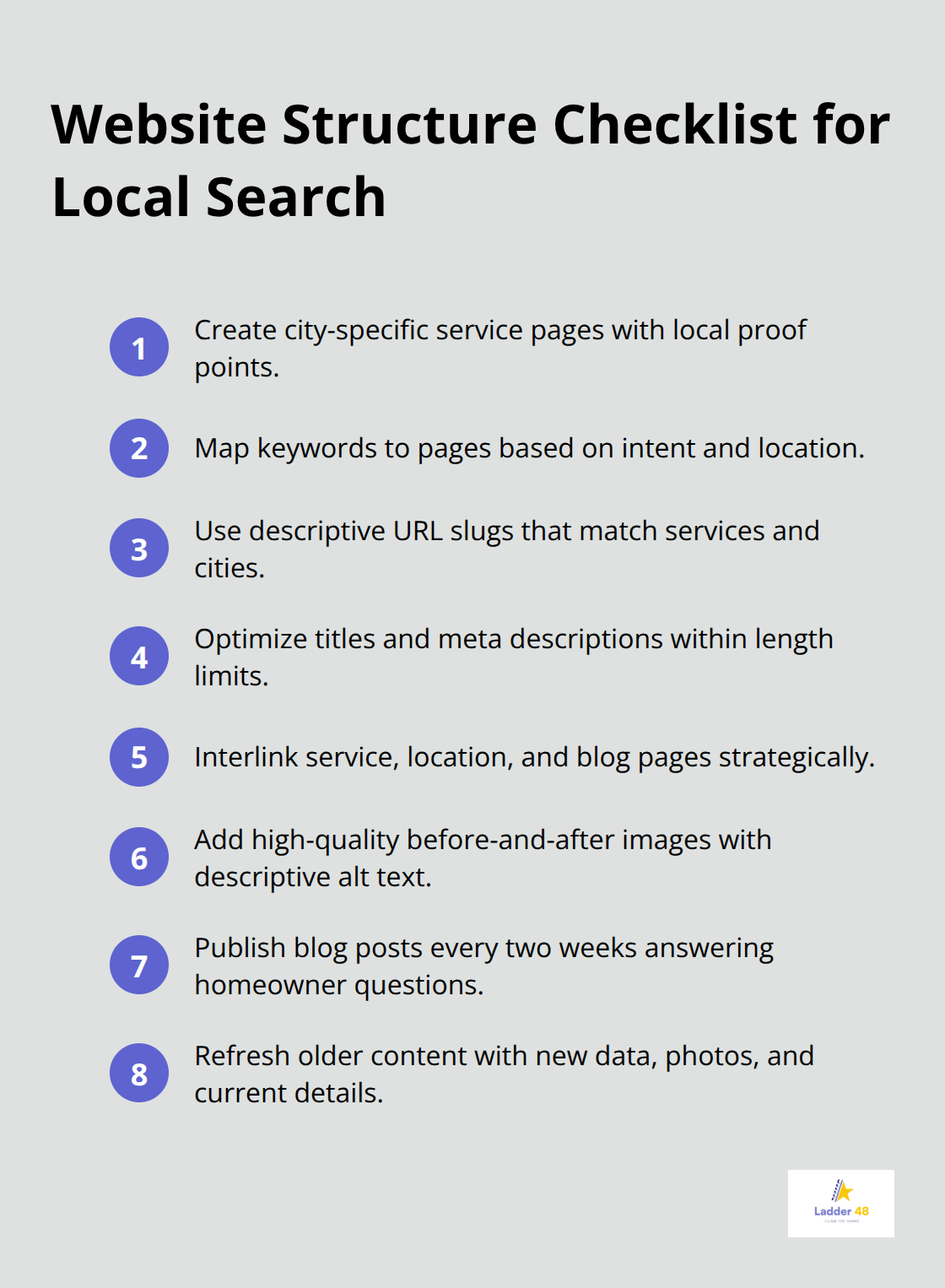
Create dedicated service pages for each major offering you provide, then create location-specific versions for each city in your service area. A page titled Bathroom Remodeling in Denver performs far better than a generic Bathroom Remodeling page because it signals to Google that you serve that exact market. Include the city name naturally in your page title, H1 heading, and throughout the content. Add local landmarks, neighborhood references, and testimonials from clients in that specific area to strengthen relevance signals.
Research Keywords That Match Local Intent
Research keywords using Google Keyword Planner or SEMrush to identify what homeowners actually search for in your locations. Whitespark’s 2026 survey found that on-page signals now account for 36% of local ranking factors, making your keyword strategy more important than ever. Map each keyword to the right page based on search intent-informational queries go to blog posts, while transactional queries like “get a free estimate” go to service pages. Use descriptive URL slugs like /bathroom-remodeling-denver rather than /service-page-1. Structure your content with clear H1, H2, and H3 headers so Google understands your page hierarchy.
Optimize Technical Elements for Search Visibility
Craft title tags and meta descriptions that include your service and city, keeping them under 60 characters for titles and 160 for descriptions to avoid truncation in search results. Internal linking connects these pages strategically-link from your main service pages to location-specific versions, and from blog posts back to relevant service pages. This architecture tells Google which pages matter most while helping homeowners navigate your site and find the information they need to call you. Upload high-resolution before-and-after project photos on your service pages and add descriptive alt text with your keywords to boost image SEO and accessibility.
Keep Your Content Fresh and Current
Update your service pages quarterly to reflect current pricing, warranty terms, and seasonal offerings. Publish a blog post every two weeks addressing questions homeowners ask about your services-foundation repair costs, kitchen remodel timelines, or bathroom design trends all capture search traffic. Interlink these posts with relevant service pages to distribute authority throughout your site. Refresh older content by adding new data, updated project photos, and current information to maintain rankings and relevance. This consistent activity signals to Google that your business operates actively and trustworthy, which directly impacts your Map Pack visibility and local search performance. With your website structure optimized for local keywords and your content strategy locked in, the next step focuses on earning authority signals that push you above competitors in your market.
Building Authority Beyond Your Website
Your website and Google Business Profile form the foundation, but they alone won’t dominate local search. Google rewards businesses that other trusted sources vouch for. Citations from industry directories signal that your business is legitimate and established. A steady stream of customer reviews proves you deliver results.
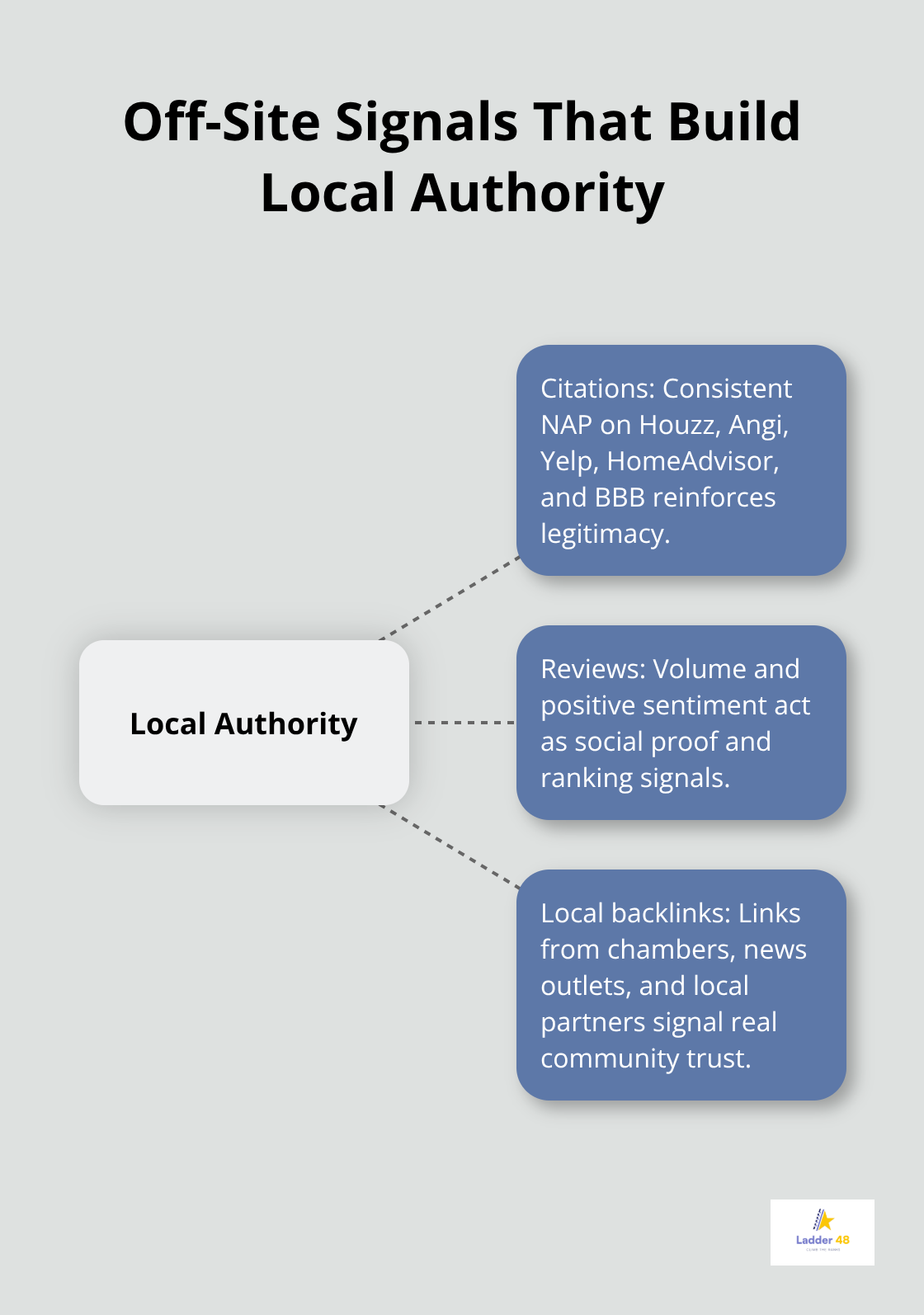
Local backlinks from community sources demonstrate that your market recognizes you as an authority. These off-site signals collectively tell Google you deserve top rankings in your service area.
Citations Signal Trust Across Multiple Platforms
Citations matter more than most contractors understand. When your business appears on Houzz, Angi, Yelp, HomeAdvisor, and BBB with consistent information, you’re essentially getting Google’s confirmation that you’re a real, trustworthy business. Inconsistencies across these platforms actively harm your rankings. A phone number that differs between your website and Angi creates doubt. An address formatted differently on Yelp versus your GBP signals poor data quality.
Tools like BrightLocal let you audit all your citations quarterly and catch these errors before they damage your local authority. Focus your citation efforts on the five platforms that matter most in your market rather than chasing hundreds of low-quality directory listings. Quality always beats volume in local SEO.
Reviews Generate Social Proof and Ranking Power
Reviews function as social proof and ranking factors simultaneously. About 90% of consumers read reviews before hiring a contractor, according to industry research. Google also uses review quantity and sentiment as ranking signals. The contractors winning in local search generate 15 to 25 reviews monthly through a systematic approach.
After project completion, send customers a direct link to your GBP review page via text or email. Make it a one-click process. Respond to every single review within 48 hours, even negative ones. A professional response to a one-star review often impresses potential clients more than ignoring it.
Local Backlinks Build Real Market Authority
Local backlinks from community sources carry far more weight than mass-produced links. When the Denver Chamber of Commerce links to your site, or a local newspaper mentions your business, Google interprets that as a genuine endorsement. Sponsor a local youth sports team, partner with an interior designer in your area, or contribute to a community nonprofit. These activities generate natural backlinks while you build real relationships in your market.
One high-quality local link from a trusted source outperforms fifty generic directory links. Try earning three to five strong local backlinks annually from sources your customers actually trust.
Final Thoughts
Local search determines whether homeowners find your business or your competitor’s when they search for a bathroom remodel or foundation repair in your city. The contractors winning right now have claimed their Google Business Profile, optimized their service pages for local keywords, built consistent citations across directories, and earned reviews that prove they deliver results. These foundational moves separate contractors who generate steady project flow from those who struggle with inconsistent lead generation.
Your market is finite, and you can’t serve every homeowner in every city, but you can absolutely dominate the specific neighborhoods and service areas where you operate. Competitors who ignore general contractor site optimization will eventually feel the pressure as homeowners increasingly start their contractor search on Google rather than through referrals alone. The contractors visible in the Map Pack capture the high-intent customers while those buried on page three get nothing.
Sustainable growth comes from dominating your local market first, then expanding from there. Build authority in Denver before chasing projects in Boulder, and become the obvious choice in your service area before spreading yourself thin across multiple regions. We at Ladder 48 help contractors build this local dominance through transparent, results-driven SEO, and your next qualified lead is waiting in a local search right now.


