Concrete contractors who ignore SEO watch their competitors capture local leads while they struggle to fill the schedule. We at Ladder 48 know that ranking in local search results isn’t optional anymore-it’s how customers find you.
This guide covers the concrete contractor SEO basics you need to dominate your local market, from claiming your Google Business Profile to earning backlinks that matter.
Local SEO Foundations for Concrete Contractors
Claim and Optimize Your Google Business Profile
Your Google Business Profile appears first when potential customers search for concrete contractors in their area. Claiming and optimizing this listing isn’t a one-time task-it’s the foundation that supports every other SEO effort you make. Verify your business on Google if you haven’t already, then fill in every section completely. Use your actual business address, phone number, and hours of operation. Add high-quality photos of completed projects from multiple angles, not stock images. Post updates at least weekly about new projects, seasonal services, or special offers. Google rewards profiles with recent activity and shows active, well-maintained listings higher in local search results.
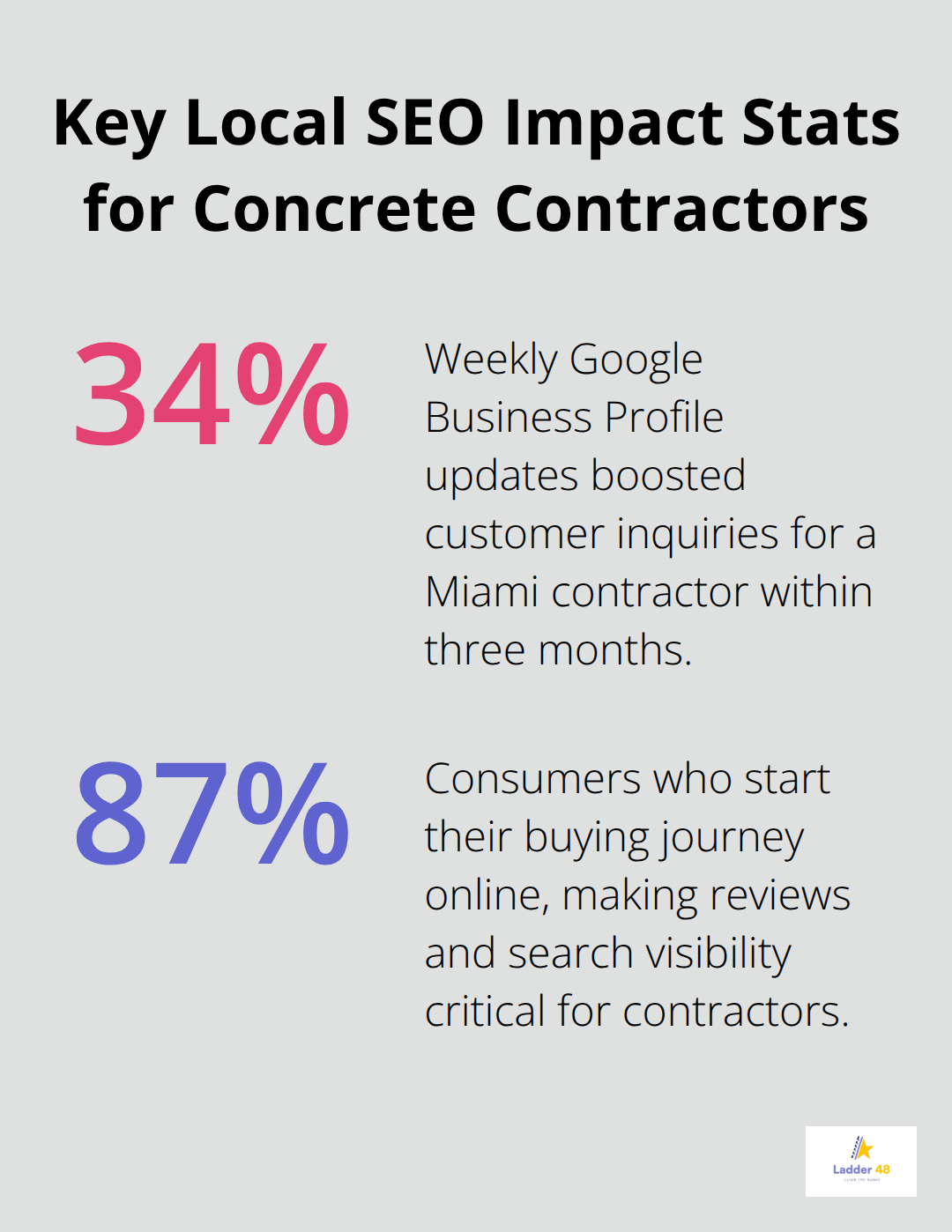
A concrete contractor in Miami who posted weekly updates to their Google Business Profile saw a 34% increase in customer inquiries within three months. This result demonstrates how consistent activity directly impacts visibility and lead volume in your local market.
Build Local Citations Across Relevant Directories
Citations across directories like Yelp, Houzz, Angi, and your local Chamber of Commerce send trust signals to Google. These listings don’t just drive direct traffic-they validate your business information and boost your local authority. Most contractors make a critical mistake: they list inconsistent information across platforms. Your business name, phone number, and address must match exactly everywhere. A single typo in one directory confuses Google’s algorithms and weakens your entire local SEO strategy.
Use a tool like BrightLocal to manage citations across multiple platforms at once, which saves time and prevents errors. Houzz matters especially for concrete contractors because homeowners actively browse project portfolios there before hiring. Complete your Houzz profile with before-and-after photos, project descriptions, and client reviews. Angi, formerly Angie’s List, shows up prominently in local search results and attracts homeowners actively looking to hire. Respond to inquiries and encourage clients to leave reviews on these platforms rather than listing yourself and disappearing.
Gather and Manage Customer Reviews
Online reviews directly influence both Google rankings and customer decisions. Research shows 87% of consumers start their buying journey online, and reviews are a major factor in that decision. Rather than hoping clients leave reviews, build a systematic process. After completing a project, send a follow-up email within 48 hours with a direct link to your Google review form (the easier you make it, the higher your response rate). Respond to every review, both positive and negative, within 24 hours. A response shows Google that you’re actively engaged and demonstrates to potential customers that you care about feedback.
Negative reviews hurt less when you respond professionally and offer to make things right. Feature your best reviews prominently on your website homepage and service pages. This builds social proof and reassures visitors that other homeowners trust your work. With your local foundation solid, you’re ready to turn your website pages into lead magnets through targeted on-page optimization.
How to Target Keywords Your Concrete Customers Actually Search For
Concrete contractors waste money and effort targeting the wrong keywords. You need to focus on what your actual customers search for when they need concrete work, not what sounds good in theory. Start with Google Search Console data from your existing website. This tells you exactly which keywords are already driving traffic to your site, how many impressions each keyword generates, and your current ranking position. If you rank on page two or three for concrete driveway terms in your service area, that’s your immediate priority-you’re close to page one visibility.
According to keyword data across the industry, terms like “concrete contractors near me” generate roughly 486,000 yearly searches but face very hard competition. More valuable for most contractors are medium-difficulty local terms with 5,000 to 50,000 annual searches. A contractor in Austin should target “concrete driveway replacement in Austin” rather than compete nationally for “concrete contractors.” Use Google Ads Keyword Planner to identify search volume for location-specific variations. The tool is free and shows you monthly search trends for phrases like “stamped concrete patio in Denver” or “concrete repair near [your city].”
Pay attention to question-based keywords because they indicate customer intent. Searches like “how much does a concrete driveway cost” or “how long does concrete take to cure” show homeowners in the research phase. These keywords typically have lower competition and convert well because customers are actively considering a project.
Build Service Pages That Target Local Searches
Create a dedicated service page for each concrete service you offer in each geographic area you serve. A contractor serving three neighborhoods with driveways, patios, and foundations needs nine separate pages minimum. Each page must include the service name plus the city or neighborhood name in the title tag and H1 heading. For example, your title tag should read “Concrete Driveway Installation in [City Name] | Your Company” not just “Driveway Services.” Google uses these signals to understand local relevance.
Include specific details about your service area on each page: mention local neighborhoods by name, reference local soil conditions if relevant to concrete work, and include project photos from that specific area. A contractor in Miami should mention seasonal weather considerations and salt-spray durability rather than generic concrete information. Add an embedded Google Map showing your service area on each location page. This signals to Google that you serve that specific area and provides visual proof to potential customers.
Include a short FAQ section addressing questions specific to that location. Homeowners in Colorado might ask about freeze-thaw cycles while Florida customers ask about humidity and salt exposure. These location-specific FAQs rank for long-tail keywords and position you as a local expert. Internal links matter significantly-link from your location pages back to your main service pages and vice versa. A Miami driveway page should link to your main driveway service page and to other Miami service pages. This structure tells Google that your site is organized around local service delivery.
Optimize Your Title Tags and Meta Descriptions for Clicks
Your title tag and meta description appear in search results and directly influence click-through rates. A concrete contractor in Denver competing for “concrete driveway Denver” needs a title that stands out. Instead of “Concrete Driveway Services Denver,” write “Concrete Driveway Installation & Repair in Denver | 25+ Years.” The second version includes a benefit, a specific differentiator, and your location. Keep title tags under 60 characters to avoid truncation on mobile devices.
Meta descriptions should be between 150 and 160 characters and include a clear value proposition. Rather than describe what concrete is, explain why choosing your company makes sense. A meta description might read “Expert concrete driveway installation in Denver. Free estimates, licensed contractors, 5-year warranty. Call today for a quote.” This tells potential customers exactly what they get and removes friction from the decision.
Test different title tag variations if you have the traffic volume. A contractor receiving 200 monthly impressions for a keyword might try two different title variations for a month each and compare click-through rates in Google Search Console. Even a 0.5% improvement in click-through rate can mean several additional qualified leads monthly. Avoid keyword stuffing at all costs-Google penalizes it and searchers ignore it. Your title tag should read naturally to a human first, include your location second, and target your keyword third.
A title that ranks well and converts clicks is worth far more than one that technically includes every keyword variation. With your keywords and pages optimized, you’re ready to build authority signals that push you past your local competitors through strategic off-page tactics.
How Backlinks Push Concrete Contractors Ahead of Local Competitors
Backlinks act as votes of confidence from other websites, and Google treats them as proof that your business matters. A concrete contractor with zero backlinks competes from a disadvantage against competitors who have earned links from local news outlets, industry directories, and partner websites. Most contractors either ignore backlinks entirely or waste time chasing low-quality links from spammy directories that hurt more than they help. Focus exclusively on high-quality backlinks from sources that actually influence rankings and drive referral traffic.
Earn Links from Local Business Directories and Industry Platforms
Local business directories and industry-specific platforms attract homeowners and architects searching for contractors. HomeAdvisor and Houzz rank as authorities in home services, meaning a backlink from either one carries significant weight. Complete your profile on both platforms with high-quality project photos, detailed service descriptions, and client testimonials.
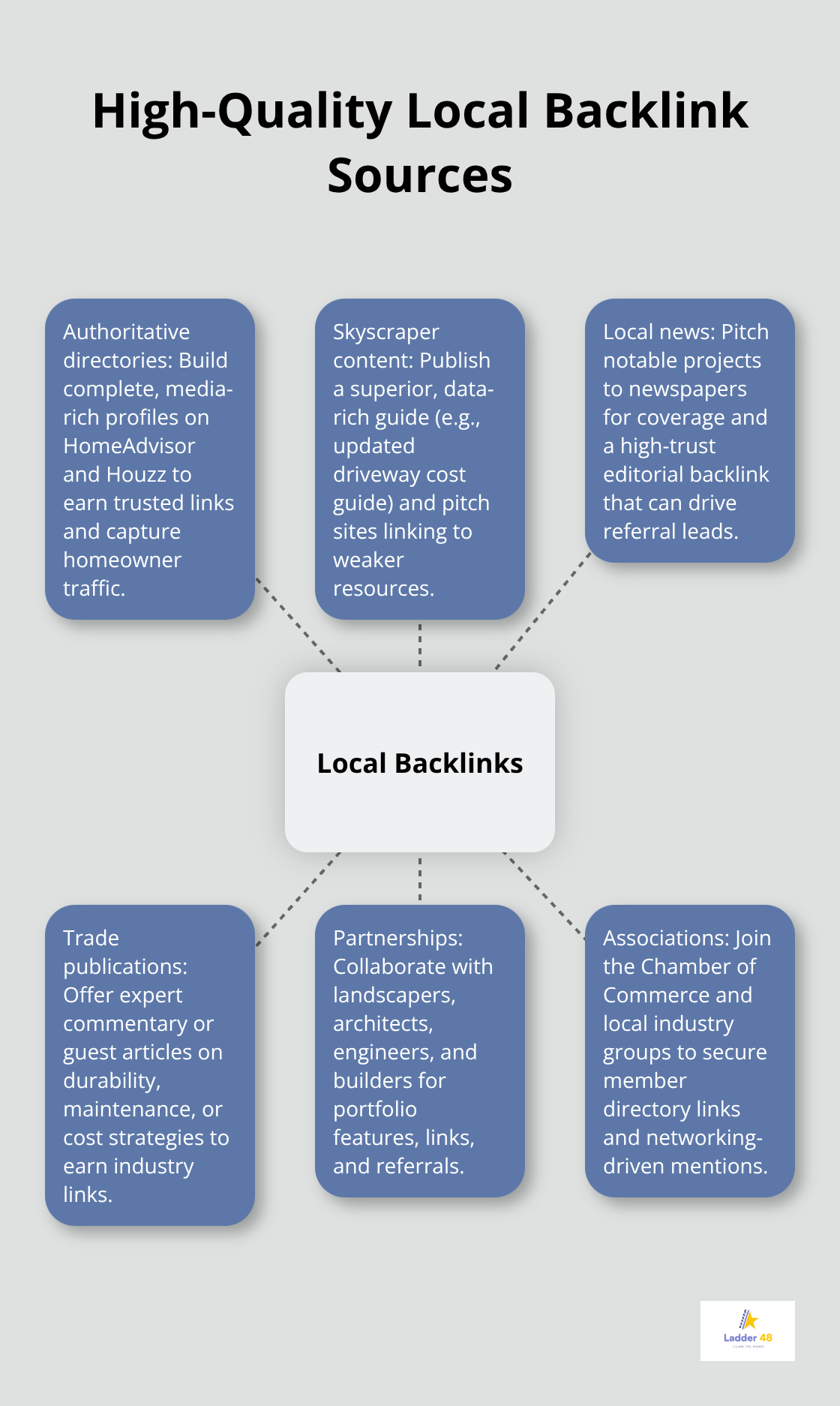
These aren’t just backlinks-they’re also direct lead sources. A contractor in Phoenix with a fully optimized Houzz profile receives consistent inquiries from homeowners who browse completed projects in their area.
Apply the Skyscraper Technique to Earn Relevant Backlinks
The Skyscraper Technique, coined by Backlinko, involves finding high-performing content in your industry, creating something better, then reaching out to sites linking to the original. For concrete contractors, this might mean identifying a popular article about driveway installation costs, creating a more detailed guide with current 2026 pricing, then contacting local home improvement blogs and trade publications with your superior resource. This approach generates backlinks from relevant sources rather than cold outreach to unrelated websites.
Build Relationships with Local News and Trade Publications
Local news outlets and trade publications need story ideas constantly. If your concrete contractor business completes a notable project-a historic building restoration, a large commercial slab, or an innovative design-contact your local newspaper or construction trade journals with a story pitch. A contractor in Colorado who installed decorative concrete at a new community center earned a backlink from the local paper’s business section and significant referral traffic.
Trade publications like Concrete Construction or regional builder magazines actively seek expert commentary on industry trends. Offer to contribute a guest article about concrete durability in your climate, proper maintenance techniques, or cost-saving strategies. Guest posts on established industry sites generate backlinks and position you as an expert that other contractors reference.
Leverage Local Partnerships for Link-Building Opportunities
Partnerships with complementary businesses create natural linking opportunities. Landscapers, architects, civil engineers, and home builders all work alongside concrete contractors. Reach out to these professionals in your area about collaboration opportunities. A landscaper who regularly refers concrete work benefits from featuring your portfolio on their website with a backlink. Architects designing residential projects need reliable concrete contractors-offer to provide technical input on their projects in exchange for a link and referral relationship.
Join your local Chamber of Commerce and actively participate in industry associations. These organizations typically link to member websites and provide networking opportunities that lead to referrals and backlinks from other members’ sites. Track your backlink progress using Ahrefs or Moz, which show you which sites link to you, how many referring domains you have, and which pages receive the most referral traffic. A concrete contractor should monitor whether backlinks from local sources actually drive qualified leads. A link from a local architecture firm might generate more valuable referrals than a link from a national directory because local architects understand your work quality and refer accordingly.
Avoid the temptation to purchase backlinks or use automated link-building services. Google’s algorithms detect these tactics increasingly well, and penalties destroy rankings faster than legitimate links build them. Focus on earning links through valuable content, genuine relationships, and consistent visibility in your local business community.
Final Thoughts
Concrete contractor SEO basics work together to fill your pipeline through three interconnected priorities. Claim and optimize your Google Business Profile, directory listings, and review management-these foundational elements cost nothing but time and directly influence whether potential customers find you when they search. Build pages targeting the specific keywords your customers actually search for in your service areas, and earn backlinks from local sources that matter: directories, news outlets, and business partners who genuinely know your work.
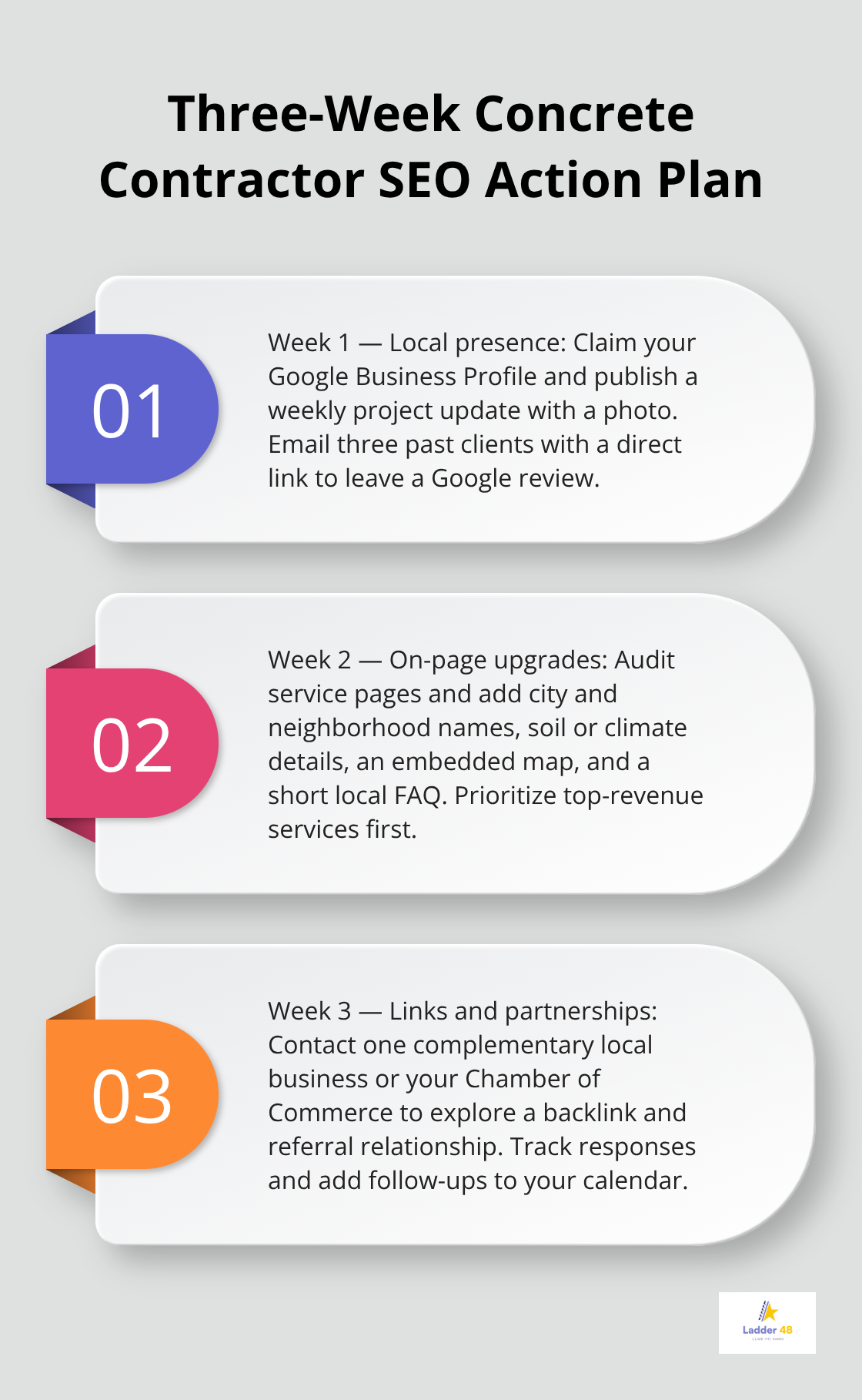
Implement quick wins this week by claiming your Google Business Profile, posting your first weekly update with a project photo, and reaching out to three past clients asking them to leave a Google review. Next week, audit your current service pages and add location-specific details such as neighborhood names, local soil conditions, embedded maps, and FAQ sections addressing questions your actual customers ask. The week after, contact one local business partner about a linking opportunity or reach out to your Chamber of Commerce about membership.
Consistent SEO effort compounds over months and years in ways that paid advertising never does. A concrete contractor who invests in SEO today builds authority that continues generating leads years later, while paid ads stop working the moment you stop paying. We at Ladder 48 help contractors implement these concrete contractor SEO basics strategically so you see measurable results without wasting time on tactics that don’t matter.