Contractors lose thousands in revenue every year because their websites don’t rank on Google. The difference between page one and page two is massive-most customers never scroll past the first few results.
We at Ladder 48 built this contractor SEO checklist to fix that. Follow these steps and you’ll have a solid foundation for organic growth.
Build Speed and Technical Foundations That Google Rewards
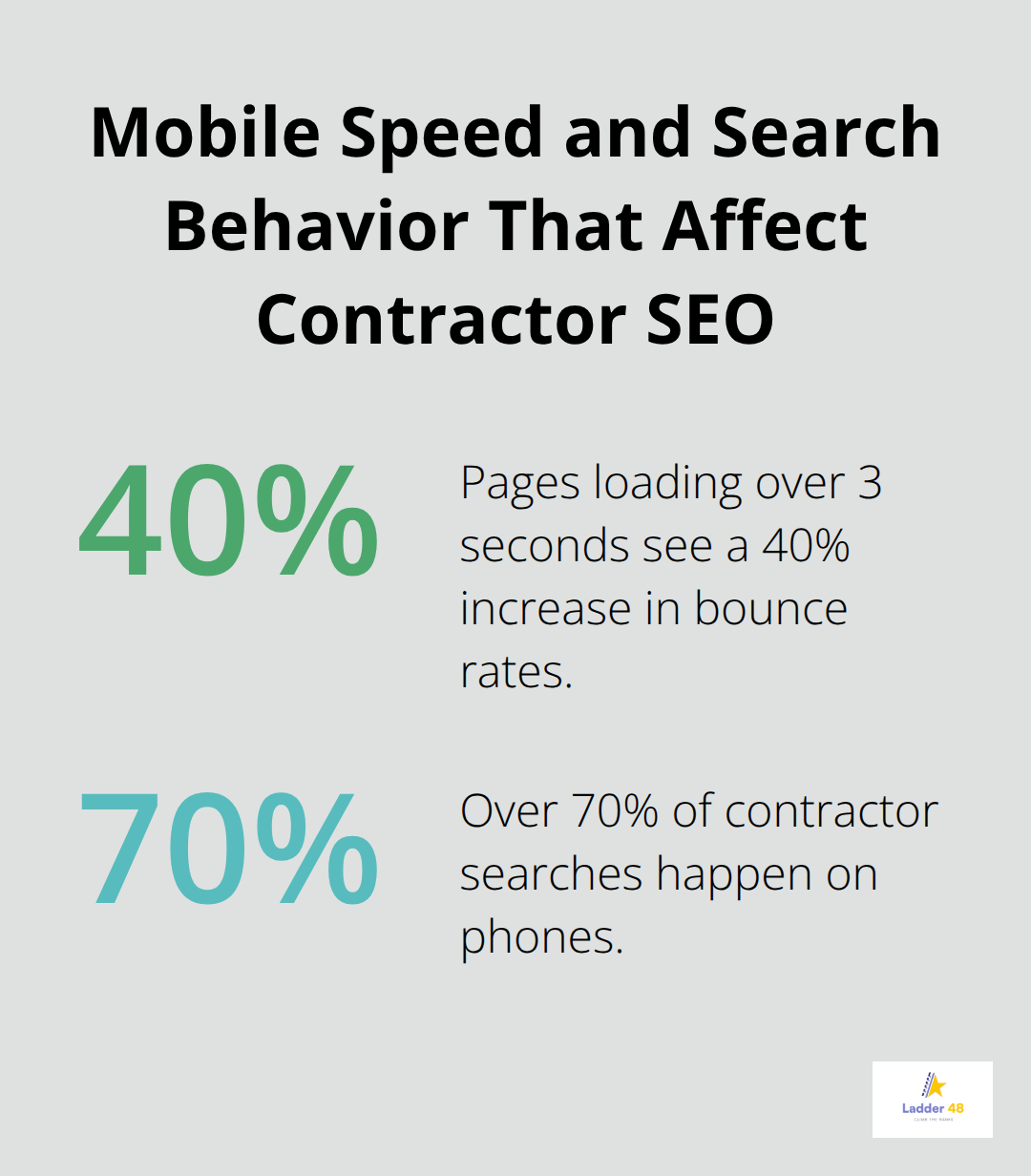
Your website’s technical health directly impacts whether Google crawls it efficiently and ranks it at all. A slow site costs contractors business fast-Google research shows that pages taking longer than 3 seconds to load see a 40% increase in bounce rates, meaning potential customers leave before seeing your work. Try targeting a Largest Contentful Paint (LCP) under 2.5 seconds on mobile networks, since over 70% of contractor searches happen on phones. Start with Google PageSpeed Insights and GTmetrix to identify specific bottlenecks.
Large project images are usually the culprit; compress them aggressively without losing quality, and lazy-load images below the fold so they don’t slow down initial page display. Remove unused plugins and scripts that add weight, and enable browser caching so repeat visitors load your site faster.
Mobile Responsiveness Determines Your Rankings
Mobile responsiveness is non-negotiable-test every page on a phone to ensure buttons are tappable, text is readable without zooming, and forms don’t require horizontal scrolling. Google’s mobile-first indexing means your mobile experience directly determines your desktop rankings. A responsive design isn’t optional; it’s the foundation that separates contractors who rank from those who don’t.
Fix Crawl Issues and Preserve Link Equity
Search engines can only rank pages they can find and understand. Check Google Search Console regularly for crawl errors and coverage issues; these reports show exactly which pages Google struggles to access. Fix broken internal links immediately, especially on service pages and project galleries, since dead links waste crawl budget and frustrate visitors. Redirect old URLs to the most relevant live page to preserve link equity-if you redesigned your kitchen remodeling page, redirect the old URL rather than letting it 404. Ensure your XML sitemap lists every important page and updates when you publish new projects or service areas. Test your sitemap at Google Search Console to confirm all URLs are discoverable. Set your robots.txt file to allow crawling of service pages, location pages, and project galleries while blocking thin duplicate pages or admin sections that waste crawl resources.
Structured Data Signals Your Business Type to Google
Implement LocalBusiness schema on your homepage and Service schema on each service page to give Google explicit signals about your business type, location, and offerings. Use JSON-LD format, which is cleaner and less error-prone than older schema methods. Include Review schema for customer testimonials and FAQ schema for common homeowner questions on service pages-these rich snippets can improve click-through rates from search results by making your listing stand out. Test your schema markup using Google’s Rich Results Test to catch errors before they affect rankings. Review schema in particular influences local rankings and builds trust signals that convince homeowners to call you over competitors. With your technical foundation solid, you’re ready to claim and optimize the local signals that drive the majority of contractor leads.
Local SEO Optimization for Contractor Services
Google’s Local Services Ads and Map Pack results capture about 70% of local customer visibility, which means contractors who skip local SEO optimization hand leads directly to competitors. Your Google Business Profile stands as the single most important asset you own online-it appears in map searches, local pack results, and Google Search itself, making it the fastest way to attract nearby customers.
Claim and Complete Your Google Business Profile
Claim your profile immediately if you haven’t already, then fill every section completely. Verify your address and phone number match exactly what appears on your website and all directories. Set your service areas to the neighborhoods where you actually work rather than leaving it blank. Choose a primary category that matches your main service like Plumber or Kitchen Remodeler, and add 3–5 relevant secondary categories.
Upload at least 10 high-quality photos showing your team, completed projects, and your office or van. Google research shows profiles with compelling visuals are 42% more likely to receive direction requests and 35% more likely to generate website clicks. Write a clear service description that answers what you do and who you serve.

Post weekly updates about recent projects, special offers, or seasonal tips to signal activity to Google’s algorithm. Accuracy matters intensely here: one wrong digit in your phone number or an outdated service area will confuse both Google and customers, killing your rankings and wasting marketing spend.
Build Citations Across Major Directories
Citations across directories amplify your local authority and fill in ranking signals Google uses to verify your business legitimacy. Submit your business to the major platforms where homeowners actually search: Yelp, Angi, HomeAdvisor, Thumbtack, Nextdoor, and the Better Business Bureau. Use the exact same Name, Address, and Phone (NAP) format on every listing-if your website says 555 Main Street but you list it as 555 Main St. elsewhere, Google treats these as different locations and downgrades your rankings.
Check for duplicate listings using BrightLocal or Moz Local, which scan directories and flag inconsistencies so you can consolidate them before they damage your local SEO.
Generate and Manage Customer Reviews Strategically
Reviews matter more than most contractors realize: BrightLocal’s Local Consumer Review Survey found that 73% of consumers trust online reviews as much as personal recommendations, making reviews a direct conversion driver. Set up a system to request reviews immediately after you complete a project-send a text or email within 24 hours while the homeowner is still satisfied.
Respond to every review within 24 hours, even negative ones, because Google’s algorithm favors businesses that engage with feedback. Keep responses professional and brief, weaving in relevant keywords like your service type and location naturally so responses boost your local SEO without sounding forced. With your local signals firing on all cylinders, you’re ready to optimize the pages on your website that actually convert homeowners into customers.
On-Page and Content Strategy for Contractors
Your service pages are where homeowners decide whether to call you or your competitor. Most contractors write generic descriptions about what they do, then wonder why their phone doesn’t ring. Instead, each service page should answer the specific questions homeowners ask before hiring: What exactly will you do? How much does it cost? How long will it take? What makes you different?
Target Keywords and Structure Your Service Pages
Target one primary keyword per page, like Kitchen Remodeling Contractor in Denver or Bathroom Renovation Services in Austin, and structure your content around answering that exact search intent. Use clear headings that reinforce your main keyword naturally, then follow with sections addressing budget expectations, timeline, materials you use, and the process you follow. Include 3–5 high-quality project photos showing before-and-after results, since visual proof outperforms written claims every time. Link internally from your service pages to relevant project case studies, FAQs, and your contact form so visitors move naturally toward conversion.
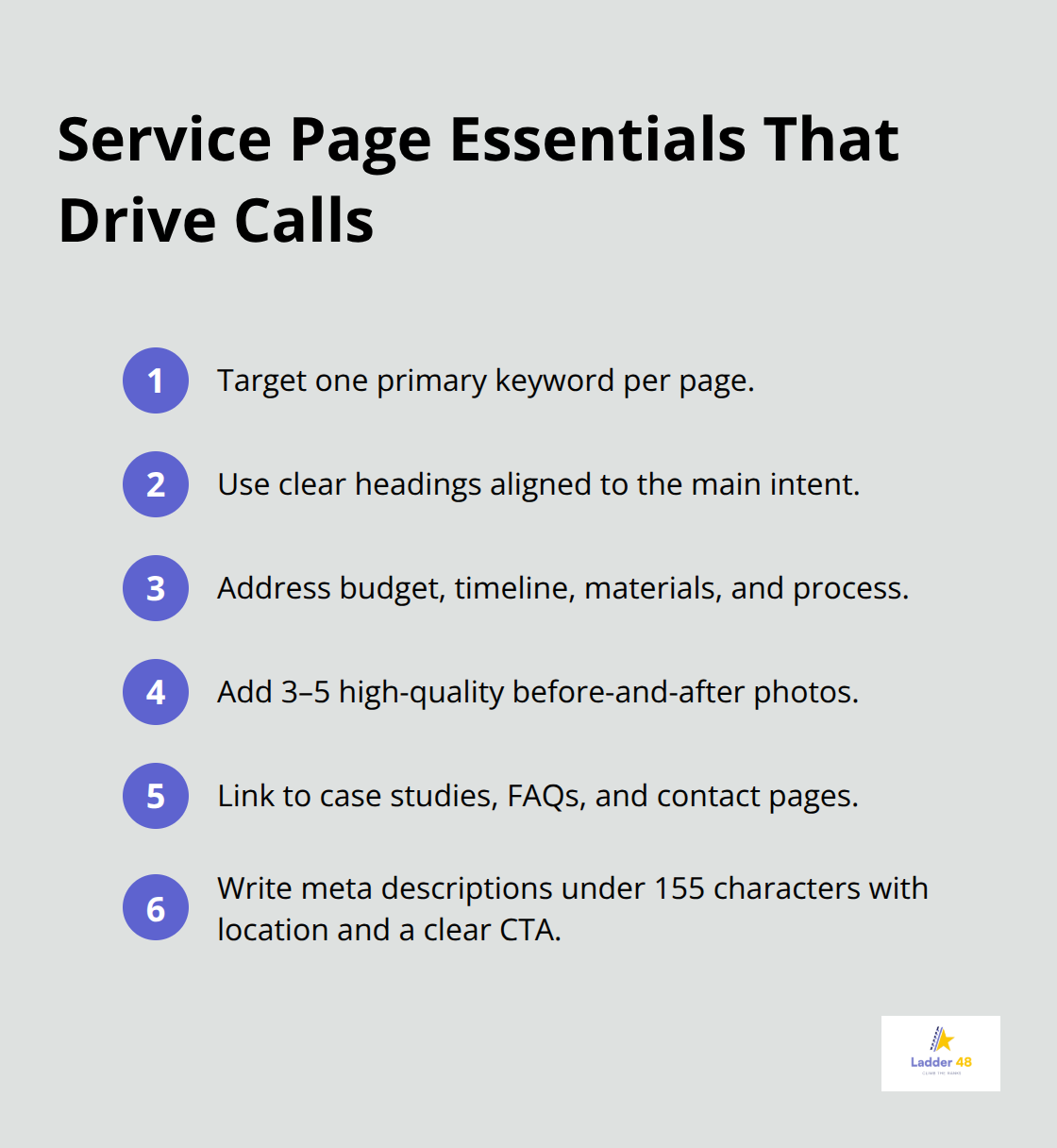
Write meta descriptions under 155 characters that include your service type, location, and a clear reason to click, like Free Estimate or Licensed & Insured Since 2015. Google rewards pages that answer real homeowner questions with higher rankings and better click-through rates from search results.
Build Location Pages With Real Local Proof
Location pages matter, but only if they’re real. Don’t create thin city pages that repeat the same generic copy across 50 neighborhoods. Instead, add concrete local proof to each location you serve: include 3 local project photos from that area, add 2 location-specific FAQs answering questions unique to that neighborhood, and mention a local detail like Serving the Historic District or Licensed with the City of Portland since 2018. If you can’t add genuine local content, skip the page and strengthen your main service hub instead. Use the city or neighborhood name naturally in your page title and first paragraph, then focus the rest of the content on solving the homeowner’s problem rather than repeating location keywords. Internal linking between your main service pages and location pages signals to Google that your content is comprehensive and locally relevant. Service-area pages with real local proof convert better and rank higher than templated city pages that every contractor publishes.
Create Content That Answers Real Homeowner Questions
Homeowners search for specific problems and costs before they search for contractors. Create content addressing the questions they ask: How much does a kitchen remodel cost in my area? What’s the difference between vinyl and fiber cement siding? How long does a bathroom renovation typically take? Target these long-tail, problem-focused keywords because they indicate high purchase intent. Use Google Search Console to see which queries already drive traffic to your site, then create detailed content answering the related questions you’re missing. A cost guide for kitchen remodeling or a timeline explainer for basement finishing attracts homeowners earlier in their decision journey, builds trust through education, and positions you as the expert they should hire. Publish educational content on a consistent schedule (one cost guide monthly and one project case study every two weeks) so you build topical authority without overwhelming your team.
Final Thoughts
You now have a complete contractor SEO checklist covering the three pillars that drive rankings and leads: technical foundations that help Google crawl your site efficiently, local signals that capture the 70% of searches happening in your service areas, and on-page content that converts homeowners into customers. Most contractors see measurable improvements within 60 to 90 days of executing this roadmap consistently, with local optimization showing results fastest (often within 30 days) while organic traffic growth takes longer as Google builds confidence in your topical authority. The timeline depends on your starting point-if your site has technical issues or missing citations, you’ll spend the first month fixing foundations before ranking movement accelerates.
The contractors who win long-term treat SEO as an ongoing system, not a one-time project. Update your top service pages quarterly with new project photos and refreshed content, maintain your review generation system so you add fresh social proof consistently, and monitor your Google Search Console monthly to catch crawl issues before they tank your rankings. Track which keywords drive actual phone calls and form submissions, then double down on the content and pages that convert most effectively.
If managing this contractor SEO checklist feels overwhelming or you lack the technical expertise to execute it properly, Ladder 48 specializes in helping contractors build sustainable SEO systems that generate qualified leads. We handle the technical audits, local optimization, and content strategy so you focus on running your business and climbing to the top of local search rankings.