
Roofing contractors lose thousands in revenue every month because homeowners can’t find them online. Most roofers skip SEO entirely, assuming it’s too complicated or expensive.
The truth is simple: roofer SEO services work. When someone searches for emergency roof repair or roof replacement in your area, they expect to find you on Google. At Ladder 48, we’ve seen contractors double their qualified leads by fixing their local search presence.
Why Local Search Determines Your Roofing Revenue
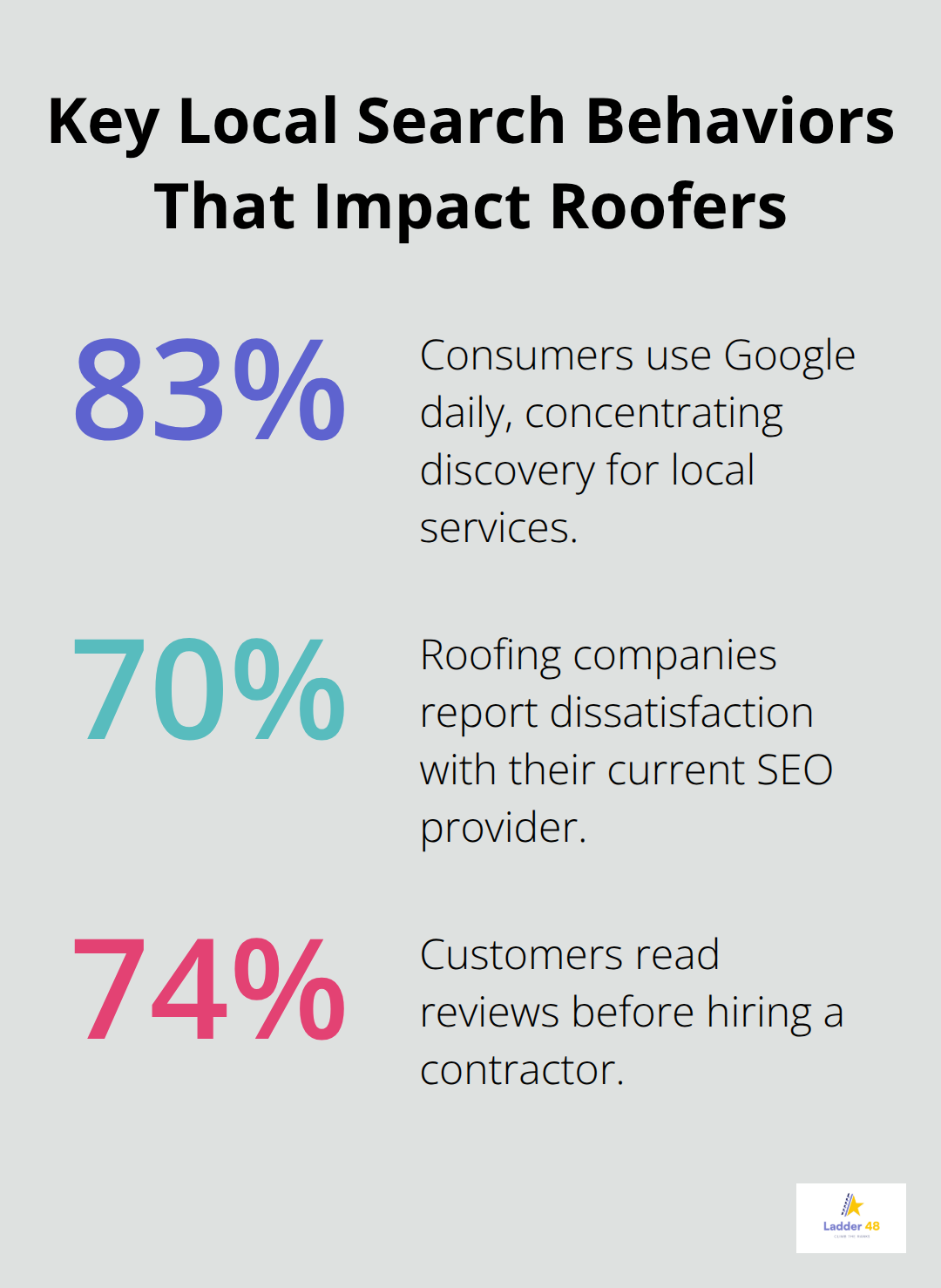
Homeowners searching for roof repair don’t browse ten websites. They call the first three contractors they find on Google. According to Google’s own data, 83% of consumers use Google daily, and for local services like roofing, the pattern is even more concentrated. When a homeowner has a leaking roof or needs emergency repairs, they’re not researching SEO strategies-they’re searching for someone nearby who can fix it today.
If your business doesn’t appear in those top local results, you don’t get the call.
The numbers prove this reality. Local demand for roofing services generates over 5,000 monthly searches, but 70% of roofing companies report dissatisfaction with their current SEO provider. This gap between demand and visibility is where roofers lose money. A contractor without strong local search presence watches competitors capture calls that should be theirs.
Your Google Business Profile Acts as Your Storefront
Your Google Business Profile is not optional-it’s your storefront. When homeowners search for roofers in your area, Google displays your profile before your website. Accurate NAP information (Name, Address, Phone) matters more than most roofers realize. If your profile shows outdated hours, a different phone number than your website, or incomplete information, you lose credibility before anyone calls.
Consistent NAP citations across directories prevent confusion and strengthen your local ranking. High-quality images of completed projects directly increase calls and inquiries. Actively collecting reviews transforms your profile from a basic listing into a trust signal. About 74% of customers read reviews before hiring, and a rating improvement from 3.4 to 4.7 (like Nova Basement Systems achieved) correlates directly with more bookings. Proactive review requests after every completed job are not a nice-to-have-they’re the fastest way to dominate local results against competitors who ignore reviews entirely.
High-Intent Keywords Convert Better Than Volume Keywords
Roofing contractors compete on volume keywords like roof repair (90,500 monthly searches) and roofing (60,500 monthly searches), but these terms waste budget because they attract tire-kickers and DIY searchers. High-intent keywords like emergency roof repair, roof replacement after hail, and leak repair near me convert at much higher rates because they signal immediate buying intent.
Long-tail and hidden search terms account for more than 50% of organic traffic, yet 98% of roofing website content generates zero traffic because it targets the wrong keywords or fails to answer what homeowners actually search for. Create dedicated landing pages for specific services in specific locations-not generic pages-to win qualified leads. Each page must optimize for a single target keyword to strengthen ranking signals. Emergency roof repair near me has far fewer searches than roof repair, but the person searching those words is ready to book today. That’s the customer worth capturing.
Location-Specific Pages Outperform Generic Service Pages
Homeowners search with location intent built into their queries. A roofer in Denver who creates a page for “roof repair in Denver” captures local demand that generic pages miss entirely. This approach (targeting both service and location on dedicated pages) prevents keyword cannibalization and makes your site more relevant to local searchers.
Service pages like roof replacement and roof inspection should each have their own location variants. Residential roofing (22,200 monthly searches) and commercial roofing (33,100 monthly searches) represent distinct customer types with different needs. Separate pages for each service and location combination signal to Google that you serve specific markets with specific expertise. The next section covers the technical and strategic foundations that make these pages actually rank.
How to Rank for Keywords Your Customers Actually Search
Roofing contractors waste thousands targeting keywords that don’t convert. You rank on page one for roof repair, attract traffic, and watch those visitors bounce because they’re not ready to hire you. Emergency roof repair, roof leak repair after storm, and roof replacement cost tell a completely different story. These high-intent keywords attract homeowners with money, urgency, and decision-making authority. The person searching emergency roof repair today will call three contractors and book one by tomorrow. The person searching roof repair might compare DIY options or research for a project two years away.
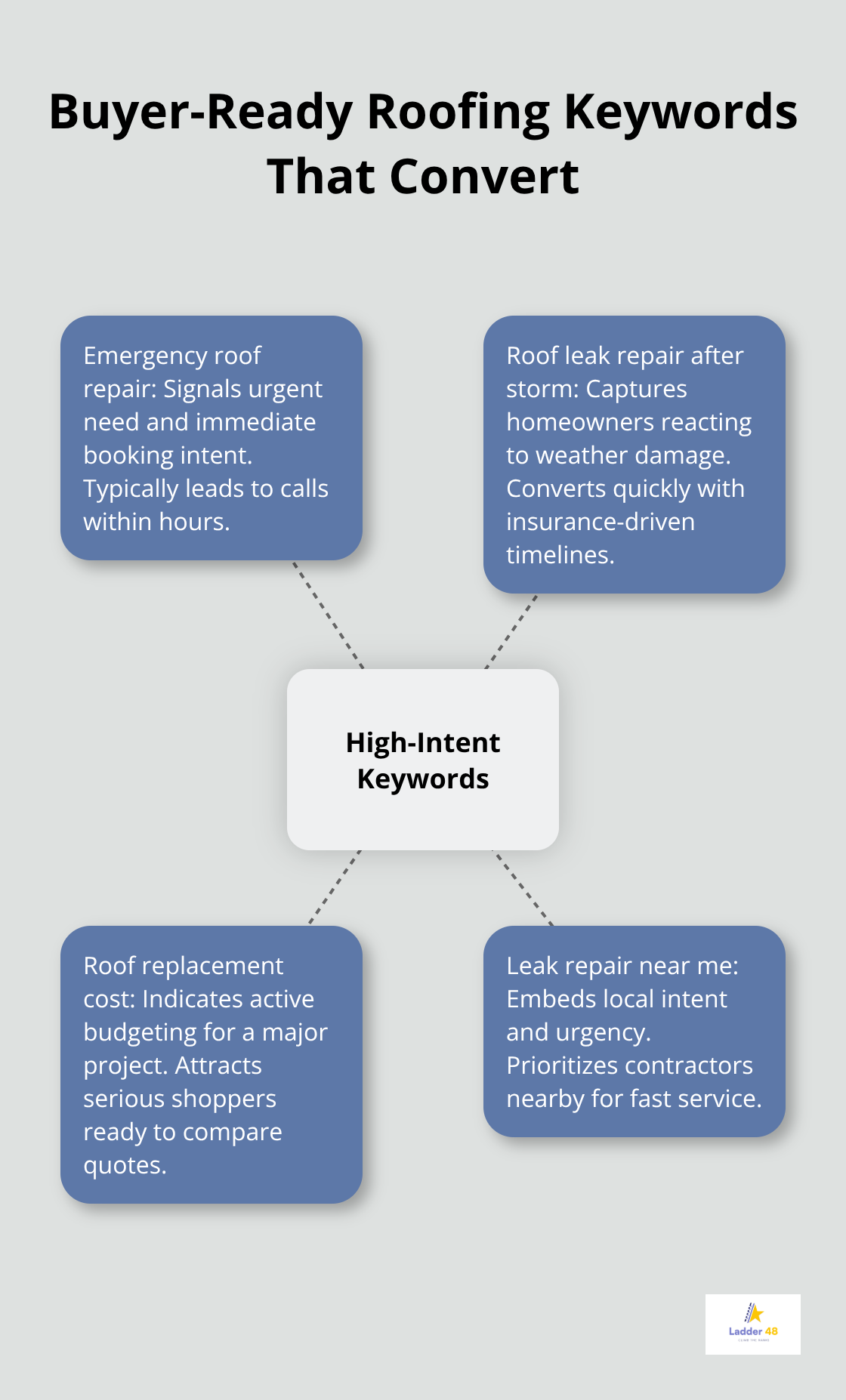
Roof replacement cost searches indicate someone actively budgeting for a major project. Target these buyer-ready keywords instead of volume metrics that look impressive in reports but generate zero jobs.
Map Services to Keywords That Convert
Start with your actual services and match them to specific keywords with proven monthly demand. Roof inspection generates 22,200 monthly searches and captures homeowners who need assessment before major repairs. Metal roof generates 22,200 monthly searches from people deciding on materials. Roof maintenance at 12,100 monthly searches attracts recurring revenue opportunities. Commercial roofing at 33,100 monthly searches separates a distinct customer segment from residential work. Build one dedicated page per service per location combination, not generic pages that try to rank for everything. A page targeting emergency roof repair in Denver performs better than a page targeting roof repair in Colorado. Location specificity matters because Google rewards relevance, and a homeowner in Denver searching for emergency help wants a contractor in Denver, not the state. Each page needs a single target keyword in the title tag, meta description, and first heading. Semrush and Ahrefs both reveal search volume and keyword difficulty, allowing you to prioritize opportunities where you can realistically rank. A keyword with 5,000 monthly searches and moderate competition beats a keyword with 50,000 searches where national competitors dominate.
Local Citations Strengthen Your Rankings Across Directories
Your NAP information scattered across the internet either helps or hurts your rankings. Inconsistent citations confuse Google’s algorithms and suppress your local visibility. Semrush Listing Management and Moz Local automate the process of updating your business name, address, and phone across directories simultaneously, preventing the manual nightmare of updating 50 directories individually. Claim and optimize your listings on Google Business Profile, Apple Maps, Yelp, Angie’s List, and industry-specific directories. High-authority local directories like your city’s chamber of commerce or Better Business Bureau carry more weight than low-quality aggregators. Consistent NAP across all citations strengthens your domain authority and improves your chances of appearing in map packs, which capture the majority of clicks on local roofing searches.
Backlinks from Real Sources Outperform Quantity
Roofers often ignore backlinks because they seem disconnected from their business, but a single link from a local news article about your emergency storm response work carries more ranking power than 50 links from irrelevant websites. Build backlinks through real community involvement. Sponsor a local youth sports team and earn a mention on their website. Partner with a nonprofit and secure a link from their partner page. Contribute expert commentary to local news stories about severe weather and roofing damage. Unlinked mentions of your business on local blogs and news sites convert into actual backlinks with a simple outreach email. These authentic local connections build domain authority while positioning you as a trusted community member, which influences both rankings and customer trust.
Mobile Speed Determines Whether Prospects Call or Leave
Google ranks fast websites higher, and homeowners with urgent roof leaks use mobile phones to search for roofers. A website that loads in three seconds on mobile converts more leads than a beautiful website that loads in seven seconds. Google PageSpeed Insights provides free speed analysis and specific recommendations. Compress images, enable browser caching, and minimize unnecessary code. A mobile-first design means your site looks and functions perfectly on phones first, then scales up to desktop. Test your site on an actual mobile device on a 4G connection, not just desktop. Homeowners don’t wait for slow pages to load when five other roofers’ sites load instantly. Page speed directly impacts whether a potential customer reaches your phone number or calls a competitor instead.
The technical foundation matters, but your content strategy determines whether prospects find you in the first place. The next section covers how to create pages that rank and convert.
Three Ways Roofers Torpedo Their Own Local Rankings
Roofers consistently make the same preventable mistakes that cost them thousands in lost leads. These aren’t complicated technical failures. They’re oversights that stem from underestimating how Google’s local algorithm works and what homeowners actually do before calling a contractor. The most damaging mistakes happen quietly, without any obvious warning sign. Your rankings decline, your phone stops ringing, and you assume the market got tougher. In reality, you’ve been eliminating yourself from the race.
Reviews Disappear When You Stop Asking for Them
Roofers complete a job, get paid, and move on to the next one. They don’t ask for reviews because they assume satisfied customers will leave them naturally. This assumption costs them. About 74% of customers read reviews before hiring a contractor, and Google’s algorithm now treats review volume and rating consistency as ranking factors. A roofing company that collects zero reviews after completing 50 jobs ranks lower than a competitor with 30 reviews, even if both companies do identical work.
Nova Basement Systems proved this relationship when they grew their Google reviews from 19 to 122 and watched their rating climb from 3.4 to 4.7. Their phone didn’t ring more because they improved the rating by one point. Their phone rang more because they appeared trustworthy to homeowners who were already searching for them. The mistake roofers make is treating reviews as optional polish rather than a core ranking signal.
After every completed job, you need a system that requests a review within 24 hours. Text the homeowner a link to your Google Business Profile review page. Make it a two-step process: text first, follow up with an email if they don’t respond within three days. Track which team members collect reviews and which ones don’t. The contractors with the highest review counts get better leads because they rank higher locally. Ignoring this creates a permanent competitive disadvantage where you remain invisible to homeowners who search in your area.
Location-Specific Pages Rank Better Than One Generic Service Page
Roofers build a single roof repair page and expect it to rank for roof repair in Denver, Phoenix, and Las Vegas simultaneously. Google doesn’t work that way. A single page cannot rank for multiple locations because the algorithm rewards relevance, and a page about roof repair in general ranks lower than a page specifically about roof repair in Denver. This mistake directly explains why many roofers see traffic but no calls.
The page ranks somewhere on page two or three for a broad term, attracting people outside your service area or people who aren’t ready to hire. Creating location-specific pages sounds like extra work. It’s actually the fastest path to qualified leads. A page targeting emergency roof repair in Denver converts better than a page targeting roof repair in Colorado because the homeowner searching for emergency help in Denver wants a contractor in Denver, not the state.
Create dedicated pages for each service and location combination. Roof replacement in Denver, roof replacement in Phoenix, roof inspection in Denver, roof inspection in Phoenix. Each page gets its own title tag with the service and location, its own meta description, and its own content addressing that specific market. Google’s algorithm notices this specificity and rewards it with higher rankings for the exact searches that convert. A roofer with 12 location-specific pages ranks higher than a roofer with one generic page because the algorithm sees expertise in specific markets rather than vague general coverage.
Technical Problems Silently Kill Your Rankings
A slow website doesn’t face penalties from Google in the traditional sense. Instead, it simply doesn’t rank as high as faster competitors. Homeowners on mobile phones won’t wait. If your site loads in six seconds and a competitor’s loads in two seconds, the competitor gets the call. You’ll never know why because Google doesn’t send a notification saying your page speed cost you a ranking. You just watch your visibility decline.
Technical SEO fundamentals include page speed on mobile devices, HTTPS security, a working robots.txt file, and proper XML sitemaps. Run your site through Google PageSpeed Insights and fix the top three recommendations. Compress images because unoptimized photos from job sites often exceed 5MB each. Enable browser caching so repeat visitors load faster.
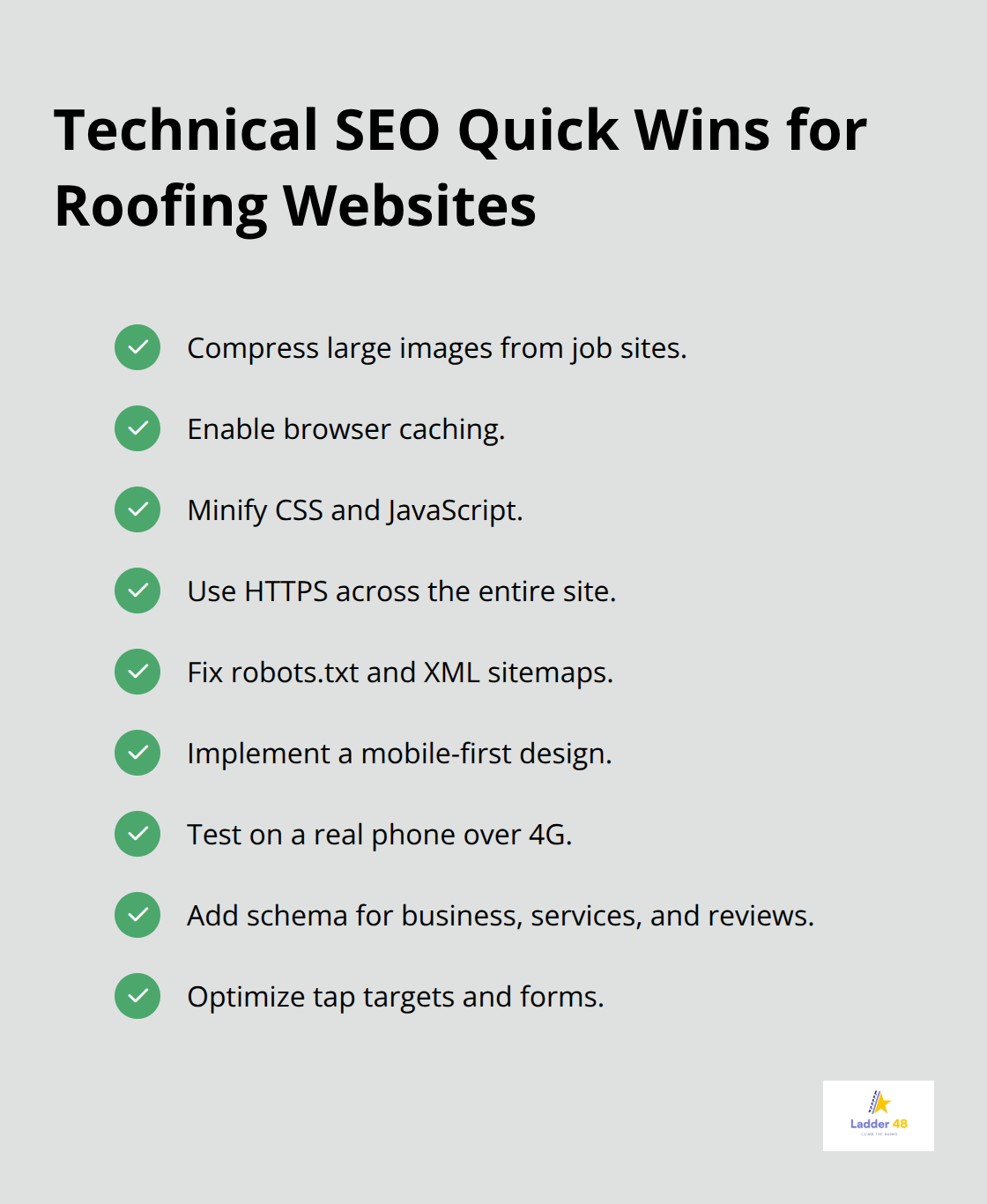
Test your site on an actual mobile phone over 4G, not just desktop or WiFi. Many roofers discover their site takes nine seconds to load on mobile only after losing leads to faster competitors.
The second technical mistake involves poor mobile design. Your site must function perfectly on phones first, then scale to desktop. Buttons should be large enough to tap with a thumb. Forms should require minimal typing. Navigation should collapse into a menu. Homeowners searching for emergency roof repair on their phones won’t scroll through a cluttered desktop layout trying to find your phone number. They’ll call the competitor whose site works instantly.
The third mistake is missing structured data. Add schema markup for your business information, services, and reviews so Google understands exactly what you offer and where. This markup appears in search results as rich snippets that increase click-through rates. Roofers who implement these three technical basics rank higher, convert better, and spend less time wondering why their phones aren’t ringing.
Final Thoughts
Roofer SEO services separate contractors who dominate local search from those who watch competitors capture their leads. Homeowners search Google before they search anything else, and the contractors appearing in the top three local results get the phone calls that translate to booked jobs and revenue. The strategies in this post work because they align with how homeowners actually search and how Google’s algorithm ranks local businesses.
You can spend months learning SEO, building pages, collecting citations, and testing strategies on your own. Or you can partner with a team that specializes in getting roofers to the top of local search results. We at Ladder 48 help contractors like you dominate local search by implementing transparent, results-driven strategies tailored to your specific market and service area. Reach out to Ladder 48 to discuss how we can help you capture more roof jobs in your area.


