
Kitchen remodels are among the most profitable services contractors offer, yet many miss out on qualified leads simply because homeowners can’t find them online. The competition for kitchen remodel SEO visibility is intense, but contractors who optimize strategically capture homeowners actively searching for renovation solutions.
At Ladder 48, we’ve seen firsthand how targeted keyword strategy and local optimization transform lead quality for remodeling businesses. This guide shows you exactly how to rank for high-intent searches and convert ready-to-buy homeowners into paying clients.
Why Kitchen Remodels Drive Contractor Growth
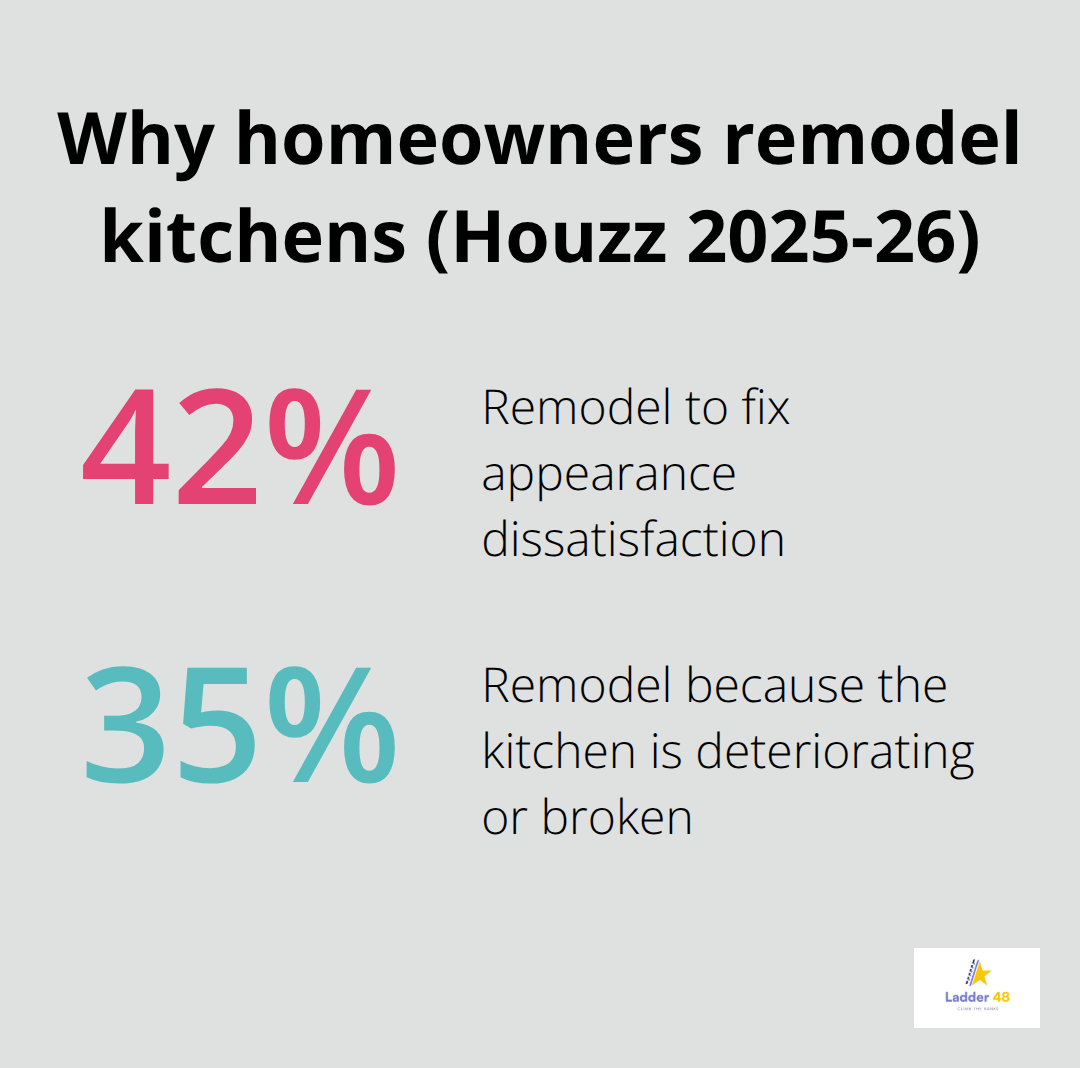
Kitchen remodels sit at the top of the contractor profit ladder for one simple reason: homeowners spend substantial money on them. According to Houzz data from 2025-26, 42 percent of homeowners remodel to fix appearance dissatisfaction, while another 35 percent tackle projects because their kitchens are deteriorating or broken. These aren’t small cosmetic fixes-they’re full-scope renovations that command premium pricing. The average kitchen remodel project exceeds $50,000, which means one closed deal generates substantially more revenue than smaller home improvement jobs.
Contractors who win kitchen remodel work build healthier margins and stronger business momentum than those chasing bathroom or general repairs.
The Search Intent Problem
Here’s where most contractors miss the opportunity: homeowners actively searching for kitchen remodels online represent the highest-intent audience you can reach. They’ve already decided to spend money and are now looking for someone to do the work. A homeowner typing kitchen remodel cost or kitchen timeline into Google isn’t browsing-they’re ready to take action. The problem is that local search results for kitchen remodeling are crowded, and many contractors simply don’t show up when these ready-to-buy homeowners search. This creates a massive gap between demand and visibility. Contractors who rank locally for these high-intent terms capture leads that other contractors never see because they lack search optimization.
Local Competition Creates Real Opportunity
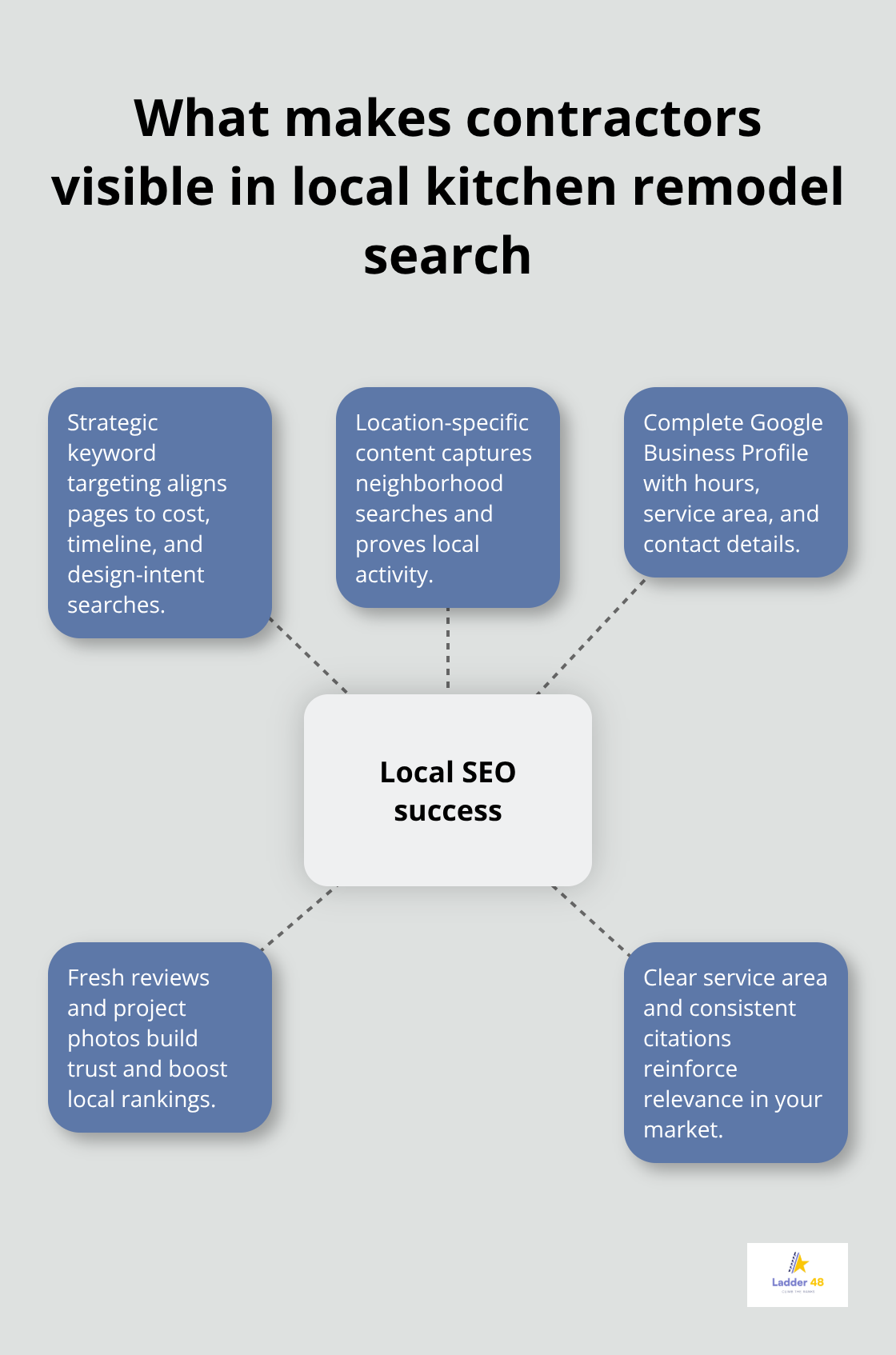
The intensity of local kitchen remodel competition actually works in your favor if you approach SEO strategically. In most markets, kitchen remodeling searches are dominated by a handful of well-optimized contractors while dozens of other qualified businesses remain invisible. This means you don’t need to outrank national brands or massive home improvement platforms-you need to beat three to five local competitors in your service area. That’s an entirely different challenge. Contractors who claim and optimize their Google Business Profile, build consistent citations across directories, and create location-specific content quickly move from page three to page one of local results. Once you’re visible to homeowners actively searching in your zip code, the conversion math becomes favorable. High-intent local searches convert at significantly higher rates than cold outreach or broad advertising campaigns.
What Separates Visible Contractors From the Rest
The contractors who dominate local kitchen remodel search results share one critical trait: they’ve invested in strategic keyword targeting and local optimization. They understand that homeowners search for specific terms (kitchen remodel cost, kitchen timeline, kitchen design ideas) at different stages of their decision journey. These contractors create content and landing pages that match each search intent, which means they capture leads at the exact moment homeowners are ready to act. They also maintain complete Google Business Profiles with project photos, customer reviews, and accurate service area information. The result is that they appear first when homeowners in their market search for kitchen solutions. The contractors stuck on page three or four typically haven’t optimized for local search at all-they’re invisible not because they lack skill, but because they haven’t aligned their online presence with how homeowners actually search.
How to Rank for Kitchen Remodel Searches in Your Market
Target High-Intent Keywords That Drive Conversions
High-intent keywords separate homeowners who are ready to hire from those still in the research phase. Kitchen remodel cost, kitchen remodel timeline, and kitchen before and after are the terms that matter because they indicate immediate buying intent. A homeowner searching kitchen remodel cost in your city has already decided to renovate-they’re now comparing prices and looking for contractors. This differs fundamentally from someone searching kitchen design inspiration, which signals early-stage browsing. High-intent searches convert at three to five times the rate of informational searches, which means you should prioritize ranking for these specific terms over generic kitchen renovation content.
Start with keyword research using Google Keyword Planner or WordStream’s Free Keyword Tool to identify the exact terms homeowners in your market actually search. Look for searches that include your city name plus kitchen remodel, kitchen remodeling cost in [city], or kitchen renovation timeline. These geo-specific, intent-heavy terms are your primary targets because they attract homeowners in your service area who are ready to spend money.
Build Location-Specific Landing Pages
Location-specific landing pages are non-negotiable if you serve multiple neighborhoods or suburbs. A single kitchen remodeling page that mentions five different cities ranks worse than five dedicated pages, each optimized for one specific location. Create individual pages for neighborhoods and suburbs where you’ve completed projects or want to win work. Each page should include the neighborhood name naturally in the headline, feature customer reviews from that area, and showcase before-and-after photos of projects completed there.
Google’s local algorithm rewards this specificity because it signals to the search engine that you’re genuinely active in those communities. If you serve Denver, create separate pages for kitchen remodeling in Capitol Hill, kitchen remodeling in Cherry Creek, and kitchen remodeling in Washington Park-not a generic Denver kitchen remodeling page. Location-specific searches that homeowners in those specific areas conduct will rank better when you take this targeted approach.
Optimize Your Google Business Profile for Local Dominance
Your Google Business Profile is where local search visibility actually happens. Claim your profile immediately if you haven’t already, then fill every section completely: accurate business hours, service area coverage, website link, phone number, and physical address. Add at least ten high-quality project photos showing kitchen remodels from start to finish.

More importantly, actively collect customer reviews after project completion. Houzz data shows that homeowners heavily weight reviews when selecting contractors, and Google’s algorithm prioritizes profiles with recent, consistent reviews. Set up an automated review request system that sends homeowners a simple request via email or text within two weeks of project completion. Profiles with ten or more recent reviews outrank those with fewer reviews in local search results, which means review generation is a direct ranking factor, not just social proof.
The contractors who dominate local kitchen remodel search results understand that SEO for home remodelers isn’t a one-time task-it’s an ongoing system. Homeowners searching for kitchen solutions in your area expect to see current project photos, recent reviews, and complete business information. When you maintain this profile consistently, you signal to both Google and potential clients that you’re an active, trustworthy contractor in your market. This foundation positions you to capture the high-intent leads that move to the next stage of their decision journey.
Content That Converts Kitchen Remodel Leads
Ranking for kitchen remodel searches matters only if your content actually moves homeowners toward hiring you. Most contractors create generic kitchen design posts that sound nice but never address the specific questions homeowners ask before committing $50,000 to a project. The content that converts tackles the exact concerns that prevent homeowners from moving forward: What will this actually cost? How long will my kitchen sit torn apart? How do I know if a contractor is trustworthy? These aren’t theoretical questions-they’re the barriers standing between a homeowner’s interest and their decision to call you.
Build Guides That Address Financial Reality
Start with guides that answer the financial reality of kitchen remodeling. Houzz data from 2025-26 shows that 36 percent of homeowners delay kitchen projects because they lack available funds, while 42 percent are motivated primarily by appearance dissatisfaction. This means your content should separate these audiences. For the appearance-focused homeowner, create detailed guides on kitchen design trends, material durability, and how different cabinet styles or countertop materials perform over five to ten years. For the budget-conscious homeowner, publish transparent cost breakdowns showing what a $30,000 remodel includes versus a $60,000 project.
Avoid vague price ranges; instead, show actual material costs, labor percentages, and permit fees. Homeowners searching kitchen remodel cost want specificity, not marketing language. Include information about financing options since availability of funds drives roughly 36 percent of remodels according to Houzz data. A practical guide comparing home equity loans, contractor financing, and cash payment options positions you as someone who understands homeowner constraints rather than just pushing expensive upgrades.
Showcase Real Projects With Tangible Outcomes
Before-and-after photo galleries mean almost nothing unless they connect to measurable value. Instead of posting pretty pictures, tell the story of what changed functionally and financially. Show a kitchen that was closed off from the living space and explain how an open layout improved daily life and increased home value. Feature a project where outdated appliances and poor workflow were replaced with efficient zones that cut meal prep time.
Include the project timeline so homeowners understand whether a renovation took eight weeks or sixteen weeks. More importantly, when legally and ethically appropriate, share the project investment range so homeowners see that a full kitchen renovation in their neighborhood costs $45,000 to $75,000, not the $15,000 they might have imagined. This transparency builds trust because homeowners realize you won’t surprise them later with hidden costs. Projects completed for homeowners in their specific neighborhood carry extra weight-a kitchen remodel in Cherry Creek completed for $62,000 matters far more to a Cherry Creek homeowner than a project from across town.
Address the Contractor Selection Problem Directly
Homeowners searching for kitchen remodelers are simultaneously terrified of hiring the wrong person. According to industry research, the real risk in kitchen remodeling isn’t finding a skilled contractor-it’s starting without a fully defined plan, which leads to late decisions and budget shocks. Create content that walks homeowners through contractor evaluation, not as a sales tactic but as genuine guidance.
Explain what a professional proposal should include: all labor, materials, permits, and contingencies, never vague pricing based on rough estimates. Discuss why a current Certificate of Insurance matters and what it protects. Describe the red flags that indicate an unreliable contractor: cash-only deals, verbal agreements, no references, or unwillingness to provide written scope details. Share what to look for in a contractor’s track record (at least three to five years in business, valid licenses specific to your state, references you can actually call, and recent kitchen projects you can inspect). This content positions you as the transparent contractor in a market full of operators trying to hide their process. Homeowners who read this guidance and then encounter your detailed proposal, your complete insurance documentation, and your willingness to explain your timeline and process will recognize you as different from contractors who avoid these conversations.
Final Thoughts
Kitchen remodel SEO separates contractors who win consistent high-value work from those who struggle to fill their pipeline. Homeowners actively searching for kitchen renovation solutions in your market right now represent immediate revenue-they’ve already decided to spend $50,000 or more and are looking for someone trustworthy to execute the work. If you don’t rank for the keywords they search, a competitor captures that lead instead.
The contractors dominating their local markets understand that three interconnected elements work together to drive results. They target the specific high-intent keywords homeowners actually search when ready to hire, they optimize their local presence so Google shows their business at the exact moment people in their service area look for solutions, and they create content that addresses the real barriers preventing homeowners from moving forward (cost concerns, timeline uncertainty, and contractor selection anxiety). This systematic approach to kitchen remodel SEO generates measurable results-page-one rankings, qualified inquiries from ready-to-book homeowners, and higher close rates because content and reviews build trust before the first conversation happens.
The gap between contractors winning consistent kitchen remodel work and those struggling to find leads isn’t talent or craftsmanship-it’s visibility. We at Ladder 48 help contractors climb to the top of local search rankings with transparent, results-driven strategies designed specifically for your market, and your next high-value kitchen remodel project waits for someone to rank for it.


![Understanding Google Algorithm Updates for Roofers [2026]](https://ladder48.com/wp-content/uploads/emplibot/roofer-seo-algorithm-hero-1780186244-300x168.jpeg)