Remodeling contractors face a tough reality: homeowners search online before picking a contractor, and if you’re not showing up in those results, you’re losing jobs to competitors who are.
At Ladder 48, we’ve seen how remodeling contractor SEO transforms visibility for small and mid-sized firms. The contractors who rank for local keywords and build genuine authority don’t just get more leads-they attract higher-quality clients willing to pay for quality work.
Why SEO Separates Thriving Contractors From Struggling Ones
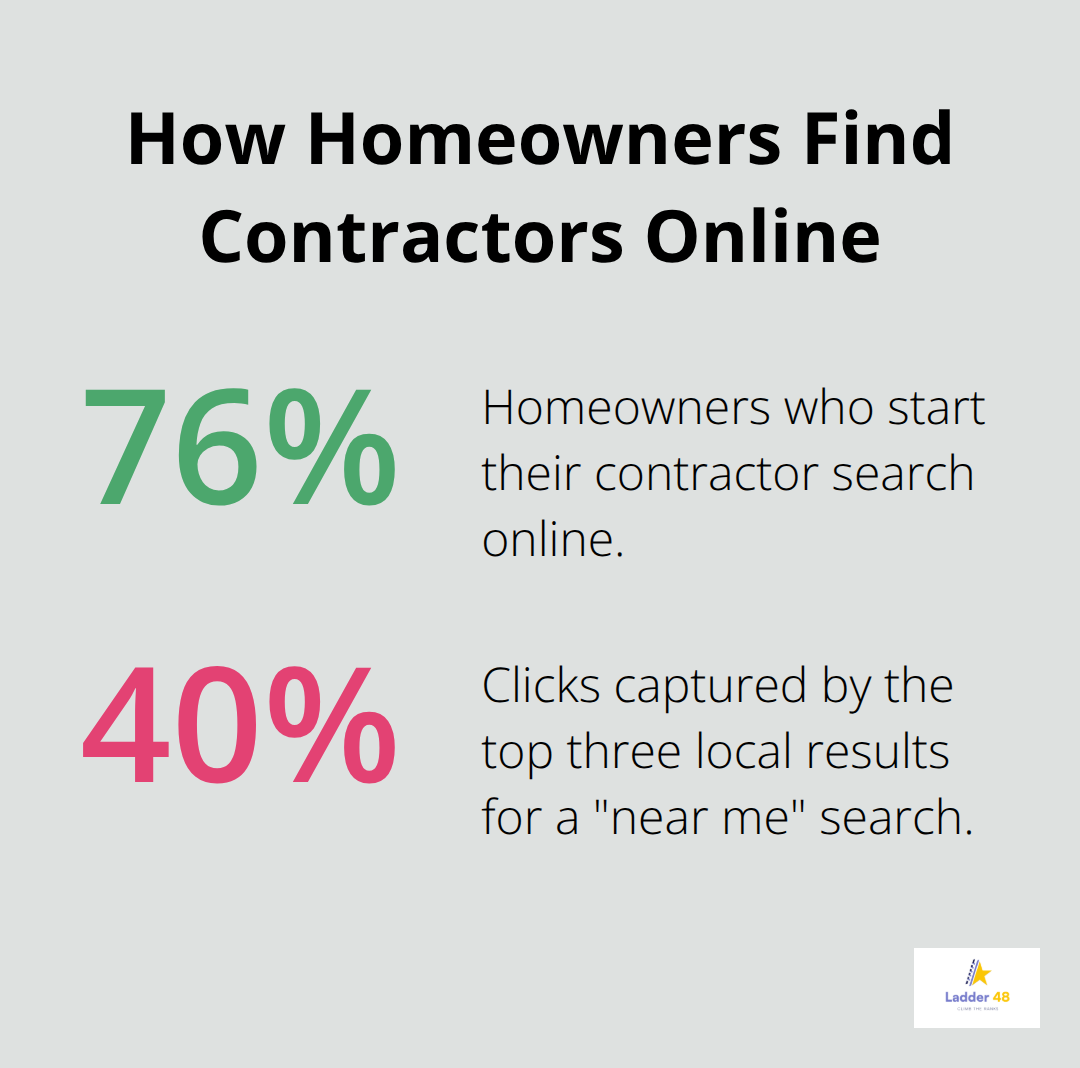
Homeowners search online before picking a contractor, and most never look past the first page of Google results. According to data from the home services industry, 76% of homeowners start their contractor search online.
If you’re not ranking for local keywords like kitchen remodeling in Denver or bathroom contractors in Austin, those leads go directly to your competitors. Contractors who invest in SEO attract clients actively ready to hire, not just casual browsers. These clients have already decided they want a remodel-they just need to find the right contractor. That’s the power of showing up when homeowners search.
Local search captures the leads that matter most
When someone types bathroom remodeler near me, Google shows local results, and those top three positions capture roughly 40% of all clicks from that search. For remodeling contractors, your geographic area becomes your primary playing field. A contractor ranking in the top three for their service area competes with a handful of local names, not national chains or large regional firms. That’s a manageable fight. Contractors outside the top three positions see dramatically lower traffic and fewer qualified leads. The gap between position one and position five isn’t just a ranking difference; it’s the difference between consistent project inquiries and sporadic phone calls.
Search rankings build credibility with homeowners
Homeowners equate search rankings with credibility. A contractor appearing on the first page of Google results has already passed a mental credibility test for most homeowners. This matters especially for high-ticket projects like kitchen remodels or whole-home renovations, where trust outweighs price. When you rank for local keywords, your website becomes proof that you’re established and legitimate. Homeowners often visit your website multiple times before calling, reading case studies, viewing before-and-after galleries, and checking reviews. Each visit builds confidence. A contractor buried on page three or four never receives those opportunities. Homeowners who find you through SEO also accept higher quotes more readily because they’ve already researched you and decided you’re worth the investment.
Local contractors outrank larger competitors through strategy
Larger remodeling companies and national franchises have bigger advertising budgets, but they don’t have better SEO. SEO rewards relevance, authority, and consistency-not spending power. A local contractor with a solid strategy, strong case studies, and citations from local suppliers can outrank a regional chain that ignores SEO. Contractors with five employees rank above firms with fifty when they focus on their service areas intensely, create content that answers specific homeowner questions, and build authority through local citations and backlinks. They also respond to customer reviews, keep their Google Business Profile updated with project photos, and maintain consistent information across directories like Houzz, Yelp, and Angi. These tactics cost far less than paid advertising but deliver leads that convert at higher rates because they’re organic and intent-driven.
The next step: optimize for the keywords your customers actually search
Your local competitors are already ranking for the keywords that matter. The contractors who win this fight understand what homeowners search for in their area and optimize their websites accordingly. This requires more than just adding keywords to your homepage-it demands a strategic approach to local keywords and service-specific content that addresses the exact problems homeowners face when they search.
How to Find and Rank for the Keywords Your Customers Search
The gap between a contractor receiving consistent project inquiries and struggling for leads often comes down to one thing: targeting the right keywords. Most contractors either chase high-volume keywords that don’t convert or ignore local search entirely. Contractors waste months optimizing for phrases like kitchen remodeling when they should target kitchen remodeling in Denver or bathroom contractors near me. The difference matters enormously. A contractor in Denver ranking for kitchen remodeling competes nationally against hundreds of sites. That same contractor ranking for kitchen remodeling in Denver faces maybe five local competitors. This is where contractors actually win jobs.
Identify what homeowners in your service area actually search for
Start by identifying what homeowners in your service area actually search for. Tools like Semrush and Ahrefs reveal search volume and keyword difficulty scores, but many contractors overlook the free data sitting in Google Search Console. If you already have a website, Search Console shows you exactly which searches triggered clicks to your site. Look for queries with impressions but low click-through rates; these are opportunities to optimize your title tags and meta descriptions.
For new contractors without this data, search your service area plus common remodeling terms into Google and study the autocomplete suggestions. Google shows you real searches people make. A kitchen remodeling contractor in Austin should research terms like kitchen remodel cost Austin, kitchen contractors near me Austin, and kitchen renovation permits Austin. Each of these targets homeowners at different stages of their decision, and you need content addressing all of them.
Keyword research is the foundation of all SEO strategies-it ensures you’re targeting the exact terms potential clients use. Keyword difficulty scores from Ahrefs range from 1 to 100, and contractors should prioritize keywords scoring below 40 initially. Trying to rank for difficulty 75 keywords when you have no authority wastes time. Build authority first with easier, local keywords, then expand.
Structure your website to match how homeowners search
Many contractors create a homepage and a few service pages, then wonder why they rank but get no calls. Structure matters because homeowners search differently depending on their project and location. A homeowner in Boulder searching for bathroom remodeling has different intent than one searching for bathroom remodeling near me or bathroom remodeling costs Boulder. Your website needs distinct pages addressing each variation.
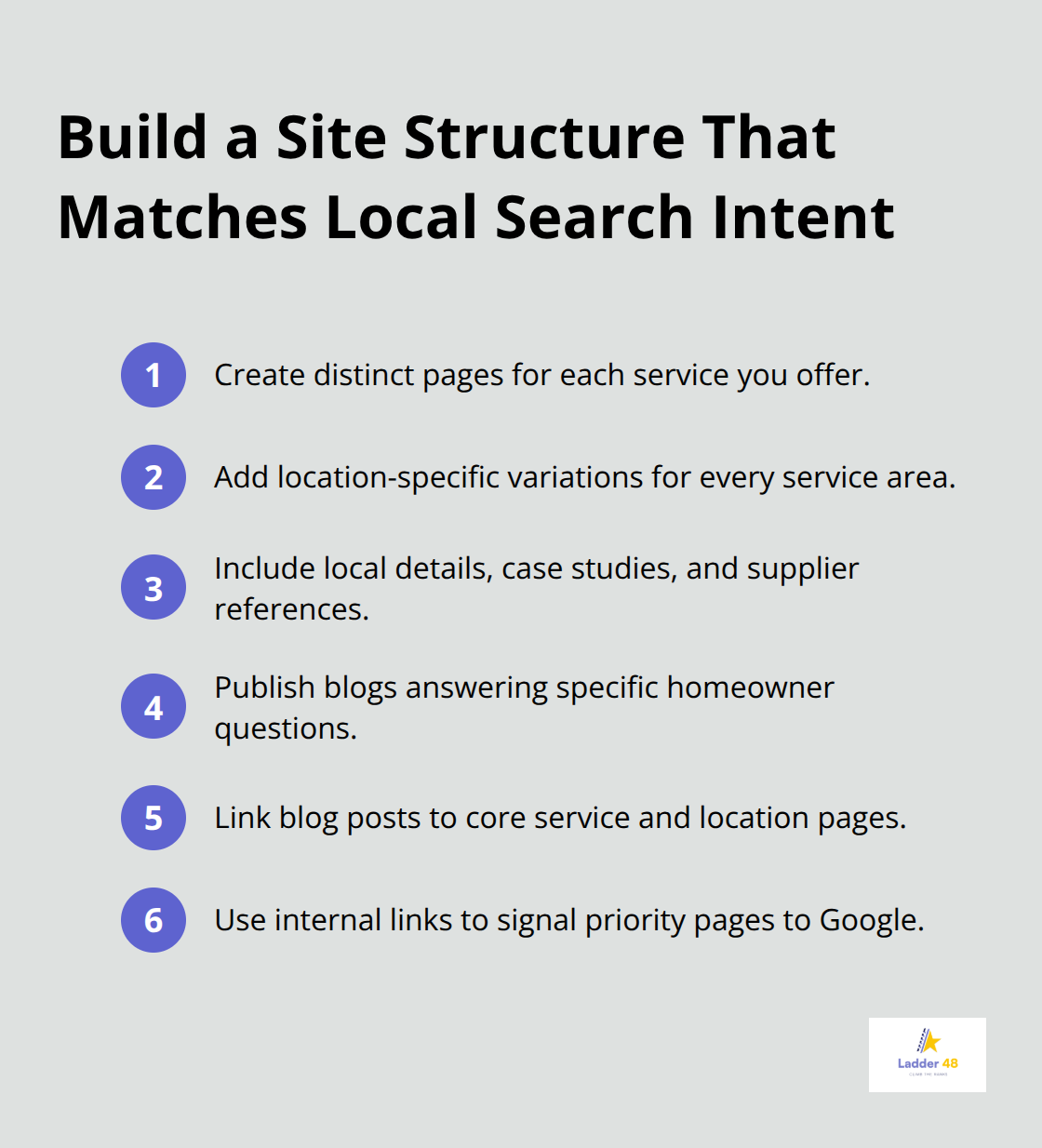
Create dedicated service pages for every remodeling type you offer: kitchen, bathroom, basement, whole-home renovations. Within each, create location-specific variations if you serve multiple areas. A contractor serving Denver, Boulder, and Fort Collins should have separate pages for kitchen remodeling in Denver, kitchen remodeling in Boulder, and kitchen remodeling in Fort Collins. Each page should include local information, case studies from that area, and references to local contractors or suppliers. Google rewards this specificity because it signals you genuinely serve that location.
Beyond service pages, create blog content answering the specific questions homeowners ask before hiring. Posts like How Much Does a Bathroom Remodel Cost in Denver or Kitchen Remodeling Permits in Boulder address search intent while building topical authority. These posts should link back to your service pages, creating an internal linking structure that tells Google which pages matter most. Contractors who skip this structural work rank for keywords but convert poorly because their pages don’t match what homeowners searched for.
Standardize your business information across all directories
Homeowners trust contractors listed on multiple platforms. Google, Yelp, Angi, Houzz, and local BBB chapters all send authority signals to search engines when your business information appears consistently. Inconsistent information destroys this effect. If your business name differs slightly between Google Business Profile and Yelp, or your phone number changes across directories, search engines treat these as separate businesses.
Audit every directory where your business appears right now. Check Google Business Profile, Yelp, Angi, Houzz, BBB, and any local chamber of commerce listings. Document exactly how your name, address, phone number, and business description appear on each. Then standardize everything. Your business name should be identical everywhere. Your address should match your actual service location. Your phone number should remain consistent. This process typically takes two weeks for a contractor serving multiple areas, but it directly impacts local search visibility.
After standardizing, add professional photos to your Google Business Profile and Houzz listing. Homeowners on these platforms expect to see before-and-after project photos. A contractor with 15 project photos on their Google Business Profile ranks higher locally than one with three generic images. These citations also serve as backlinks, which Google considers authority signals. A contractor listed on Houzz, Yelp, and Angi with consistent information has more authority signals than one appearing on a single platform-and that advantage compounds as you build your presence across more directories.
Building Authority That Search Engines and Homeowners Trust
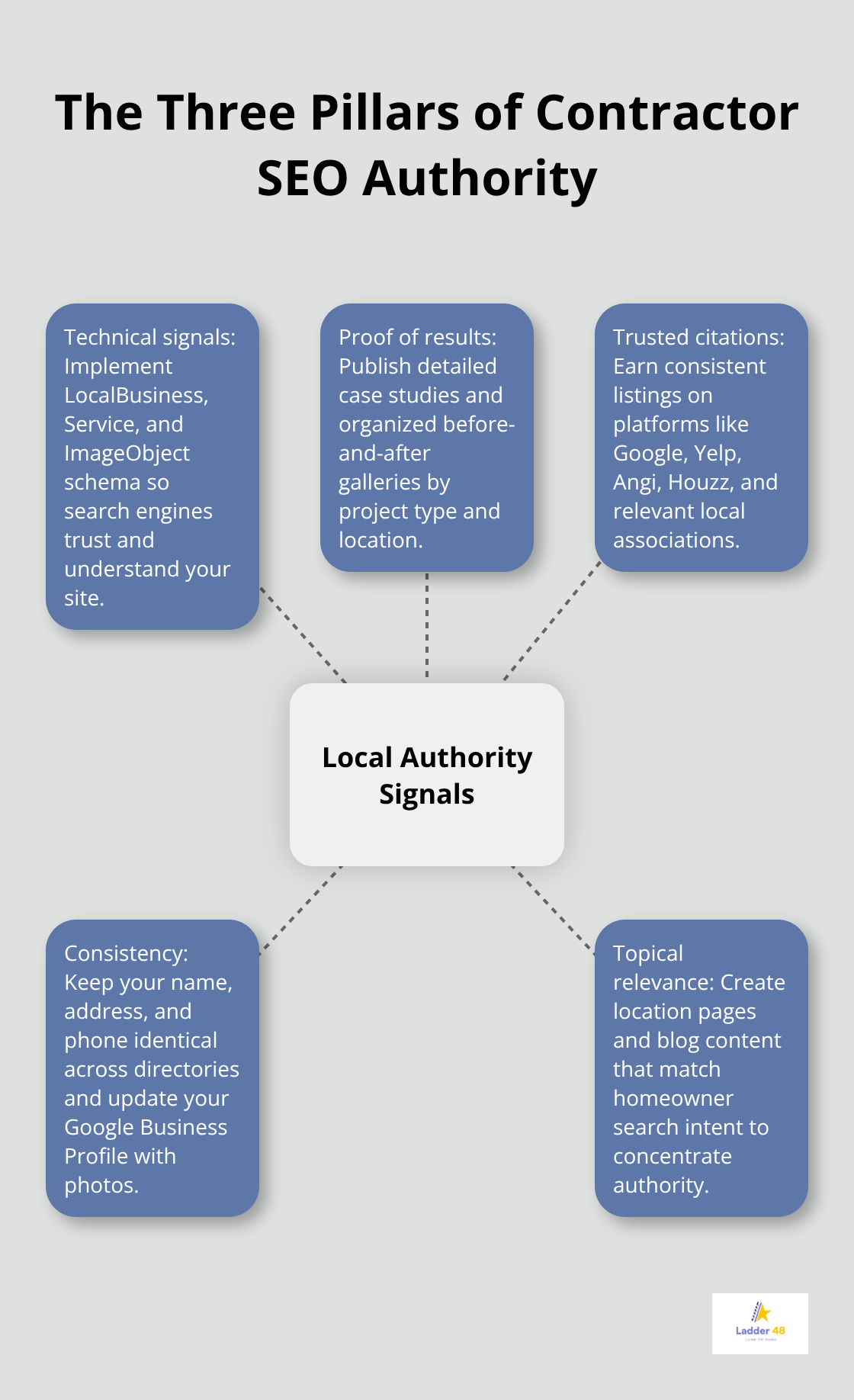
Ranking for local keywords gets your website in front of homeowners, but authority determines whether Google keeps you there and whether visitors actually call. Two contractors ranking for the same keyword don’t compete equally. The one with stronger authority signals wins more visibility and higher conversion rates. Authority comes from three places: technical signals that tell search engines your site is trustworthy, content that proves you deliver results, and citations from respected local sources that vouch for your legitimacy.
Structured data turns your projects into search engine assets
Most contractor websites waste their best content. A before-and-after photo gallery looks great to homeowners but tells search engines almost nothing about your projects, service areas, or expertise. Structured data fixes this problem. Structured data is code that labels information on your website so search engines understand exactly what you offer and where you offer it. A kitchen remodeling contractor in Denver using structured data tells Google: this is a kitchen remodel, it happened in Denver, and here’s the before-and-after proof.
Without structured data, Google sees a nice photo but doesn’t connect it to your service area or project type. Contractors who implement Schema markup for local business information, service areas, and project galleries see measurable improvements in local search visibility. The technical requirement sounds complex, but modern website builders like WordPress handle most of this automatically. You need to ensure your website includes LocalBusiness schema, Service schema for each remodeling type you offer, and ImageObject schema for before-and-after photos.
These three additions alone signal authority to Google and help your projects appear in image searches when homeowners research remodeling styles. A contractor serving Denver, Boulder, and Fort Collins should use geo-specific schema markup on location pages so Google understands you serve multiple areas with distinct expertise. This approach prevents diluting your authority across generic national keywords and instead concentrates it where homeowners actually search for you.
Case studies and before-and-afters convert skeptical prospects into clients
A homeowner reading your website wants proof you deliver. Generic testimonials stating you’re great don’t work. A detailed case study shows a bathroom remodel from concept to completion, including the original problems the homeowner faced, your specific approach, challenges you overcame, and the final result with measurable improvements. This converts skeptical prospects into clients.
Contractors who publish three to five detailed case studies per quarter see higher-quality leads than those publishing generic testimonials. Each case study should be a dedicated blog post with professional before-and-after photos, a client quote, and specific details about the project scope and timeline. Title these posts with the project type and location: Kitchen Remodel in Boulder: How We Transformed a 1970s Layout Into a Modern Space. This approach targets long-tail keywords while building authority.
Before-and-after galleries on your service pages matter, but you must organize them by project type and location. A homeowner searching for bathroom remodeling in Denver should see bathroom projects from Denver specifically, not a mixed gallery of random projects from different areas. This relevance signals expertise to both homeowners and search engines. Video content showing walkthroughs of completed projects ranks higher in Google results than static photos and keeps homeowners on your site longer. A contractor posting a three-minute video of a kitchen remodel from empty space to finished project builds more authority than ten written testimonials.
Local citations create authority signals search engines trust
A contractor listed on Yelp, Angi, Houzz, and the local chamber of commerce has more authority than one listed nowhere. Each citation acts as a vote of confidence. Google treats citations from established platforms as third-party validation of your business legitimacy. However, not all citations carry equal weight. A citation from Houzz, where homeowners actively research remodeling projects, carries more authority than a citation on a generic business directory.
Contractors should prioritize citations on platforms where homeowners actually spend time researching remodeling work. Beyond directories, local citations from trade associations, material suppliers, and design partners strengthen authority significantly. A contractor listed as an approved partner on a local tile supplier’s website or featured in a local design magazine’s contractor directory sends stronger authority signals than generic directory listings. These specialized citations tell Google that local industry experts recognize your work.
Building these citations requires outreach. Contact local suppliers you work with and ask if they maintain partner directories. Reach out to trade associations in your area about membership listings. Pitch local design publications about featuring completed projects. A contractor building five to ten specialized citations from industry-relevant sources within six months establishes genuine local authority that generic directories alone cannot achieve. This approach takes more effort than simply listing your business on every directory that exists, but the authority payoff justifies the work.
Final Thoughts
SEO transforms how homeowners find remodeling contractors. The contractors ranking on the first page of Google results for local keywords attract clients actively ready to hire, not casual browsers. These clients have already decided they want a remodel and simply need to find the right contractor. That’s the competitive advantage remodeling contractor SEO delivers.
Building authority in your niche requires consistent effort across three areas: target the keywords homeowners in your service area actually search for and structure your website to match those searches with dedicated service pages and location-specific content; prove your expertise through detailed case studies, before-and-after galleries organized by project type, and video walkthroughs that show your work; establish authority signals through structured data markup, consistent business information across directories, and citations from local suppliers and industry partners. The contractors winning this fight understand that SEO isn’t a quick fix-it’s a long-term strategy that compounds over time. A contractor who publishes one case study per month, maintains consistent citations across five platforms, and updates their Google Business Profile with project photos every week builds unstoppable local authority within six months.
Start by auditing your current online presence across Google Business Profile, Yelp, Angi, and Houzz, then standardize your business information across all platforms. Identify three to five keywords homeowners in your area search for and create dedicated pages targeting each one. Ladder 48 specializes in helping contractors build stronger online authority through tailored SEO strategies designed to attract qualified local leads and drive sustainable growth.