Home remodelers who ignore keyword research leave money on the table. Your potential clients are searching for specific services in your area right now, and if you’re not showing up, your competitors are capturing those leads.
At Ladder 48, we’ve seen firsthand how home remodeler keyword research transforms local visibility into actual project inquiries. The right keywords connect you with homeowners actively ready to hire, not just browsing.
Why Keyword Research Matters for Home Remodelers
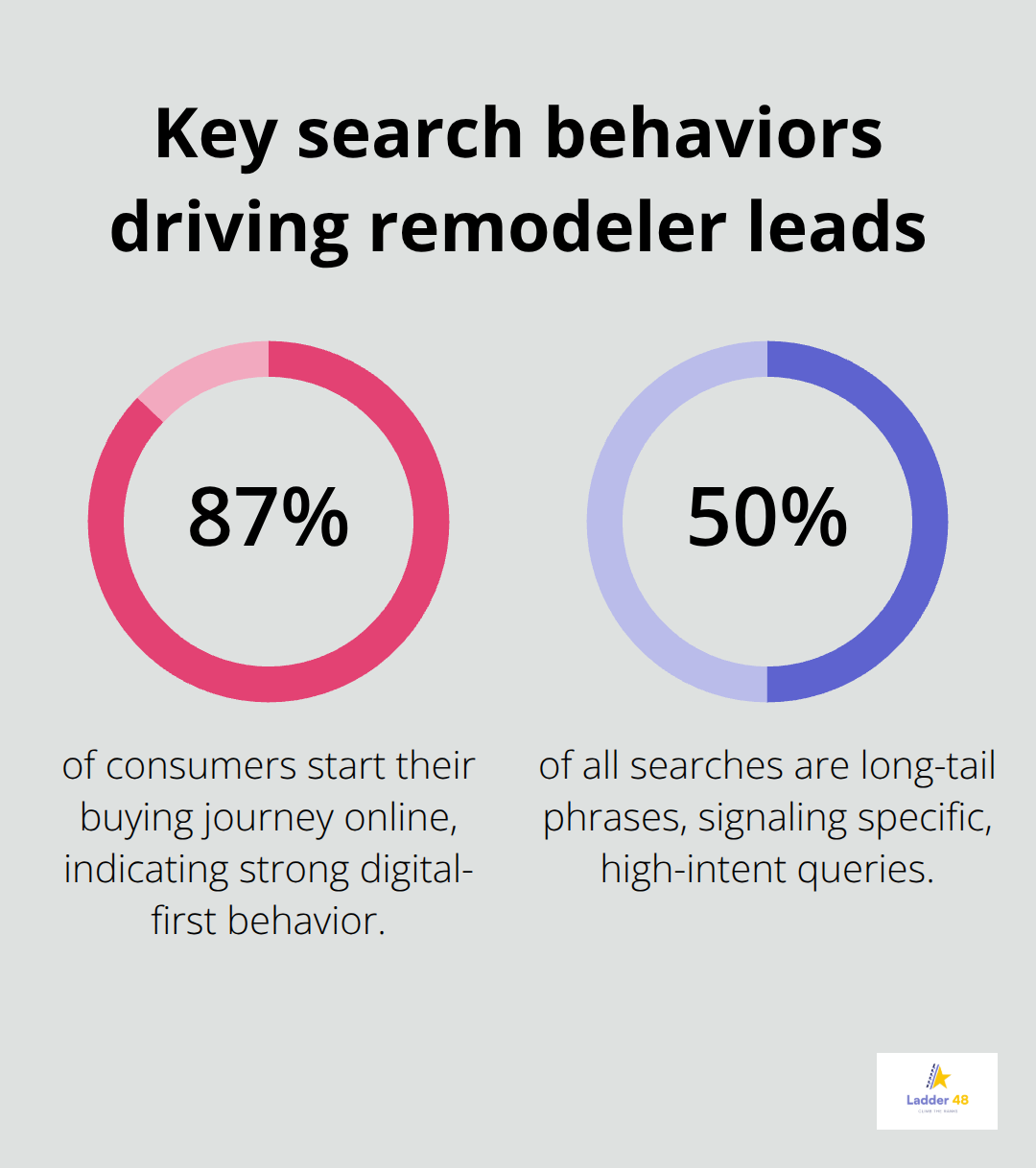
Local search has become the primary battleground for home remodeling leads. According to CGN, 87% of consumers start their buying journey online, which means homeowners who search for bathroom remodels, kitchen renovations, or general contractors in your area are actively looking right now. These aren’t casual browsers.
They’re people with budgets, timelines, and a genuine need for your services. Most remodelers treat keyword research as optional, then wonder why they lose projects to competitors who appear first in search results. Your competitors capture these high-intent searches because they understand that the right keywords form the direct path between a homeowner’s problem and your solution.
The difference between clicks and qualified leads
Not all search traffic converts equally. A homeowner who types “bathroom remodeling near me” or “kitchen contractor in Denver” differs fundamentally from someone who searches “home remodeling tips.” The first two show intent to hire. The third seeks information. This distinction determines where you invest your effort. Long-tail keywords like “luxury bathroom remodel in Austin” or “kitchen renovation contractor within 5 miles” attract fewer total searches but pull in homeowners with serious intent. About 50% of all searches are long-tail phrases, which means the majority of your opportunity sits in these specific, localized terms rather than broad, competitive keywords like “home remodeling.” Tools like Google Search Console show exactly which searches bring people to your site and which ones convert into calls or inquiries. Most remodelers never check this data, so they miss obvious opportunities to capitalize on what’s already working.
Where your competitors rank and why it matters
Your competitors already rank for keywords you should own. Tools like Semrush or Ahrefs reveal which keywords drive traffic to their websites and how much monthly search volume those terms generate. If a competitor ranks on page one for “bathroom remodeling in your city” and you’re nowhere to be found, that represents a direct loss of qualified leads every single month. The keyword difficulty score in these tools tells you whether a term warrants your effort or if you should focus elsewhere. A keyword with 40 monthly searches in your local market might seem low, but if it converts even one project per month at an average contract value of $15,000, that equals $180,000 annually from a single keyword phrase. This is why local, specific keywords outperform generic national terms. Your job involves identifying which keywords your competitors have overlooked or which ones are underserving the market, then building content and pages around those opportunities before they do.
Moving from research to action
The keywords your competitors rank for tell you what works in your market. The keywords they miss tell you where your next opportunity lies. Once you identify these high-value phrases, you need a strategy to claim them-and that strategy starts with understanding how to place these keywords across your website and content in ways that actually attract the right homeowners.
How to Find Keywords Your Competitors Miss
Your top three local competitors already rank for keywords you should own. Open Semrush or Ahrefs and run a competitor analysis on their domains. You’ll see every keyword they rank for, the search volume behind each term, and their estimated monthly organic traffic. These are real rankings pulling real visitors to their sites right now. Filter the results to show keywords with 10 or more monthly searches and a difficulty score below 50. Those are the terms you can realistically compete for without spending a year climbing the rankings.
Spot the gaps your competitors leave open
Look specifically for service-area keywords like “kitchen remodeling in Denver” or “bathroom contractor near Aurora.” Your competitors likely dominate some of these, but you’ll also spot gaps-keywords they rank for with low traffic, or high-intent terms they completely ignore. Those gaps are your openings. Screenshot these opportunities and organize them by service type and location. If your competitor ranks for “master bath renovation in your city” but not “guest bathroom remodel in your city,” that’s a keyword worth pursuing because it shows local demand exists but remains underserved.
Search volume tells only half the story
Google Keyword Planner shows search volume estimates, but these numbers are often inflated because they’re designed for paid advertisers. A term showing 150 monthly searches might actually generate 40 realistic clicks to organic results. Use Ahrefs to check estimated monthly organic visitors instead-this metric accounts for click-through rates and shows what you’ll genuinely gain by ranking.
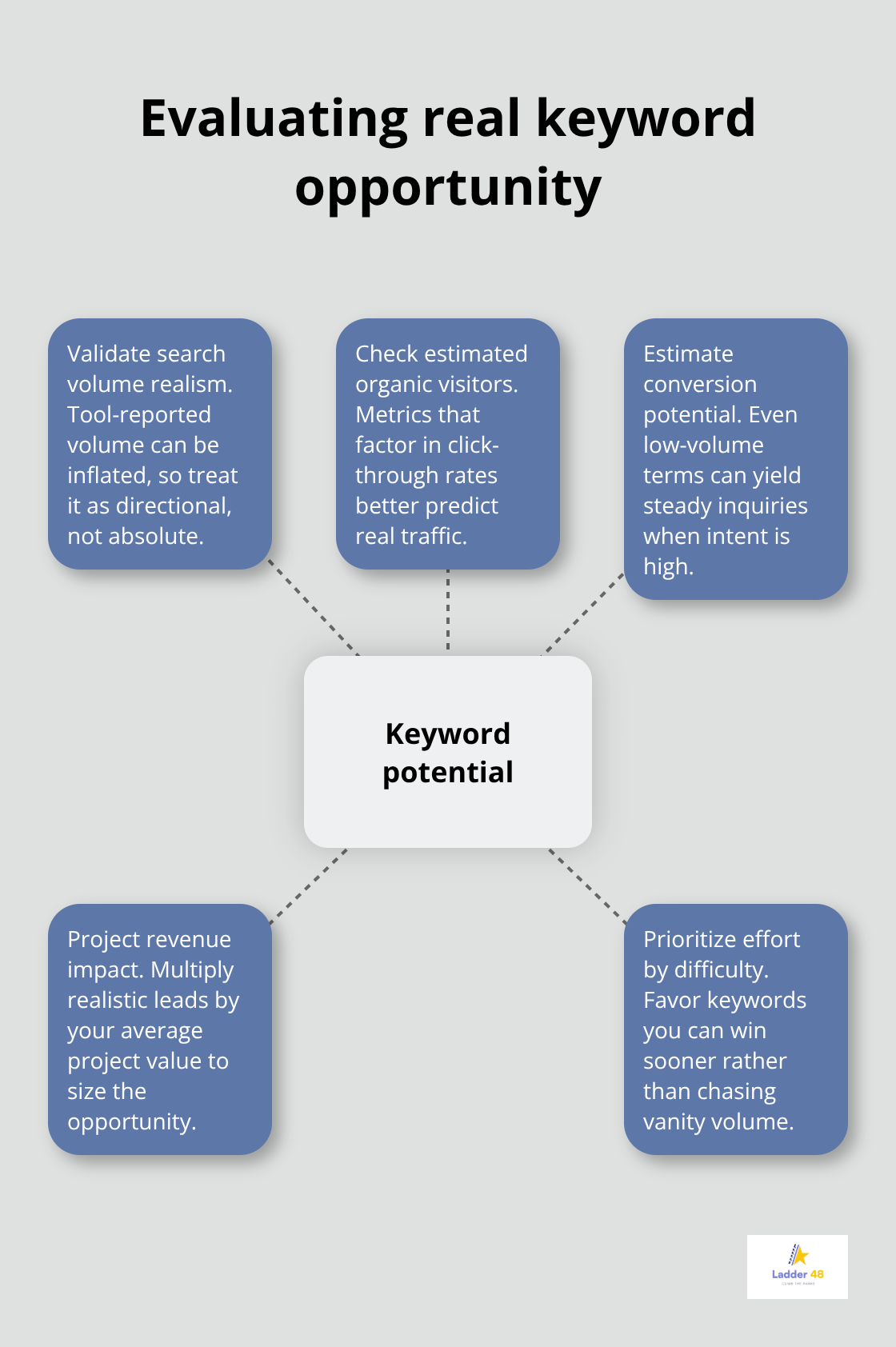
A keyword with 40 monthly searches converting even two inquiries per month means roughly 24 qualified leads annually. At a typical remodeling project value of $20,000, that single keyword phrase could generate $480,000 in annual opportunity.
Long-tail keywords like “energy-efficient kitchen remodel in your neighborhood” often show zero or minimal volume in tools, yet homeowners actively search these exact phrases. Trust your local knowledge here. If you know homeowners in your area care about energy efficiency, create content around these terms regardless of what the tools show. Google Search Console reveals the truth-it shows actual search queries that brought people to your site. Check your Performance tab monthly and look for queries with high impressions but low click-through rates. Those queries indicate people are seeing your site but not clicking. Optimize your title tags and meta descriptions for those specific terms, and you’ll capture traffic you’re already close to winning.
Prioritize difficulty and opportunity over volume alone
Don’t chase volume alone. A keyword with 500 monthly searches that requires six months to rank is worse than a keyword with 80 monthly searches you can own in six weeks. Create a spreadsheet with three columns: keyword phrase, monthly search volume, and keyword difficulty score. Prioritize terms under difficulty 40 where your local competitors show weak presence. Include geographic modifiers like your city name, nearby neighborhoods, and ZIP codes. Service-area keywords convert better than national terms because they signal local intent. Someone searching “home remodeling” could be anywhere. Someone searching “kitchen remodel contractor in your city” is ready to hire someone local.
Include question-based keywords too-these appear in People Also Ask sections and often have lower competition. “How much does a bathroom remodel cost in your area” or “What’s included in a kitchen renovation” capture homeowners at the research stage, earlier in their buying journey. These informational keywords build authority and trust before someone searches for a contractor. Try a mix: 40% transactional keywords showing immediate hiring intent, 40% service-area keywords targeting your specific locations, and 20% informational keywords establishing expertise.
Track this list quarterly. Markets shift, new competitors emerge, and search behavior changes. Refresh your keyword research every three months to stay ahead of what homeowners in your area are actually searching for right now. Once you’ve identified which keywords matter most, the next step involves placing them strategically across your website and content to actually attract those homeowners.
Placing Keywords Where They Actually Drive Leads
Your keyword research means nothing if those words never appear where homeowners can find them. Most remodelers scatter keywords randomly across their website and hope Google notices. That approach wastes months of potential leads. Instead, you need a deliberate placement strategy that tells Google exactly what services you offer in which locations, while keeping the content natural enough that actual homeowners want to read it.
Strategic Keyword Placement on Your Core Pages
The homepage title tag should include your primary service and city, like “Kitchen and Bathroom Remodeling in Denver” rather than generic phrases. Your meta description appears directly in search results and influences click-through rates significantly. A meta description reading “Award-winning kitchen remodels in Denver with 20+ years experience. Free consultations available” outperforms vague descriptions that waste this prime real estate.
Service pages need target keywords in the H1 heading, the first paragraph, and naturally throughout the body. If you’re targeting “luxury bathroom remodel in Austin,” that exact phrase should appear in your H1, but forcing it into every sentence creates the robotic content Google now penalizes. Try keyword density around 1-2% of your total page content. URL slugs matter too-a page about kitchen remodeling should use /kitchen-remodeling-denver rather than /services-page-3.
Image alt-text is overlooked territory where you can reinforce keywords without sounding forced. An image of a finished master bath gets alt-text reading “luxury master bathroom remodel in Austin completed by [Your Company]” instead of just “bathroom photo.” Google Search Console data reveals which of your pages rank for which keywords and which ones need optimization. If a page ranks on position 8 for “bathroom remodeling contractor near me,” improving that page’s title tag and meta description often moves it to position 3 or 4 within weeks.
Building Location-Specific Content That Converts
Location-specific content separates successful remodelers from those stuck on page two of search results. A single generic “Service Areas” page that lists ten cities wastes an opportunity. Instead, build dedicated landing pages for each major service area with unique content reflecting that location’s specific concerns.
A homeowner in Phoenix cares about desert heat and water conservation in ways a Denver homeowner doesn’t. Your Phoenix kitchen remodeling page should address energy efficiency and sustainable materials. Your Denver page might emphasize mountain home aesthetics and high-altitude construction challenges. Include neighborhood-specific references, local landmarks, and actual project photos from that area. Reviews that mention specific locations boost these pages significantly.
Google Business Profile Insights show the exact keywords that trigger your local listing. If homeowners search “bathroom remodel near Union Square Denver” and your profile appears, that’s a signal to create content around Union Square specifically. This localized approach (combined with authentic project photos and neighborhood details) helps Google understand your service areas while building trust with local homeowners.
Matching Content to Purchase Intent
Content around local keywords and service problems converts faster than informational content. Someone searching “how much does a kitchen remodel cost” needs education. Someone searching “kitchen remodeling contractor in my city” needs your phone number. Allocate roughly 60% of your content effort toward service pages that target transactional keywords showing hiring intent, 25% toward location pages that capture neighborhood-specific searches, and 15% toward blog content that answers common questions.
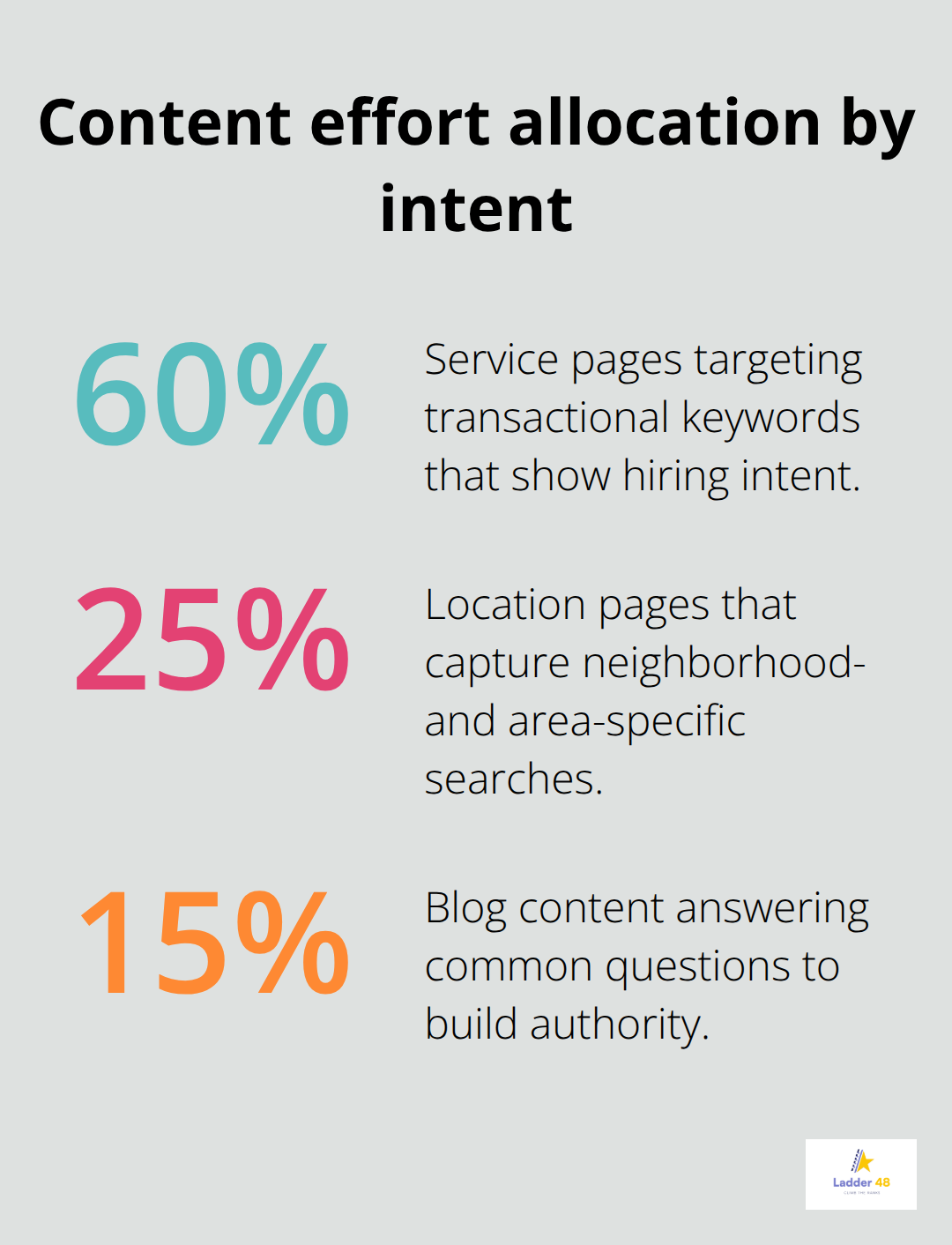
This ratio reflects where homeowners actually convert into projects.
Final Thoughts
Home remodeler keyword research isn’t a one-time project you complete and forget. The homeowners searching for your services change their language, new competitors enter your market, and Google’s algorithm shifts constantly. Your keyword strategy must evolve with these changes or you’ll watch your rankings slip while competitors capture the leads you should own.
Focus on keywords that actually convert to project inquiries, not vanity metrics. A keyword with 200 monthly searches that brings zero qualified leads wastes your time, while a keyword with 40 monthly searches that converts two homeowners into $20,000 projects generates $480,000 annually. Track which keywords drive phone calls and form submissions through Google Search Console and your analytics, then double down on what works and eliminate what doesn’t.
Quarterly reviews keep your strategy sharp-check your competitor rankings every three months, identify new keywords emerging in your market, refresh your location pages with updated project photos and testimonials, and monitor your Google Business Profile Insights to see which search terms trigger your listing. If managing home remodeler keyword research alongside running your remodeling business feels overwhelming, we at Ladder 48 help contractors build SEO strategies that attract qualified local leads without consuming your time.