
Roofer search optimization determines whether homeowners find your business or your competitors. Most roofing contractors lose leads because they’re invisible in local search results, even when they do quality work.
At Ladder 48, we’ve seen firsthand how the right local ranking tactics transform roofing businesses. This guide shows you exactly how to dominate local search and attract more qualified customers.
The Foundation: Getting Your Google Business Profile and Local Listings Right
Your Google Business Profile is the first thing homeowners see when they search for roofers near them. It appears above your website in local results and on Google Maps, which means it controls whether potential customers even know you exist. Most roofers treat their GBP like an afterthought, filling it out once and never touching it again. That’s a massive mistake.
Why Your GBP Photos and Details Drive Real Results
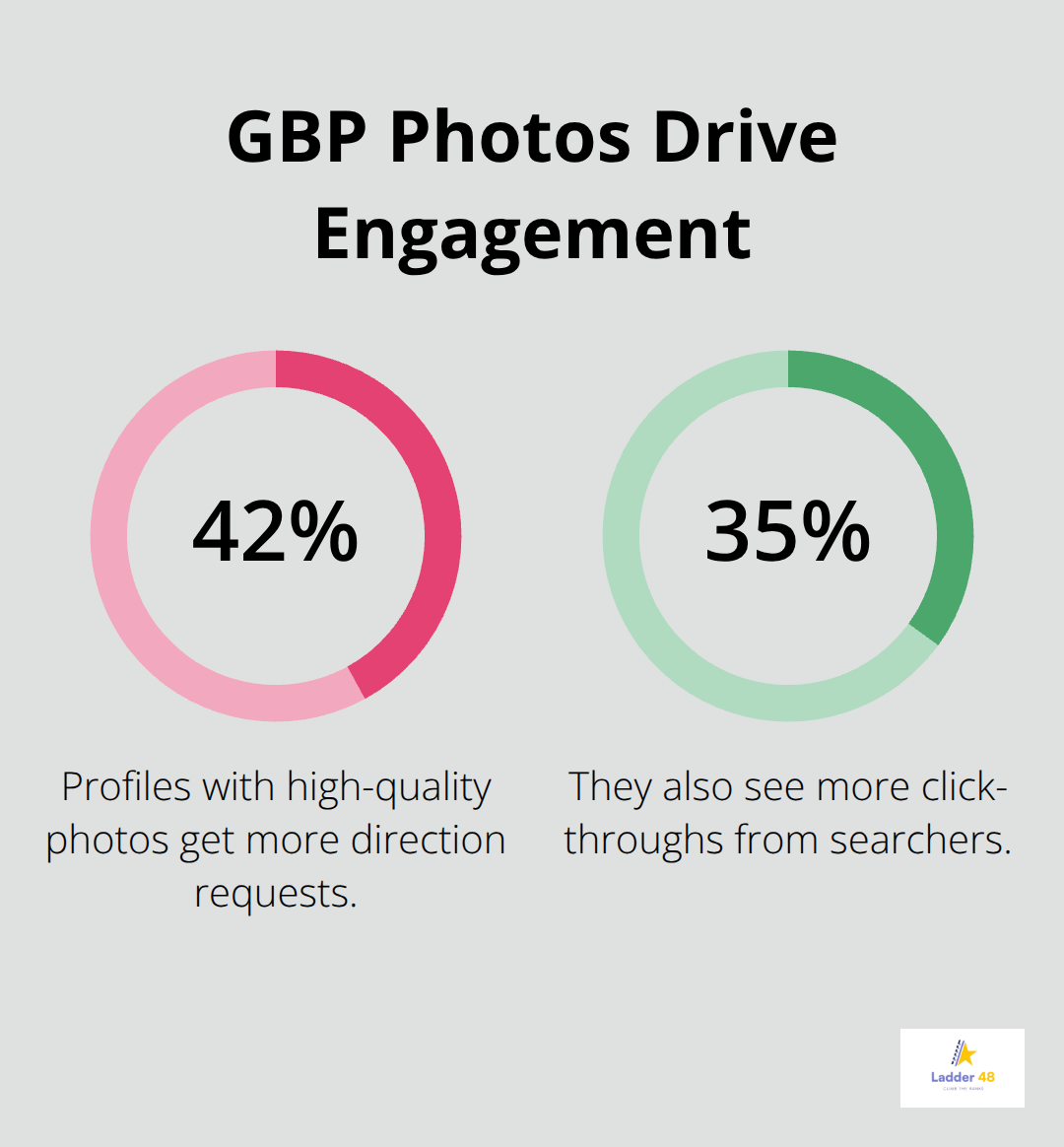
According to Google data, profiles with high-quality photos receive 42% more direction requests and 35% more click-throughs. The exact business name, a precise local address, and a local phone number are non-negotiable. If your GBP says something different than your website or your citations, homeowners and Google both get confused.
Choose your primary category as Roofing Contractor, not something vague. Upload photos that actually matter: your logo, crew photos, before-and-after shots from real jobs, and images of your work site. Name those files descriptively so Google understands what it’s looking at. Set a generous service area radius so you capture nearby towns and don’t miss customers within a reasonable driving distance.
Post updates regularly, at least weekly if possible. This keeps your profile active in Google’s eyes and shows homeowners that your business is current and engaged.
Citations and NAP Consistency Matter More Than Most Realize
A citation is simply your business information listed on another website. When your Name, Address, and Phone number appear identically across Google, Yelp, Angi, HomeAdvisor, BBB, Houzz, and your local Chamber of Commerce, Google trusts you more and ranks you higher. Inconsistency kills your rankings. A typo in your address on one directory or an outdated phone number on another tells Google that your information isn’t reliable. Audit all your listings quarterly and fix errors immediately.
Reviews: The Single Most Powerful Ranking Factor
Reviews are the ranking factor that matters most in local search, and they matter far more than most roofers realize. Try for at least 50 Google reviews with a 4.5-star average, and actively collect them after every completed job. Request reviews within 1-2 weeks while the work is fresh in the homeowner’s mind. Provide a direct link to your Google review page on invoices, emails, and text messages so customers don’t have to hunt for it.
Respond to every single review within 24-48 hours. When you get a negative review, treat it as a chance to show other potential customers that you care about fixing problems. Ask the unhappy customer if you can address their concerns and request an updated review once resolved. Recent five-star reviews boost your rankings more than older ones, so consistency matters. Automation tools (like text-based review requests after job completion) help you stay on top of this without manual effort every time.
Your GBP and citations form the bedrock of local visibility, but they only work if homeowners can actually find you through search. The next section shows you how to optimize your website itself so you rank for the specific roofing services and locations where your customers search.
How to Target Roofing Keywords That Homeowners Actually Search For
Your website ranks only when you optimize for the exact keywords homeowners type when searching for roofers. Generic pages about roof repair or roof replacement won’t work. Homeowners search with location intent-they want a roofer in their specific city or neighborhood. Research shows 46% of Google searches have local intent, and for roofing services, that percentage climbs even higher because homeowners need someone nearby who can arrive quickly.
Identify Service-Location Keyword Combinations
Start by listing the roofing services you actually offer, then pair each one with the cities and neighborhoods where you operate. If you do roof repairs, replacements, inspections, and gutter work across five service areas, you’re looking at 20 distinct keyword combinations minimum. Keyword research is the foundation of all SEO strategies-it ensures you’re targeting the exact terms potential clients are using to find roofing services. Look at the queries that show impressions but low click-through rates-those are opportunities to optimize existing pages or create new ones.
Target phrases like “roof repair in Springfield,” “emergency roofer near downtown,” or “best roofing company in zip code 45678.” These specific combinations tell Google exactly where you operate and what you do, which improves your chances of appearing in the local pack.
Create Dedicated Pages for Each Service-Location Pair
A single generic roof repair page won’t rank well for roof repair in Cincinnati, roof repair in Columbus, and roof repair in Cleveland simultaneously. Google wants to see dedicated, detailed content that addresses the specific needs of homeowners in each location. Your Cincinnati roof repair page should mention Cincinnati neighborhoods, local weather patterns that affect roofs in that area, and specific challenges Cincinnati homeowners face. Embed your Google Maps location for Cincinnati on that page. Link internally from your main services page to this Cincinnati-specific page so Google understands the hierarchy.
These location pages should run 400–600 words of unique, helpful content per page. Explain what roof repair means, why homeowners in that specific area might need it (storm damage, aging materials, weather exposure), what the process looks like, and how to contact you. Include your phone number prominently and a click-to-call button for mobile users. Never duplicate content across pages. Copying your Cincinnati roof repair page and swapping in Columbus for every instance hurts your rankings because Google sees it as duplicate content. Write each page fresh, with details specific to that location.
Optimize Title Tags, Meta Descriptions, and Headers
Your title tag is the blue clickable link in search results. It’s the single most important on-page SEO element, and most roofers waste it. Instead of a vague title like “Roofing Services,” use “Roof Repair in Springfield OH – Licensed & Insured Roofer.”
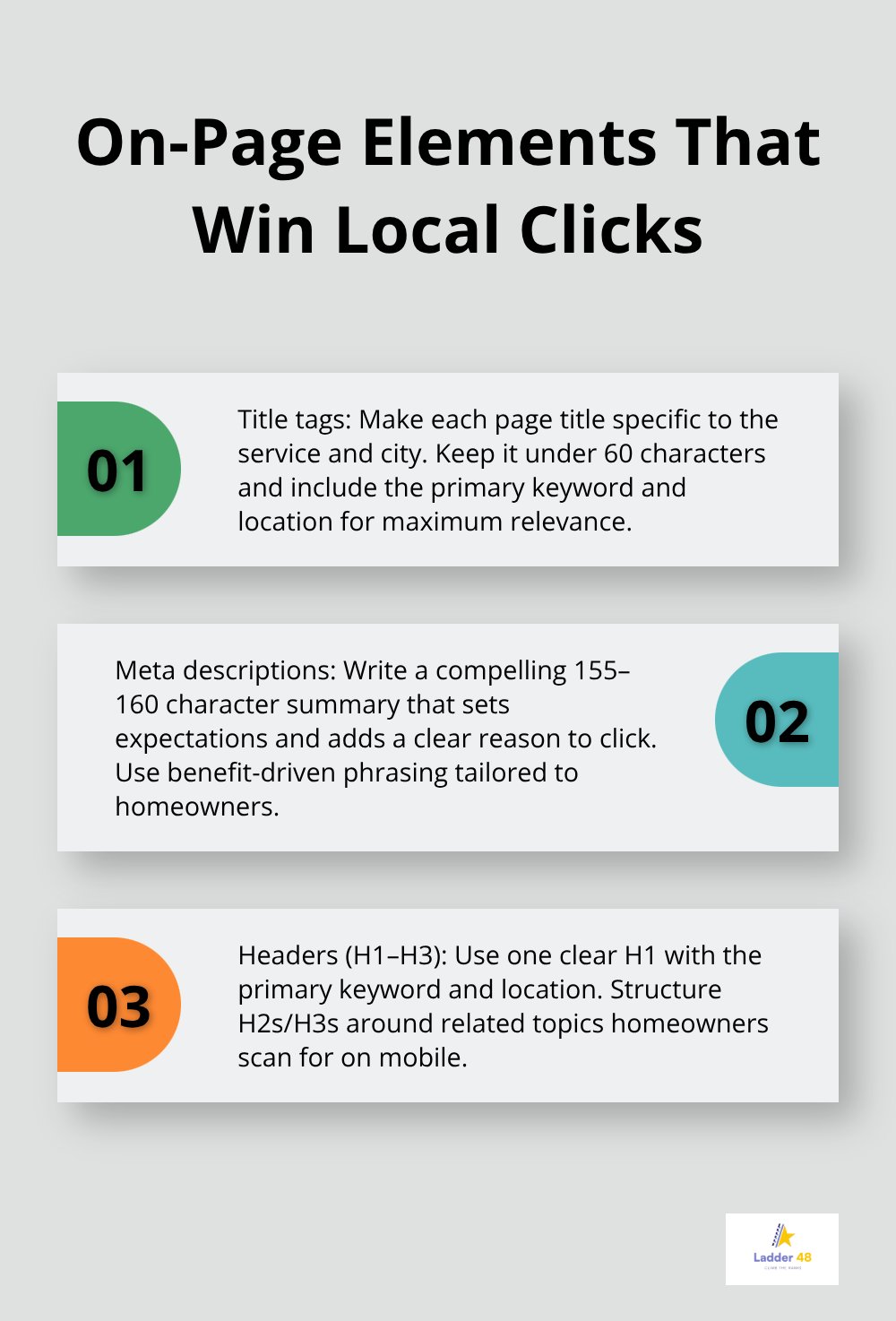
That title tells homeowners exactly what you do and where, and it includes the keywords Google uses to rank you. Keep titles under 60 characters so they don’t get cut off in search results.
Your meta description appears below the title in search results and should be a compelling 155–160 characters that explain what’s on the page and include a reason to click. Something like “We provide fast, affordable roof repairs in Springfield. Licensed roofers available for emergency calls 24/7. Call now for a free inspection” works far better than generic descriptions.
Header tags (H1, H2, H3) structure your page and signal to Google what’s important. Use your primary keyword in the H1 tag-only one H1 per page. If your page is about roof repair in Springfield, your H1 might be “Professional Roof Repair Services in Springfield, Ohio.” Subheadings can target related keywords: “Why Springfield Homeowners Choose Our Roof Repairs,” “Common Roof Problems in Ohio Weather,” or “How Our Roof Repair Process Works.” These headers make your page easier to read for humans and help Google understand your content’s relevance to local roof repair searches. Mobile users especially benefit from clear headers because they scan pages quickly on small screens.
The keywords and pages you build form the backbone of your website’s visibility, but they only matter if other websites point to you. The next section shows you how to earn the backlinks and authority signals that push you above your competition in local search results.
Building Authority Through Strategic Partnerships and Coverage
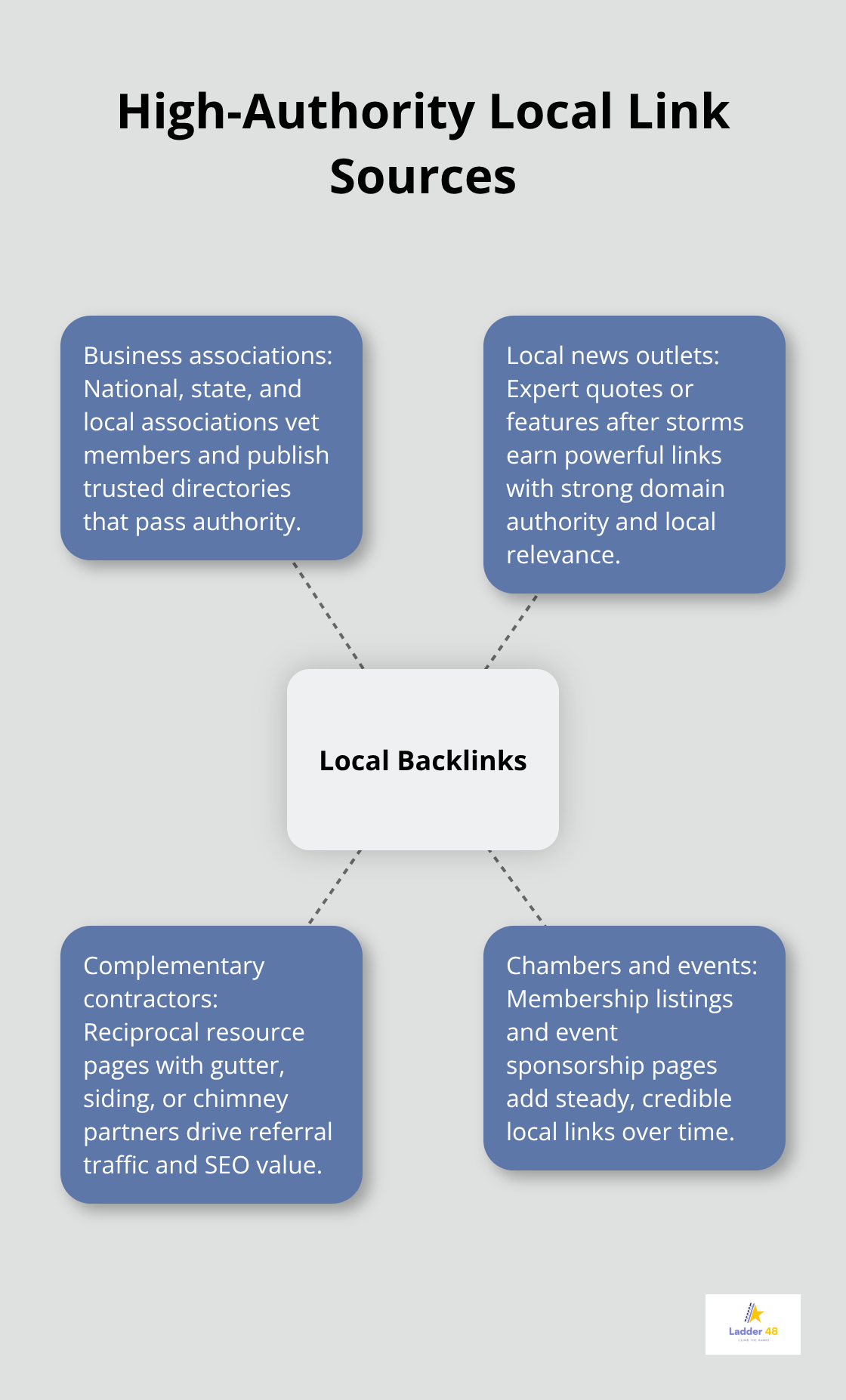
Backlinks from other websites act as votes of confidence in Google’s algorithm, and the quality of those votes determines whether you rank above competitors or disappear into page two. Most roofers chase low-quality backlinks from directory farms or pay for links, which actually hurts their rankings. Google penalizes these tactics. Instead, focus on earning links from sources that homeowners and Google both trust: local business organizations, news outlets, and complementary service providers in your area.
Local Business Associations and Trade Organizations
Local business associations and trade organizations offer underutilized opportunities for backlinks. The National Roofing Contractors Association, state-level roofing associations, and local chambers of commerce all publish member directories or partner listings. Contact the association directly and ask about membership or directory inclusion. Verify that your NAP information matches your Google Business Profile exactly. These organizations carry authority because they vet their members, which means their links carry real weight with Google.
Earn Coverage from Local News Outlets
Local news coverage generates the strongest ranking signals. When a severe storm hits your area, local journalists search for contractors who can comment on damage or repairs. Pitch yourself as an expert source before disaster strikes. Send a brief email to local reporters and editors, introducing yourself as an available roofing expert for storm coverage. When journalists quote or feature you, that news site’s backlink to your website becomes a powerful ranking signal. The Associated Press and local news outlets have enormous domain authority, so even a single mention can move your rankings noticeably.
Create Partnerships with Complementary Service Providers
Partnerships with complementary home service providers create mutual benefit. General contractors, gutter specialists, siding companies, and chimney services work alongside roofing regularly. Reach out to three or four non-competing contractors in your area and propose a simple link exchange: you feature them on a resources or referral partners page, and they do the same for you. These links carry moderate weight because they come from related local businesses, and they drive actual referral traffic beyond the SEO benefit. Relevance matters-a link from a local electrician helps more than a link from an unrelated business across the country.
Leverage Chamber of Commerce and Event Sponsorships
Local chamber of commerce membership often includes web directory listing and sponsorship opportunities that generate backlinks. Event sponsorships at community festivals, charity fundraisers, or local business expos frequently result in sponsor recognition pages with backlinks to your site. These carry less direct ranking weight than news coverage but accumulate quickly when you sponsor three or four events per year.
Monitor and Protect Your Link Profile
Track where every backlink comes from using Google Search Console, which shows all sites linking to you. Disavow any low-quality or spammy links immediately to protect your domain authority. Quality always beats quantity-ten authoritative local backlinks from chambers, news sites, and business associations will outrank hundreds of directory links from irrelevant sources.
Final Thoughts
Roofer search optimization compounds over months and years, delivering steady leads while your competitors struggle for visibility. Start with your Google Business Profile by verifying it, filling every field accurately, uploading real photos from your jobs, and posting updates weekly. Build citations across Yelp, Angi, HomeAdvisor, BBB, and your local chamber so your NAP information appears identically everywhere, then collect reviews aggressively after every completed job and respond to every single one within 48 hours.
Next, audit your website and create dedicated pages for each service-location combination you serve. Optimize title tags and meta descriptions with specific keywords like roof repair in your city, and write unique content for each location page instead of copying and pasting. These pages capture homeowners searching with local intent, which converts at higher rates than generic traffic.
Finally, earn backlinks from sources that matter by contacting your local chamber of commerce, pitching yourself to news outlets as a roofing expert, and building partnerships with complementary contractors. We at Ladder 48 specialize in SEO strategies for contractors, providing transparent, results-driven optimization that attracts qualified local leads and builds sustainable growth.


