
Concrete patio extension contractors are discovering a goldmine in outdoor living. Homeowners are spending more than ever on backyard upgrades, and the margins on these projects are hard to beat.
At Ladder 48, we’ve seen contractors who add this service to their portfolio double their revenue within a year. This guide walks you through everything you need to launch concrete patio extensions and build a profitable new revenue stream.
Why Contractors Should Add Patio Extensions to Their Service Menu
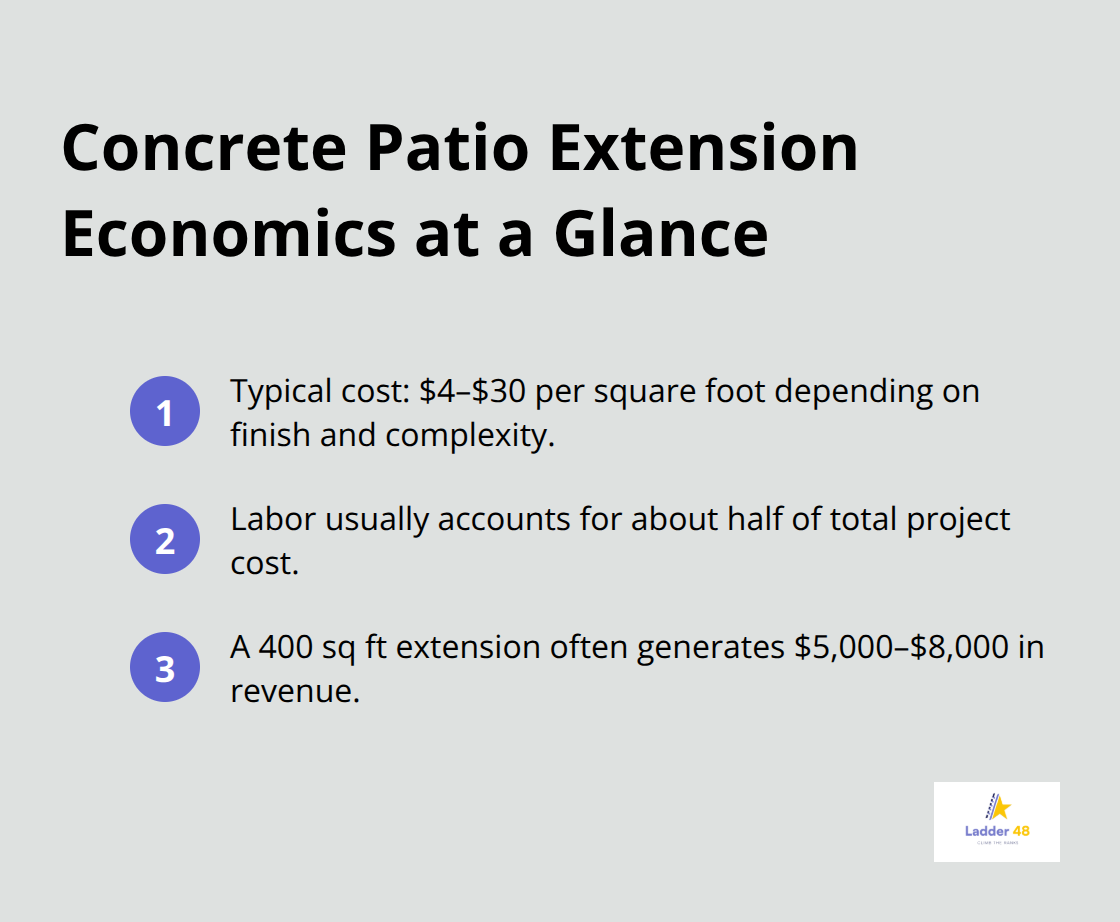
Concrete patio extensions deliver the kind of profit margins that make contractors sit up and take notice. According to Angi cost data, concrete patios run between $4 and $30 per square foot depending on complexity and finish, with labor accounting for roughly half the total project cost. A 400-square-foot extension at mid-range pricing lands around $5,000 to $8,000 in revenue, and since your crew already knows concrete work, the overhead stays predictable.
Strong demand meets weak competition
Homeowners actively hunt for patio extension services. The outdoor living trend continues to accelerate-property values climb when patios are installed or extended, and buyers increasingly expect finished outdoor space. You won’t compete against dozens of contractors for every patio extension job the way you might for a standard driveway. Most general contractors still haven’t added this to their service line, which means less competition and stronger pricing power in your local market.
The loyalty multiplier effect
Once you pour a patio extension, you’ve built trust with a homeowner who already knows your work quality and reliability. That same customer becomes your best referral source for driveways, walkways, and other concrete projects they suddenly notice need attention. Existing customers cost significantly less to sell than cold leads, and they close faster. A contractor who completes one patio extension for a client often lands three additional projects from that same household within two years.
Real costs that justify the investment
The extension itself typically costs between $550 and $1,700 to remove the old slab if one exists, plus site prep running $1,000 to $3,200 depending on terrain-real money that justifies bringing in equipment and crews. Permits add $50 to $400 depending on your location, but that’s a conversation you handle upfront. Finishing touches like sealing every three to five years at $3 to $5 per square foot create an ongoing service relationship.
Upselling opportunities that expand project value
Extensions position you perfectly to upsell integrated features-outdoor kitchens, fire pits, built-in seating-that push project values well beyond the base patio cost. These additions transform a straightforward extension into a comprehensive outdoor living solution. Your next step involves understanding the specific tools, training, and supplier relationships you’ll need to execute these projects at the quality level your customers expect.
What Concrete Patio Contractors Actually Need to Succeed
Essential Equipment to Launch Extensions
Launching concrete patio extensions requires specific equipment, but you likely already own most of what matters. If you run a concrete contracting business, your existing tools-concrete mixers, wheelbarrows, shovels, levels, and finishing trowels-handle the core work. Extensions demand precision and scale that standard driveways don’t require. You’ll need a quality concrete saw for clean cuts when bonding new concrete to existing slabs, a power washer to prep old surfaces properly, and tamping equipment for proper base compaction. Rebar cutters and benders become essential when you reinforce extensions, especially for heavy-load projects like outdoor kitchens or hot tubs that require six-inch-thick concrete instead of the standard 3.5 to 4 inches. A laser level eliminates guesswork on slope and drainage-critical because poor drainage causes the most customer complaints on patio extensions.
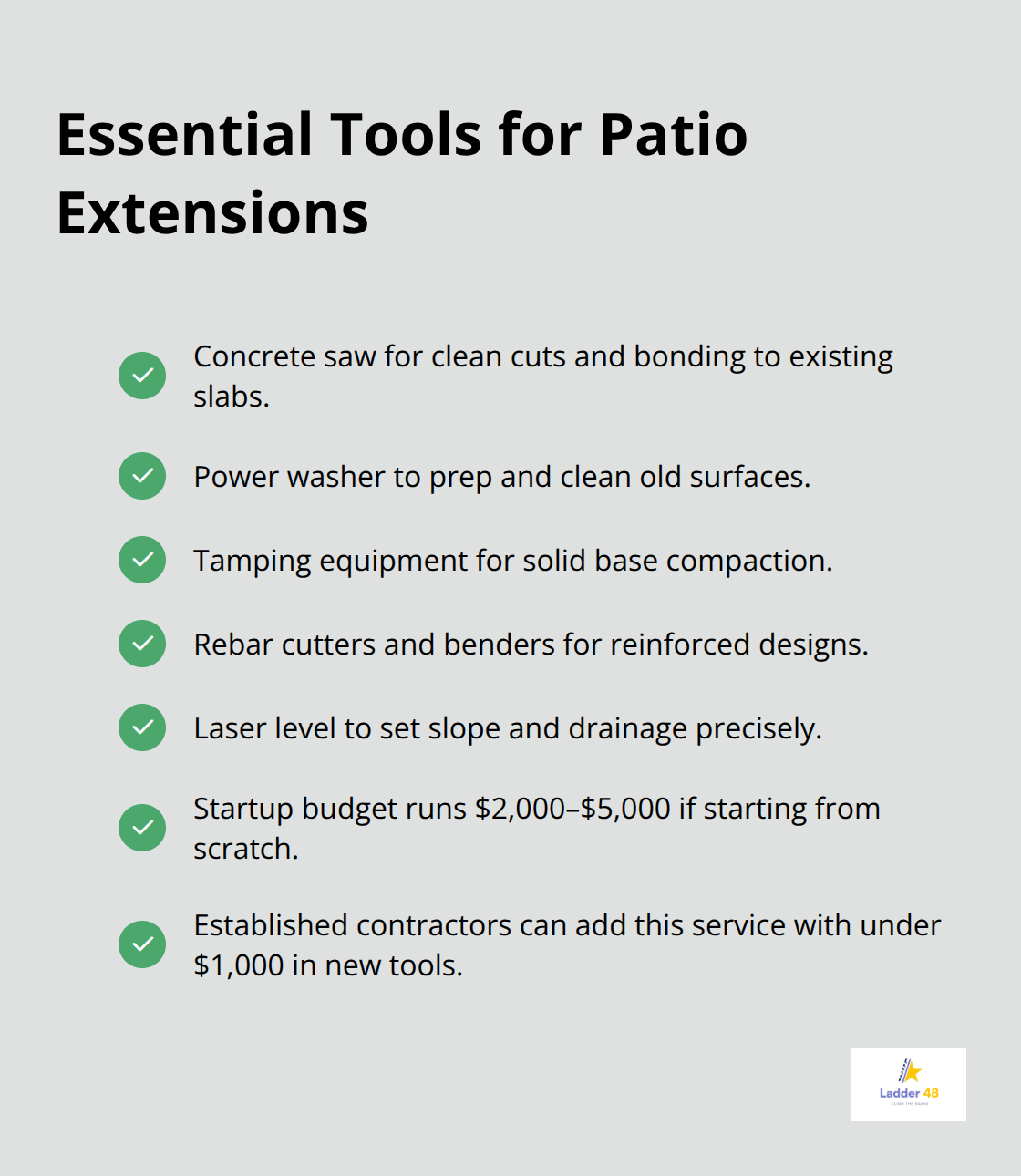
These tools run $2,000 to $5,000 total if you start from scratch, but most established contractors can launch this service with under $1,000 in new equipment.
Understanding Concrete Behavior in Your Climate
Training and certifications matter less than hands-on experience and understanding concrete behavior in your specific climate. You don’t need a formal patio extension license in most states, but you absolutely need to understand site preparation, proper curing conditions, and how temperature affects concrete setting. Angi data shows concrete pours perform best between 50 and 60 degrees Fahrenheit, and extreme temperatures complicate curing and affect final results. Your biggest learning curve involves matching new concrete to existing slabs-a technical challenge because batch-to-batch pigment variations, UV fading, and curing differences mean a perfectly seamless extension is rarely achievable. Experienced contractors set expectations upfront about what’s realistic, then use deliberate design transitions like contrasting borders or paver extensions to make color differences read as intentional design choices rather than mismatches.
Building Supplier Relationships That Protect Your Margins
Material sourcing determines your margins directly. Concrete mix costs around ten dollars per square foot, rebar runs roughly $1.40 to $1.85 per two feet, and your supplier relationships determine whether you pay retail or contractor pricing. You should build relationships with three to five local concrete suppliers and negotiate volume discounts-most offer better pricing at 10 or more cubic yards monthly. Permeable concrete and recycled-content mixes appeal to environmentally conscious homeowners and command premium pricing, so stock suppliers who offer these options. Your supplier should also handle permit guidance because regulations vary dramatically by location, with costs ranging from fifty to four hundred dollars depending on your jurisdiction. The right supplier partnership transforms material costs from a liability into a competitive advantage that lets you quote faster and tighter than competitors who haven’t invested in these relationships.
How to Find and Convert Homeowners Ready for Patio Extensions
Target Homeowners at the Decision Stage
Homeowners most likely to hire you for a patio extension are already searching for exactly what you offer-they just don’t know your name yet. These ready-to-buy customers start their search when they notice problems with their existing patio: cracks, uneven surfaces, limited entertaining space, drainage issues, or outdated design. These pain points drive them to Google, and that’s where you intercept them. Search terms like patio extension contractors, concrete patio repair, or backyard patio installation pull in customers at the decision stage, not the awareness stage. You want these high-intent searchers, not casual browsers. According to Angi data, concrete patio extensions average around $3,551 nationally, with costs spanning $800 to $10,000 depending on size and finish. Homeowners aware of this price range are already mentally committed to the project; they’re comparing contractors, not deciding whether to proceed.
Dominate Local Search with Geographic Keywords
Focus your local SEO efforts on geographic modifiers-your city name, nearby neighborhoods, and regional identifiers matter far more than generic patio content. If you service Baltimore, your target keyword is Baltimore concrete patio extension contractors, not just concrete patio extensions. Your job is to appear in front of comparison shoppers with proof that you deliver the quality and reliability they expect. Local search optimization positions you directly in front of customers who can actually hire you, not prospects across the country who will never call.
Leverage Before-and-After Photos for Conversion
Before-and-after photos become your most powerful conversion tool because they show real results on homes that look similar to the searcher’s own property. Upload these images to Google Business Profile, your website portfolio, and local directories-consistency across platforms signals legitimacy to both Google’s algorithm and potential customers. When you photograph extensions, capture images from multiple angles and in different lighting conditions; afternoon sunlight often reveals texture and finish quality better than midday brightness. Include photos of the finished patio in use: furniture arranged, people enjoying the space, evening lighting activated. Homeowners don’t just want to see concrete; they want to envision their own entertaining space.
Build Social Proof Through Reviews and Testimonials
Reviews and testimonials from previous customers function as social proof that directly influences conversion rates. Angi’s research shows that contractors with 4.5-star ratings or higher receive significantly more inquiries than those with lower ratings, and negative reviews about drainage problems or color mismatches will kill your phone. Ask every completed patio extension customer to leave a review within one week of project completion, when satisfaction runs highest. Provide them with a direct link to your Google Business Profile or preferred review platform-friction kills review generation. Respond to every review, positive or negative, within 48 hours.

A thoughtful response to a complaint about color matching shows future customers that you take concerns seriously and handle problems professionally. Testimonials that mention specific details (how you managed weather delays, matched the existing patio, or upsold integrated features like fire pits) outperform generic praise. Your local reputation compounds over time: contractors with 50+ reviews consistently outrank those with 10 reviews, even when both have identical star ratings. This means your first 20 reviews matter more than you think; prioritize getting them quickly rather than waiting for perfect projects.
Final Thoughts
Concrete patio extension contractors who launch this service gain immediate access to high-margin projects with minimal competition in most markets. The demand exists, the profit potential is real, and your existing concrete expertise translates directly into execution capability. A single 400-square-foot project generates $5,000 to $8,000 in revenue while your overhead stays predictable, with labor accounting for roughly half the total cost.
Three actions position you directly in front of homeowners actively searching for patio extension services. Invest in the specific equipment you’re missing-a concrete saw, power washer, laser level, and rebar tools-spending under $1,000 to $5,000 depending on your current inventory. Build supplier relationships that lock in material pricing and permit guidance, then dominate local search by targeting geographic keywords, uploading before-and-after photos across platforms, and systematically collecting reviews from satisfied customers.
Long-term growth emerges naturally once you establish this service, as existing customers become your best referral source for additional concrete work and upselling integrated features like outdoor kitchens and fire pits pushes project values well beyond base patio costs. Contractors with 50+ reviews consistently outrank competitors with fewer reviews, even at identical star ratings, which means your first 20 reviews matter more than perfection. If you’re ready to attract qualified leads in your local market, Ladder 48 specializes in helping contractors build stronger online visibility through tailored SEO strategies that position your services in front of ready-to-buy customers.


