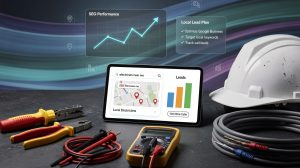
HVAC contractors lose thousands in revenue every month by ignoring local search optimization. The Google Local Pack-those three business listings at the top of search results-controls where customers find you first.
At Ladder 48, we’ve seen contractors jump from page three to the Local Pack within weeks by fixing their HVAC SEO strategy. This guide shows you exactly how.
Google Local Pack Fundamentals for HVAC Contractors
How the Local Pack Works and Why It Matters
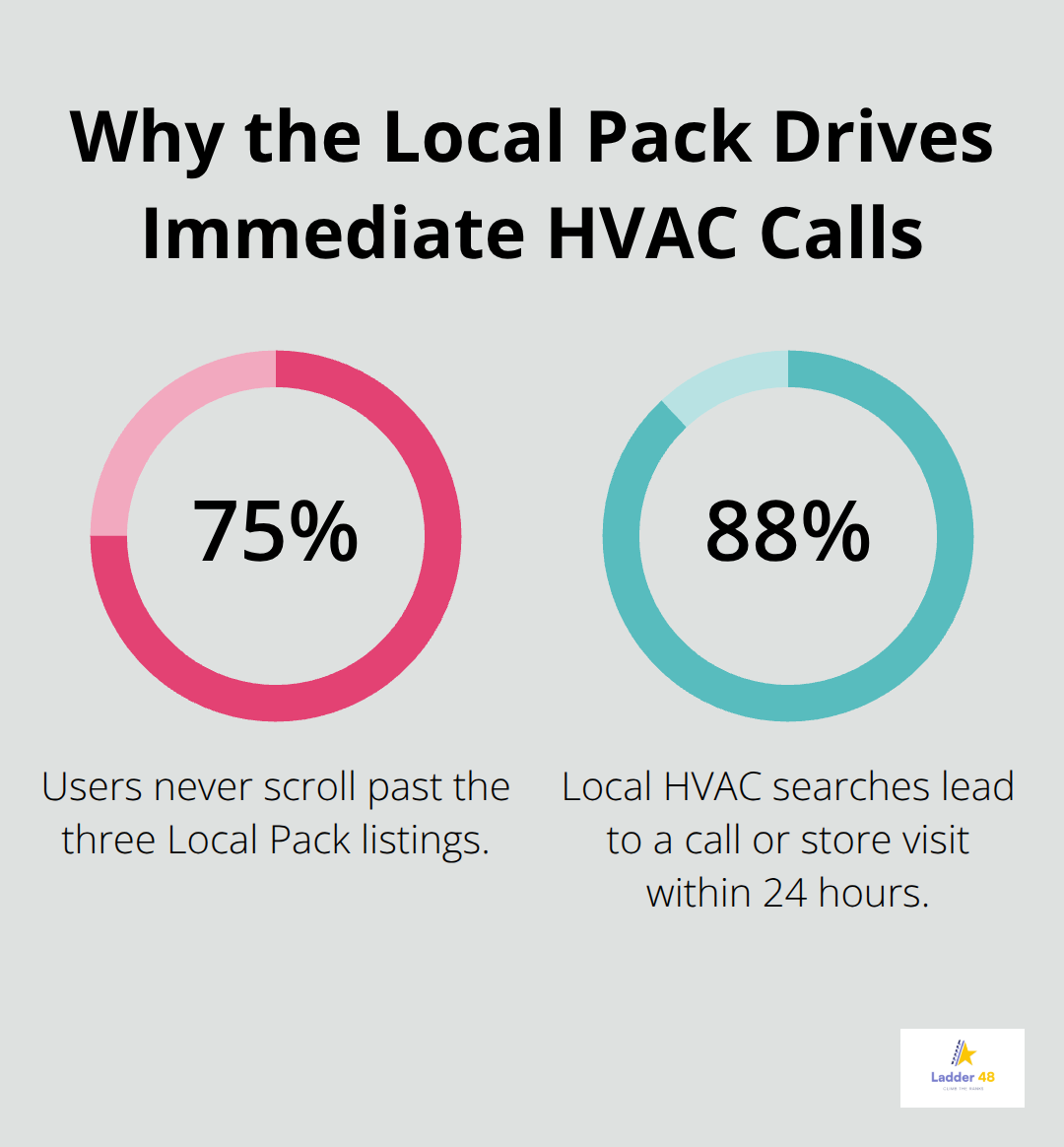
The Google Local Pack sits at the absolute top of search results when someone searches for HVAC services in their area. This isn’t a minor placement-roughly 75% of users never scroll past these three listings. For HVAC contractors, this means the Local Pack controls whether customers call you or your competitor. About 88% of local HVAC searches lead to a phone call or store visit within 24 hours, so appearing in those top three spots directly translates to immediate revenue.
Google displays the Local Pack because it knows customers searching for HVAC repair or installation want results nearby, not across the country. When someone types “HVAC repair near me” or “emergency furnace service,” Google shows businesses it believes are relevant, trustworthy, and closest to them. That’s the Local Pack working as intended.
Three Ranking Factors That Control Your Position
Google uses three primary signals to rank businesses in the Local Pack: relevance, distance, and prominence. Relevance means your business information, website content, and service pages match what the customer searches for.

If someone searches “air conditioning repair” and your Google Business Profile lists heating as your primary service, you’ll rank lower.
Distance is straightforward-Google prioritizes businesses closer to the searcher, though service-area businesses can hide their physical address while still appearing locally. Prominence is where most contractors fail. This includes your review count and average rating, the number of quality backlinks pointing to your website, how often your business appears in local directories, and how actively you use your Google Business Profile. A business with 150 five-star reviews will dominate one with 12 reviews, even if both are equally relevant and equally distant.
An optimized Google Business Profile makes customers 70% more likely to visit your business, yet most HVAC contractors leave critical fields blank or outdated.
Why Local HVAC Competition Intensifies Rapidly
HVAC is one of the most competitive local service categories because customers have high immediate intent and are willing to pay premium prices for fast service. About 1.5 billion “near me” searches happen monthly, and HVAC captures a significant portion of those. Your competitors aren’t just the three businesses in the Local Pack-they’re every HVAC contractor bidding on paid ads, every business listed on Angi or HomeAdvisor, and every contractor with a halfway decent Google profile.
Mobile dominates local search, accounting for 60% of all local HVAC queries, which means customers search while their system breaks down. They’re not comparison shopping-they’re calling whoever appears first. This creates intense competition for the top three spots.
The Multi-Location Challenge for Service-Area Contractors
Service-area HVAC businesses face unique challenges because they need to appear locally across multiple cities without physical offices in each one. A contractor serving a five-county region must rank in all five counties simultaneously, which requires hyper-localized content and precise service-area configuration that most contractors ignore.
This complexity is exactly why your Google Business Profile setup and local authority strategy matter so much. The next section shows you how to optimize your profile to win across all these ranking factors.
Optimizing Your Google Business Profile for Local Visibility
Your Google Business Profile is your storefront on Google Maps and Search. Most HVAC contractors treat it like a checkbox-fill in the basics and move on. That approach costs you ranking positions and customer calls. The difference between a half-completed profile and a fully optimized one is often the difference between ranking in the Local Pack and ranking on page three.
Complete and Accurate Business Information Setup
Start by filling every single field: business name, address, phone number, website URL, hours including 24/7 emergency availability, primary category as HVAC Contractor, and secondary categories like Air Conditioning Repair Service and Furnace Repair Service. These secondary categories capture high-intent searches you’d otherwise miss.
Then add your service areas by zip code and city rather than just listing your address. A contractor serving five counties must explicitly define those boundaries in the profile, or Google won’t show you to customers in outlying areas. Your business description should highlight what makes you different-whether that’s NATE certification, EPA compliance, authorized dealer status, or same-day service guarantees. This isn’t marketing fluff; it’s information that reduces customer anxiety and signals expertise to Google.
An optimized Google Business Profile makes customers 70% more likely to visit your business, yet most HVAC contractors leave critical fields blank or outdated.
Photo and Video Strategy That Converts
Profiles with 100+ high-quality photos generate significantly higher engagement and trust than profiles with a handful of blurry images. Upload your logo, storefront exterior, interior workspace, uniformed technicians, service vehicles, before-and-after project photos, and close-ups of your certifications or awards. Keep images high-resolution at 720 pixels or larger, well-lit, and geotag them when possible so Google knows the location is relevant. Update your photo rotation monthly-Google’s algorithm rewards fresh content, and seasonal photos signal an active business.
Respond to customer photos posted on your profile as well; engagement here tells Google your business is trustworthy and responsive. Videos perform even better. A 30-second clip of your technician explaining a common HVAC problem or showing your service process generates more trust and conversions than a static image. Post these to Google Posts weekly, especially around seasonal demand like spring tune-ups or emergency winter repairs. Google Posts appear directly in your profile and disappear after seven days, which keeps your listing feeling current and active.
Managing Reviews and Responding to Customer Feedback
An optimized profile with five reviews will lose to a mediocre profile with 150 reviews. Review quantity and quality are among Google’s top ranking factors for local results. Try for at least 100 reviews with an average rating around 4.7 or higher. Build this systematically: request reviews from every satisfied customer within hours of completing their service, send them a direct link to your Google review page rather than making them search for it, and never incentivize reviews-Google penalizes this.
Respond to every single review, positive or negative. A response to a negative review isn’t damage control; it’s proof to Google and future customers that you take feedback seriously. If a customer complains about pricing or service speed, a professional response explaining your position or offering to make it right turns a negative into a trust signal. Track your review volume and average rating monthly using Google My Business Insights. If your rating drops below 4.5 or your review count stalls, you have a service delivery problem or a review collection problem-likely both.
Negative reviews from real customers reveal actual service gaps you need to fix. Ignoring them means Google will continue showing your profile to fewer and fewer searchers. The next step is building authority beyond your profile itself-earning local citations and backlinks that tell Google your business deserves prominence in the Local Pack.
Building Local Authority and Backlinks for HVAC Services
Your Google Business Profile is only half the battle. Google’s algorithm weights three critical ranking factors for local prominence: review signals, local citations, and backlinks from authoritative websites. We’ve covered reviews extensively, but citations and backlinks are where most HVAC contractors completely fail. A citation is any online mention of your business name, address, and phone number-whether on Angi, HomeAdvisor, Yelp, the BBB, or local chamber directories. Backlinks are hyperlinks from other websites pointing to yours. Both tell Google your business is established, trusted, and worth showing to more customers. The data is clear: backlinks rank among Google’s top three local ranking factors, and contractors who systematically build citations across major platforms see measurable ranking improvements within 60 to 90 days.
Getting Listed in Local HVAC Directories
Start with the platforms where HVAC customers actually look. Angi and HomeAdvisor aren’t optional-they’re where 40% of homeowners searching for HVAC services land first. Claim your free listings and complete every field with accurate information. Upload photos of your work and maintain consistent NAP data across both platforms. Then move to Yelp, the BBB, Nextdoor, and your local chamber of commerce. Each citation reinforces your legitimacy to Google and puts your business in front of customers actively searching for HVAC services.
The key mistake contractors make is creating these listings and then abandoning them. Update your hours when they change, add new photos quarterly, and respond to messages and reviews. Inconsistent NAP data across platforms actively damages your local rankings-if your address differs between Angi and your website, Google loses confidence in your business information entirely. Use a spreadsheet to track every citation platform where you appear and audit them monthly for accuracy.
Earning Backlinks from Local Business Websites
Backlinks from high-authority local websites carry far more weight than generic directory submissions. A single backlink from the Washington Post signals credibility that 50 directory citations cannot match. For HVAC contractors, backlinks typically come from three sources: local business partnerships, community involvement, and earned media mentions.
The first source is most controllable. If you partner with a local electrician, plumber, or roofing contractor, ask them to add a link to your website on their referral partners page. This takes 10 minutes on their end and costs nothing, yet Google sees it as a genuine endorsement. Similarly, if you sponsor a local youth sports team, Little League organization, or school fundraiser, ask the organization to link to your website from their sponsors page. These aren’t high-traffic backlinks, but they’re locally relevant and demonstrate community integration that Google rewards in local rankings.
The second source requires visibility. Local media outlets, trade publications, and community blogs mention HVAC contractors when they have a newsworthy story. Did your company recently hire 10 new technicians? That’s a local business growth story. Did you earn NATE certification across your entire team? That’s industry credibility worth mentioning. Did you complete an unusually complex installation or retrofit? That’s a technical story. Send press releases to local news outlets, neighborhood blogs, and HVAC industry publications. One mention in a credible outlet often generates backlinks from multiple sources as the story gets shared and cited.
The third source is harder to predict but easier to maintain: your existing customer base and professional network naturally link to you when you produce valuable content or become known as a local expert. Create detailed guides on seasonal HVAC maintenance, emergency preparedness, or the 2026 refrigerant transition from R-410A to R-32 or R-454B. When local contractors, home improvement bloggers, or HVAC educators link to your content as a resource, those backlinks carry authority that directly improves your Local Pack ranking.
Partnerships with Complementary Service Providers
Complementary service providers are your untapped ranking asset. Electricians, plumbers, roofing contractors, and home energy auditors all work with the same customers you do, and they all have websites. A plumber who installs water heaters often refers customers to HVAC contractors for furnace work. A roofer replacing a roof often finds ventilation issues that require HVAC attention. These aren’t competitors-they’re referral sources who can amplify your local authority.
Contact three to five complementary contractors in your service area and propose a mutual referral relationship. Ask them to add you to their referral partners or recommended contractors page with a link to your website. Offer to do the same on your site. This creates local backlinks, positions you as a trusted professional in the eyes of other contractors, and generates actual referral business. Most contractors handle this informally, but Google sees formal backlinks as stronger signals. The contractors who systematically build these partnerships across 15 to 20 complementary businesses in their service area see measurable ranking improvements within months because they’ve created a network of local endorsements that Google interprets as prominence.
Final Thoughts
The contractors dominating their local markets act immediately rather than wait for perfect conditions. Start this week by completing every field in your Google Business Profile, uploading 20 high-quality photos, and requesting reviews from your last five customers. These actions take a few hours and often produce ranking movement within two to three weeks, which means your HVAC SEO local pack visibility improves fast when you prioritize the fundamentals.
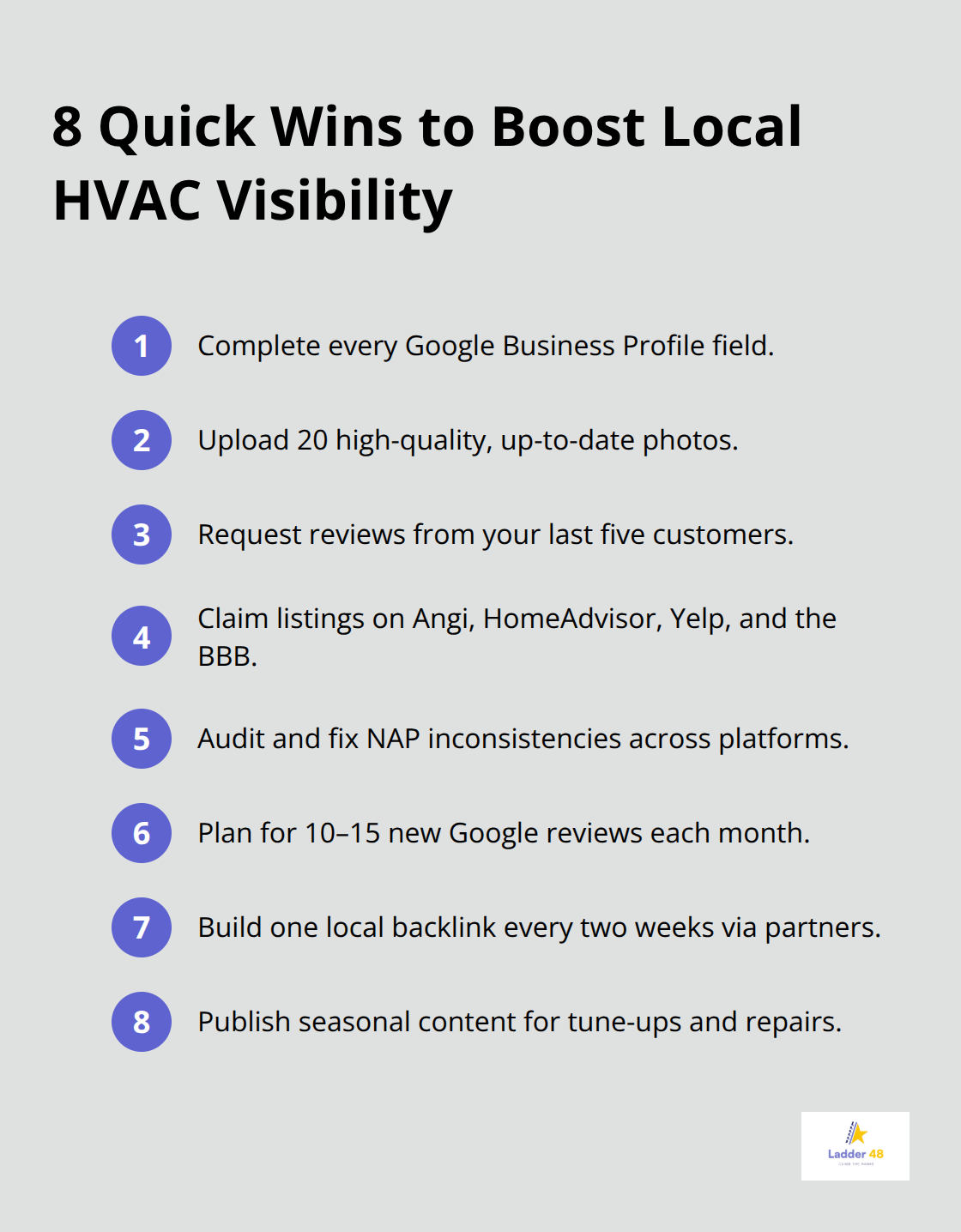
Simultaneously, claim listings on Angi, HomeAdvisor, Yelp, and the BBB if you haven’t already. Audit your NAP consistency across all platforms and fix discrepancies immediately, since inconsistent business information actively damages your local rankings. Plan to generate 10 to 15 reviews monthly, build one local backlink every two weeks through partnerships with complementary contractors, and publish seasonal content around spring tune-ups, summer emergencies, fall safety checks, and winter repairs.
Initial ranking movement appears in three to four months, but dominant page-one positions for competitive terms typically take six to twelve months of consistent effort. The contractors who stick with this timeline pull ahead of competitors who quit after two months. If managing your HVAC SEO local pack strategy internally feels overwhelming, we at Ladder 48 help contractors build and execute these systems consistently while you focus on running your business.