
Most electrical contractors lose leads because potential customers can’t find them online. Google searches for local electrical services happen thousands of times daily, and if you’re not showing up, your competitors are capturing that work.
We at Ladder 48 know that electrical contractor SEO tips aren’t just about rankings-they’re about getting qualified calls from homeowners and businesses in your service area. This guide walks you through the exact strategies that move the needle.
Local SEO Fundamentals for Electrical Contractors
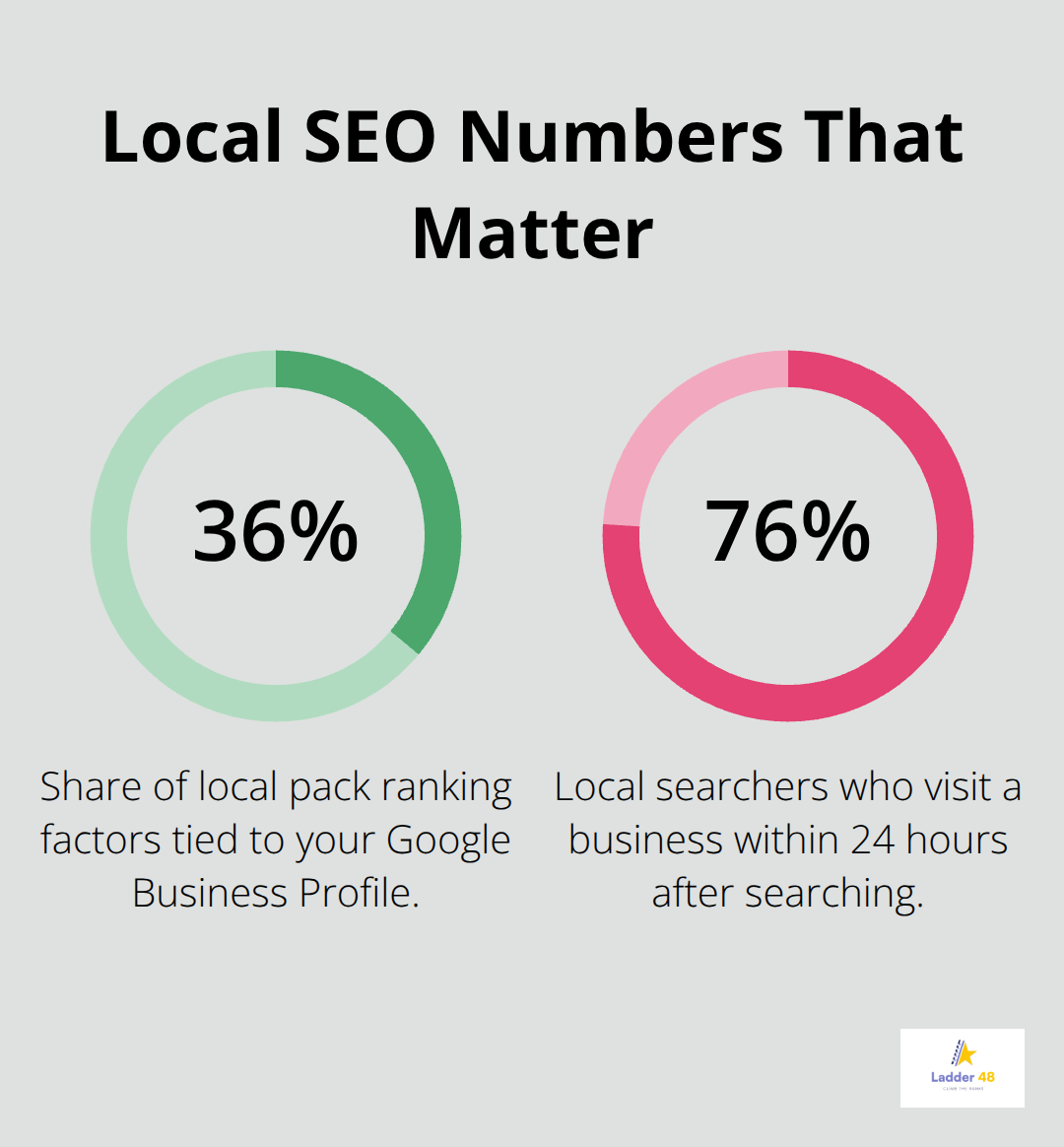
Your Google Business Profile decides 36% of local pack rankings, according to Whitespark Local Search Ranking Factors. This isn’t a secondary task-it’s your front door. Claim your listing immediately if you haven’t already, then fill in every field with precision.
Your business name, address, and phone number must match exactly across your website, invoices, and every directory listing. A single typo or inconsistency tanks your rankings. Upload real photos of your team and completed work, not stock images. Google’s algorithm recognizes authentic project photos as trust signals, and they also increase engagement significantly. Add all your core services explicitly-emergency repairs, panel upgrades, EV charger installation, whatever applies to your business. This specificity helps Google match your profile to high-intent searches. Update your profile weekly with posts, photos, or service announcements. Consistency signals active management to both Google and potential customers.
Build Local Citations That Actually Matter
Citations are directory listings that reinforce your location and credibility. The critical point here is consistency across platforms. Build citations on Yelp, Better Business Bureau, Apple Business Connect, and Nextdoor, but only if you can maintain identical NAP information. One mismatched address across five directories damages your authority more than having zero citations. Focus on industry-specific directories first-trade associations and electrical contractor networks carry more weight than generic business sites. After you’ve locked down your core citations, monitor them quarterly for changes or errors. Tools exist to manage this, but manual audits catch inconsistencies that automated systems miss. High-intent local keywords like “emergency electrician in [city]” or “licensed electrician near [your neighborhood]” should appear naturally in your citation descriptions, not forced or repeated.
Target Keywords That Drive Actual Calls
Around 230,000 people search “electrician near me” monthly on Google, and roughly 76% of people who search for local services visit a business within 24 hours, according to Google data. This means your keyword strategy must target transactional intent, not generic information-seeking. Use Google Autocomplete to find what people actually type. Start typing “electrician in [your city]” and watch what Google suggests-these are real, high-volume queries. Try 8–12 core keywords that combine your service and location. Include these keywords in your title tags, H1 headings, and Google Business Profile service entries. Don’t stuff keywords into unnatural sentences; Google penalizes that and so do readers. Your meta description should include a location keyword and a clear value proposition. If you serve multiple cities, create separate service-area pages for each one. A dedicated page for “electrician in Toronto” ranks far better than a generic footer list of cities. Each page should reference local landmarks, include testimonials from that area, and embed a map to reinforce locality.
Create Service-Area Pages That Convert
Service-area pages separate high-intent searchers from tire-kickers. When someone searches “electrician in [specific neighborhood],” they want a contractor who knows that area. Each service-area page needs unique content-not copy-pasted variants with swapped city names. Add local references, real customer testimonials from that area, and a map embed to prove you serve that location. This approach (combined with consistent citations) signals to Google that you’re a legitimate local operator, not a national franchise pretending to be local. Your next step involves the on-page strategies that make these pages rank and convert visitors into phone calls.
On-Page SEO Strategies That Drive Results
Service-area pages fail when contractors treat them as templates. Most electricians copy a base page, swap the city name, and call it done. Google’s algorithm detects this instantly, and so do potential customers reading generic nonsense. Each page needs genuinely different content that speaks to that specific location.
Research what electrical problems plague that neighborhood. In older neighborhoods, outdated panel capacity and grounding issues dominate. In new developments, EV charger installation and smart home integration matter more. Write H2 subheadings that address these local pain points directly. A page for an older Toronto neighborhood might feature an H2 like “Upgrading 60-Amp Panels in Post-War Homes” instead of the generic “Panel Upgrade Services.”
Include testimonials from actual customers in that area, not anonymized quotes. People trust neighbors more than strangers. Embed a Google Map showing your service territory. This combination of specific content, local testimonials, and visual proof of your service area convinces both Google and homeowners that you genuinely serve that location.
Content That Answers Real Questions Generates Leads
HubSpot data shows companies that publish regular blog content see 55% more website visitors and 67% more leads. But most contractor blogs fail because they answer nobody’s questions. Create content around problems customers actually search for before they call.
Search Google for “why does my breaker trip” or “how much does a panel upgrade cost in [your city]” and you’ll find the exact questions your prospects ask. Write detailed answers to these questions. A post on why breakers trip during winter in cold climates solves a real seasonal problem that drives calls. A post on EV charger installation costs in your specific area beats generic national pricing guides.
Link every blog post back to a relevant service-area page. A post about winter electrical problems links to your main service page. A post about EV charger costs links to your EV charger service page for your primary service area. This internal linking structure guides readers toward conversion while signaling topic relevance to Google. Publish one new post monthly focused on a local electrical problem or seasonal issue. Consistency matters more than volume.
Speed and Mobile Experience Separate Leads from Lost Calls
Think With Google research shows a one-second mobile delay cuts conversions by roughly 20%. Most contractor websites load slowly because they use heavy image sliders, unoptimized photos, and cheap hosting. A homeowner searching for an emergency electrician at night won’t wait three seconds for your site to load.
Test your site speed right now using Google PageSpeed Insights. If your score falls below 70, fix it immediately. Compress all images to WebP format, which reduces file size by 25–35% without visible quality loss.
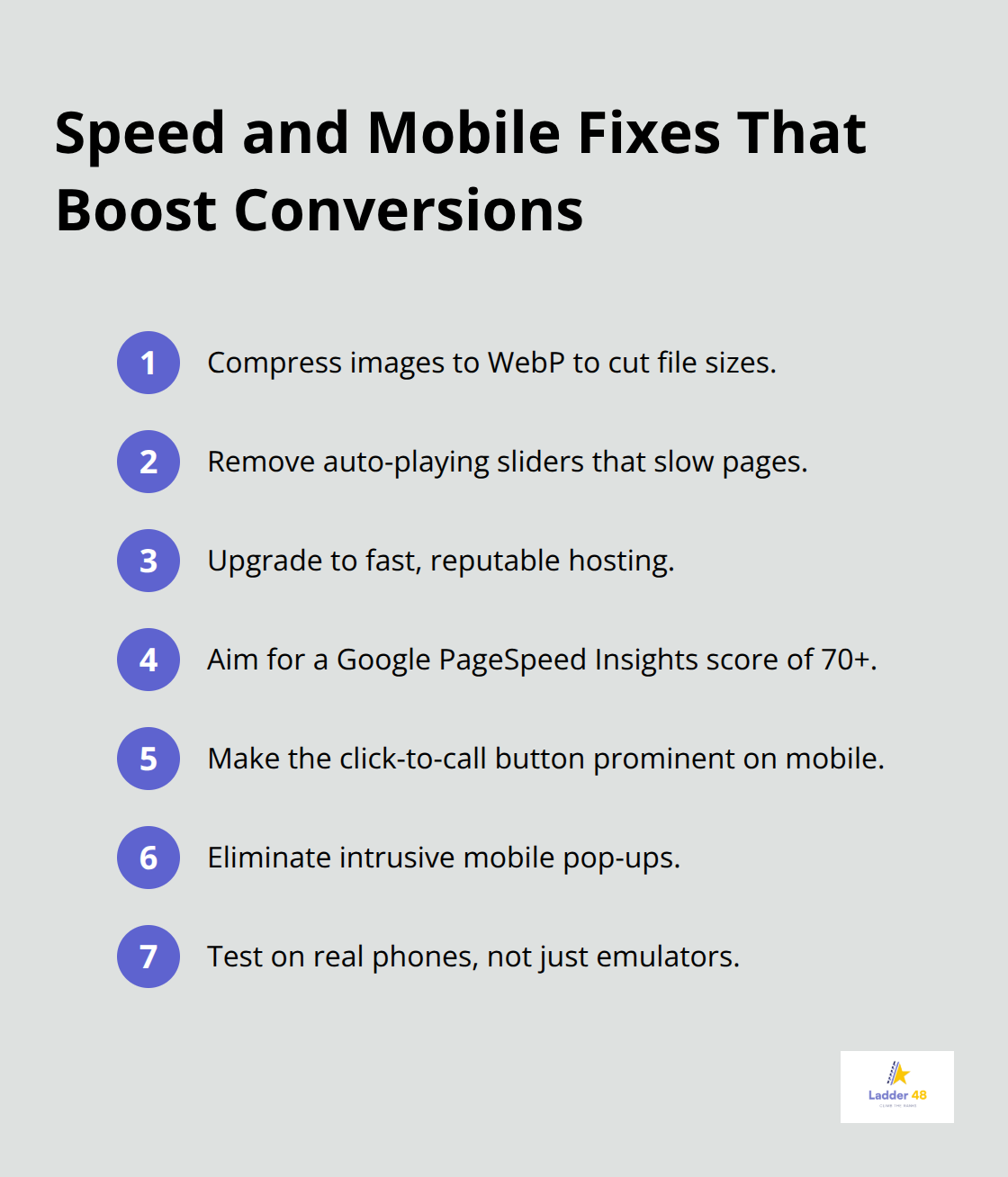
Remove auto-playing video sliders that slow pages down and rarely convert anyway. Switch to fast hosting like SiteGround or Cloudways if you’re currently on budget shared hosting.
Mobile responsiveness matters equally. Ensure your click-to-call button appears prominently on mobile devices. Make buttons large enough to tap without zooming. Remove pop-ups that block content on mobile (most contractor websites show intrusive pop-ups on mobile that frustrate visitors immediately). A clean mobile experience with a visible phone number and one clear call-to-action outperforms a cluttered desktop-first design every time. Test your site on actual mobile devices, not just browser emulators.
Your website now converts faster and serves mobile users better. The next step involves building authority beyond your own site-earning backlinks and leveraging reviews to signal trust to Google and potential customers alike.
Link Building and Authority for Contractors
Backlinks remain one of Google’s top ranking signals, and Backlinko’s 2024 research shows top-ranking pages typically have 3.8 times more backlinks than lower-ranking competitors. For electrical contractors, this doesn’t mean chasing thousands of low-quality links from irrelevant websites. One high-authority local link beats fifty spammy directory listings.
Get Listed in Industry-Specific Directories
Industry directories carry real weight with Google because experts curate them, not automated aggregators. The National Electrical Contractors Association, local electrical licensing boards, and trade-specific platforms all signal authority to search engines. These listings also appear in search results directly, giving potential customers multiple touchpoints to find you.
Start with industry directories where other electricians and contractors already exist. After you’ve locked down these core listings, expand to general business directories, but prioritize quality over quantity. Each listing reinforces your credibility and creates additional opportunities for customers to discover you online.
Earn Backlinks from Local Sources
Focus on earning backlinks from genuinely local sources that matter. Partner with local real estate agents, home renovation companies, and interior designers who serve your area. When a respected local real estate agent links to your website from their recommended contractors page, Google sees that as a vote of confidence from an established local authority.
Sponsor local events or join your chamber of commerce, then ask those organizations to link to you from their website. A single link from your city’s official chamber website carries exponentially more weight than links from content farms or paid directory networks. Link your pages together to build authority across your site-connecting service pages and blog posts strengthens your entire domain’s credibility. Avoid backlink brokers who promise hundreds of links cheaply-Google’s algorithm identifies and penalizes manipulative link schemes instantly, and the penalty can tank your rankings for months.
Build Trust Through Customer Reviews
Customer reviews function as both social proof and ranking signals. BrightLocal’s 2024 research shows 87% of consumers read online reviews before deciding whether to hire a contractor, and 48% won’t even consider businesses with fewer than four stars. More importantly for SEO, Google uses review quantity, recency, and response rate as local ranking factors.
A contractor with 40 recent reviews that receive prompt responses ranks higher than one with 200 old, ignored reviews. Ask for reviews immediately after completing jobs-this is when customers feel most satisfied and are most likely to comply. Send direct Google review links via text message or email rather than asking customers to search for you. Tools like Jobber and Podium automate review requests after job completion, eliminating the manual follow-up work.
Respond to Reviews and Strengthen Local Authority
Respond to every single review within 48 hours, even negative ones. Your response doesn’t need to be lengthy, but it must be genuine and include local keywords naturally. If a customer complains about a breaker panel issue in their Toronto home, your response might mention your expertise with Toronto panel upgrades.
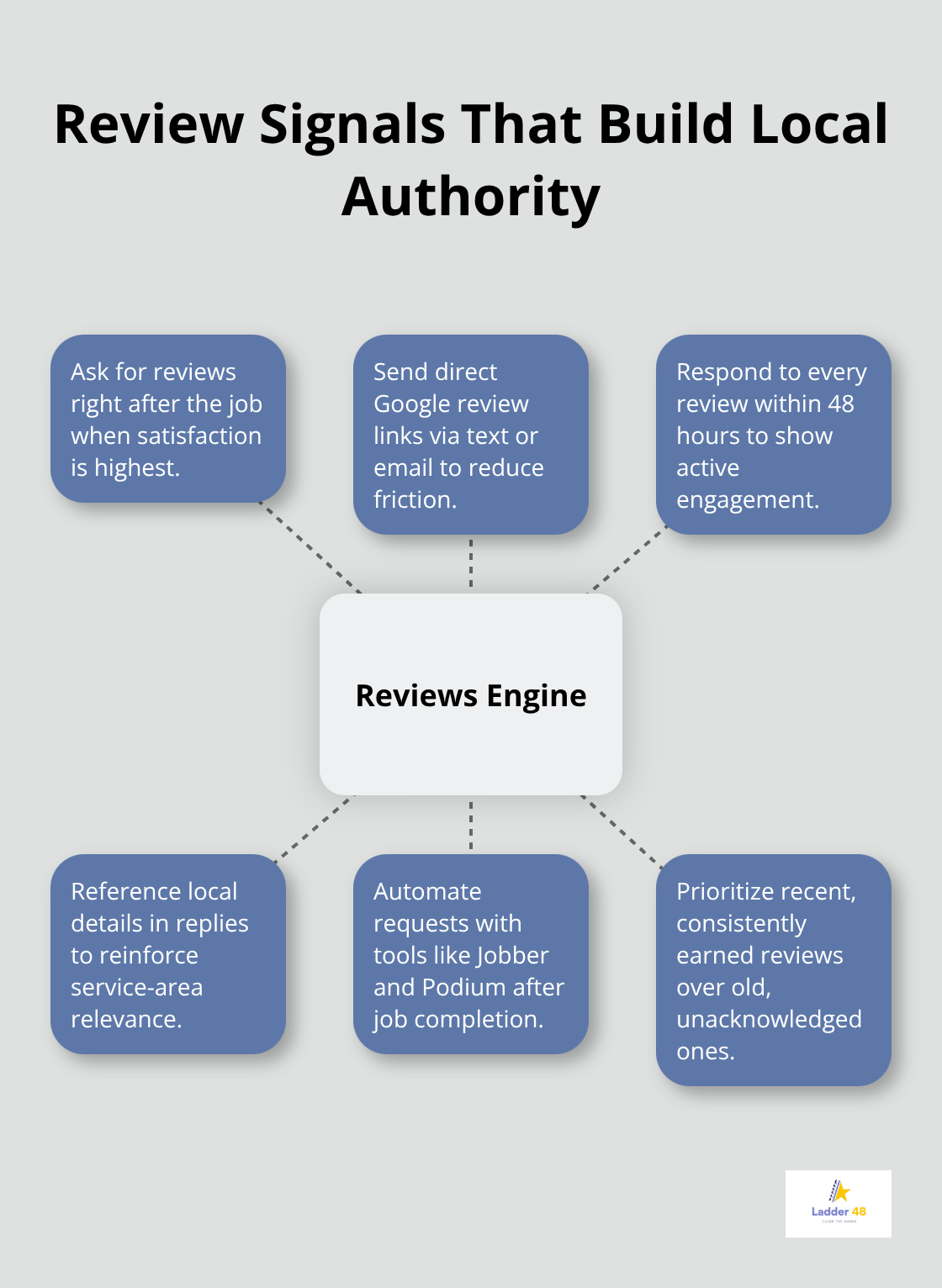
This approach signals to Google that you’re an active, engaged business while demonstrating to potential customers that you care about feedback.
Spiegel Research Center found that reviews boost conversion rates by 270%, meaning the effort to build and maintain a strong review profile directly translates to more phone calls and booked jobs. The combination of high-quality backlinks, industry directory presence, and an active review management strategy establishes your authority in local search results and separates you from contractors who ignore these signals.
Final Thoughts
Electrical contractor SEO tips work because they address what Google rewards and what customers actually search for. You’ve now seen the exact strategies that move rankings and generate qualified calls: optimizing your Google Business Profile, building local citations with precision, targeting high-intent keywords, creating service-area pages with genuine local content, publishing answers to real customer questions, speeding up your website for mobile users, earning backlinks from credible local sources, and actively managing reviews. The contractors winning in local search aren’t doing all of these tactics perfectly-they’re doing the fundamentals consistently.
Start with four immediate actions that will move your rankings and calls within 60 days. Claim and complete your Google Business Profile if you haven’t already, then fix any NAP inconsistencies across your citations. Identify your top 8–12 local keywords and optimize your title tags, H1 headings, and service-area pages around them. Publish one blog post monthly that answers a question your customers actually ask, and test your site speed and mobile experience this week using Google PageSpeed Insights.
SEO compounds over time, meaning consistent effort beats sporadic bursts of activity. We at Ladder 48 help contractors dominate local search by handling these strategies end-to-end, focusing on transparent, results-driven SEO that attracts more local customers and generates qualified leads for your business. Partner with Ladder 48 to build a stronger online presence and stop losing work to competitors.


