Most general contractors lose potential customers because their websites don’t show up in local search results. We at Ladder 48 know that ranking on Google isn’t optional anymore-it’s how homeowners find you.
This general contractor SEO guide walks you through the exact steps to get more visibility, attract qualified leads, and turn website visitors into paying customers. You’ll learn what actually works, not theoretical tactics.
What Keywords Do Homeowners Actually Search For
The Language Homeowners Use
Homeowners search for contractors with very specific language, and most contractors miss it entirely. They don’t search for generic terms like “contractor near me”-they search for solutions to specific problems. A homeowner with water damage searches for “emergency water damage restoration in Denver,” not “restoration contractor.” A homeowner planning a kitchen remodel searches for “kitchen remodeler in Austin” or “kitchen renovation costs.” The difference matters because high-intent keywords convert better than broad ones. According to WordStream data, the U.S. residential construction market recently surpassed $500 billion, meaning demand exists in your area right now. The question is whether homeowners can find you when they search.
Finding Keywords That Convert
Start with Google Keyword Planner or Semrush to identify what homeowners in your service areas actually search for. Focus on keywords that include your service plus your location. “Roof repair in Chicago” converts better than “roofing services.” “Bathroom remodel cost” converts better than “bathroom contractor.” The search volume doesn’t need to be massive-local search volume is naturally smaller, but the intent is higher. A keyword with 100 monthly searches in your city that directly matches your service beats a keyword with 1,000 searches that’s too broad.
Competition as a Market Signal
Competition matters, but not in the way most contractors think. High competition means demand exists in that market. Target keywords where you can realistically rank in the top three results within six months, not keywords dominated by national sites. Most contractors waste budget on keywords too competitive or too generic. Instead, focus on service-plus-location combinations where homeowners show buying intent.
Organizing Keywords by Service and Location
If you offer kitchen remodels, roof repair, and general contracting, create separate keyword lists for each service in each city you serve. This specificity drives the traffic that converts to actual jobs, not just website visitors. Your keyword strategy should reflect the actual services you provide and the actual places you serve. When you align keywords with real demand in your area, your website attracts homeowners ready to hire. This foundation sets up your on-page optimization for success, which is where you’ll turn that targeted traffic into actual leads and booked projects.
How to Structure Your Website for Search Engines and Conversions
Title Tags, Meta Descriptions, and Headers That Work
Your keyword research means nothing if Google can’t understand your website or if homeowners leave before your page loads. Title tags, meta descriptions, and header tags tell Google what your page covers and give homeowners a reason to click your result instead of a competitor’s. A title tag like “Kitchen Remodeling Services in Denver | Expert Contractors” outperforms “Kitchen Remodels.” Your meta description should answer the homeowner’s question in 160 characters. Instead of “We do kitchen remodels,” write “See our Denver kitchen remodels with before-and-after photos. Free estimates. Licensed and insured since 2015.”
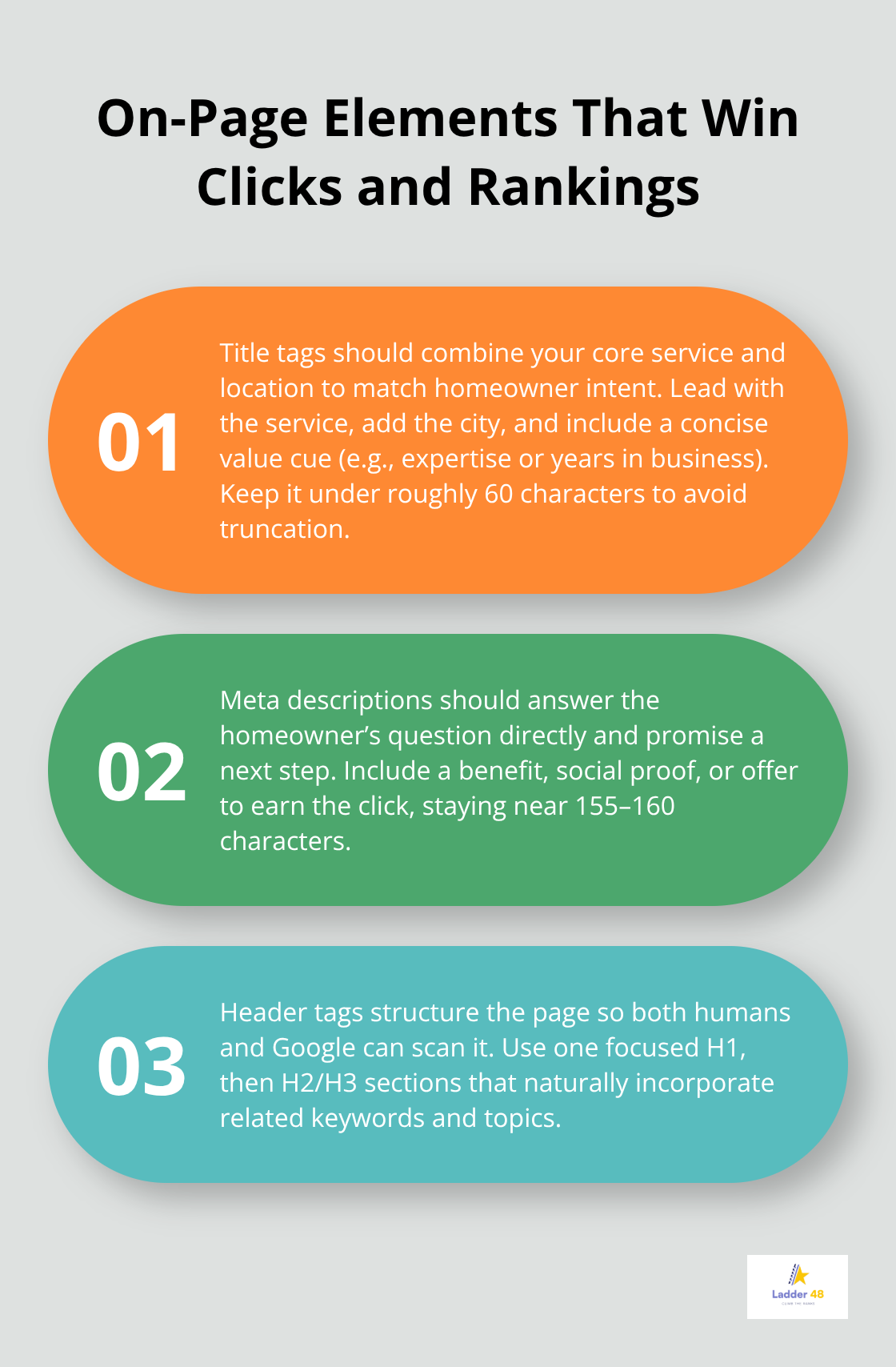
Header tags (H1, H2, H3) organize your content so Google understands the hierarchy. Use one H1 per page that includes your service and location. H2 and H3 tags should break down your content logically, using keywords naturally where they fit.
Speed and Mobile Performance Drive Conversions
Mobile responsiveness and page speed are non-negotiable. Google’s own research shows that pages loading in under three seconds have bounce rates around 32 percent, while pages taking five seconds jump to 90 percent bounce rates. Try to keep page load times under three seconds by compressing images to under 100KB, using WebP format, enabling GZIP compression, and leveraging a content delivery network. Test your site speed with Google PageSpeed Insights and fix the red-flagged issues first.
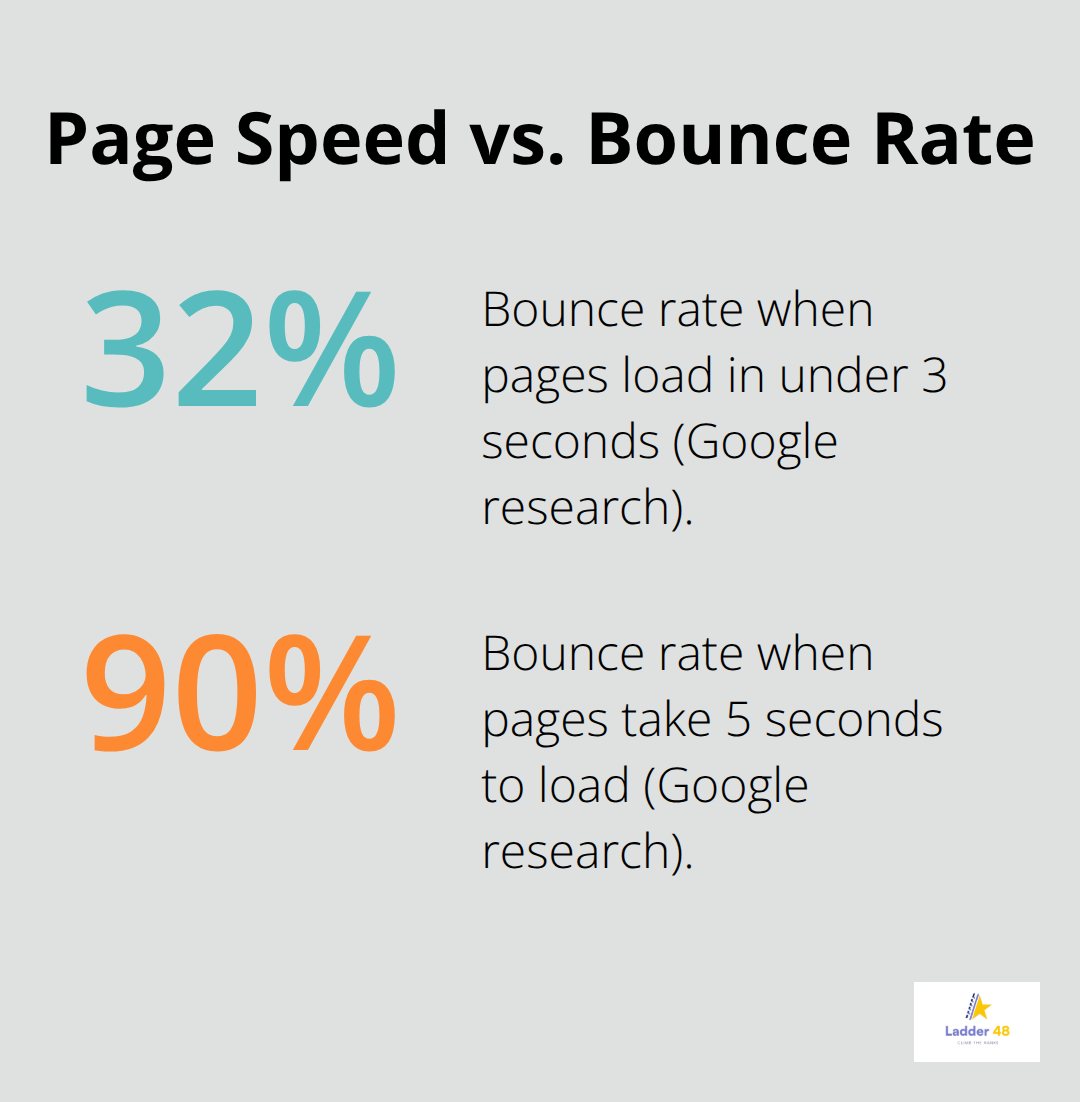
Homeowners on mobile devices expect fast results-a slow site sends them straight to your competitor’s website.
Clean URLs and Internal Linking Structure
Your site structure determines how effectively Google crawls and ranks your pages. Create clean URLs like yoursite.com/kitchen-remodeling-denver instead of yoursite.com/page?id=12345. Use internal linking to connect related content (link your kitchen remodeling service page to your kitchen remodeling case studies and your Denver service area page). This structure signals to Google that your content is organized and authoritative. Most contractors ignore URL structure and internal linking, then wonder why they don’t rank for their target keywords. The contractors who win local search treat their website architecture as seriously as their keyword research, which means your next step is creating content that actually answers what homeowners want to know.
How Google and Homeowners Judge Your Credibility
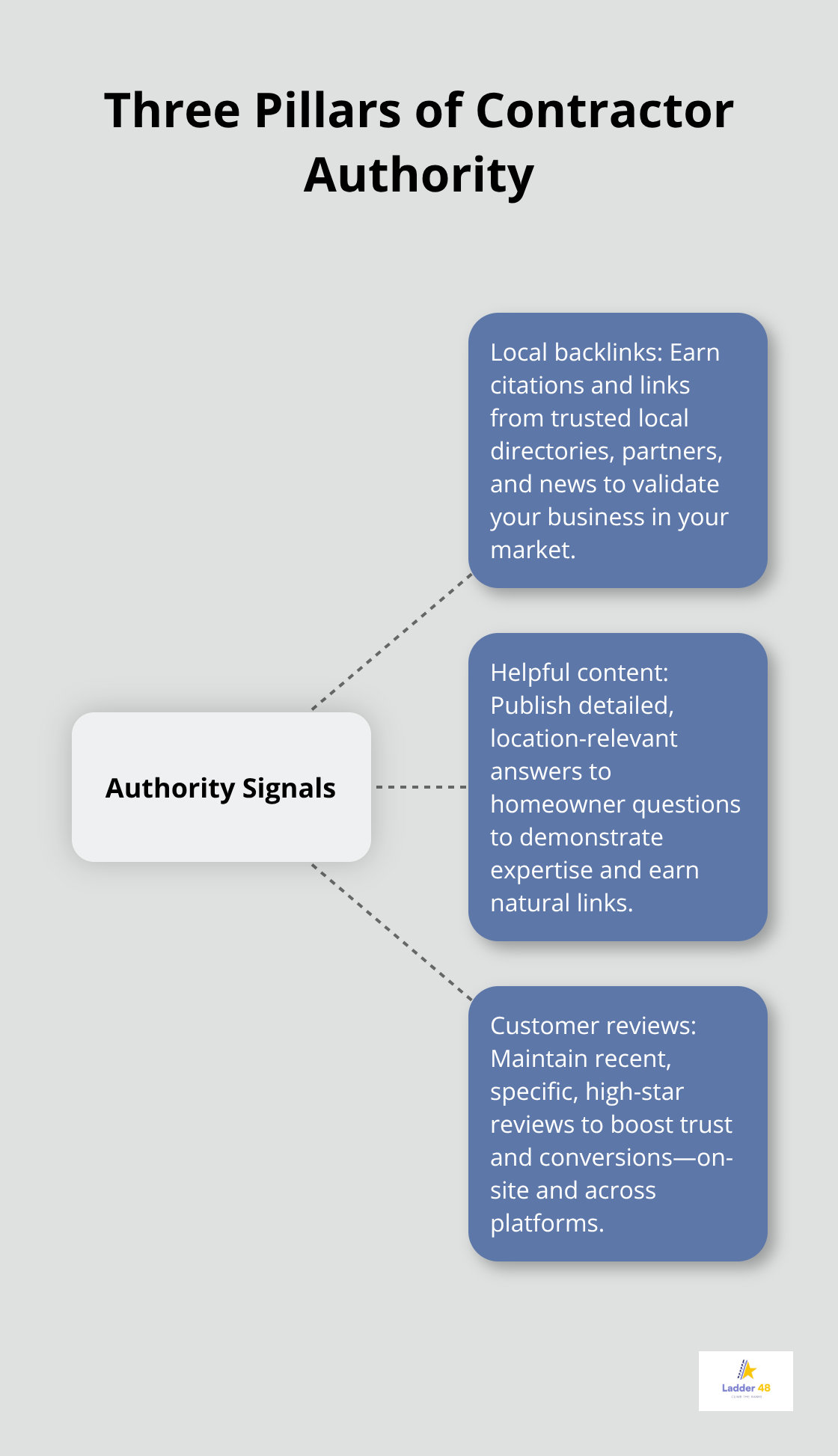
Homeowners trust contractors who appear trustworthy online, and Google ranks contractors who demonstrate authority and credibility higher in search results. The two work together: Google’s algorithm rewards sites with strong trust signals, and homeowners convert faster when they see proof that you’re legitimate. A 2025 industry report found that over 90 percent of homeowners read reviews before hiring a contractor, which means your reputation directly impacts your ability to rank and convert. Contractors with 4.8-star ratings and dozens of verified reviews consistently outrank competitors with higher page authority but weak reputation management. Your authority comes from three sources: backlinks from credible local sources, content that answers the specific questions homeowners ask, and customer reviews that prove you deliver results.
Build Backlinks From Local Sources
Local business directories and industry associations provide the most valuable backlinks for contractors because Google trusts them. List your business on Yelp, Google Business Profile, BBB, Angie’s List, and Apple Maps with identical business information (name, address, phone number). Each citation acts as a vote of confidence, and consistency across directories signals legitimacy to Google’s algorithm. Beyond directories, build backlinks from local sources: ask real estate agents and architects to link to your portfolio, contribute guest posts to local business blogs, and get featured in local news when you complete notable projects. These local backlinks matter more than links from national sites because they signal you’re an active member of your community.
Create Content That Attracts Links Naturally
Content that answers homeowner questions converts better than promotional content because it addresses real concerns at the moment they’re researching. Publish blog posts answering questions homeowners actually search for: “How long does a kitchen remodel take,” “What does foundation repair cost,” “Signs you need roof replacement,” “How to choose a general contractor.” These posts should be 1,000 words or longer and include specific information relevant to your service areas. Include real numbers-if foundation repair in your area costs between $3,000 and $15,000, state that. If a kitchen remodel timeline is typically four to eight weeks, specify that. Homeowners trust contractors who provide concrete information instead of vague answers. Add before-and-after photos from actual projects, customer testimonials that mention specific results, and clear explanations of your process. This content ranks for long-tail keywords that convert at higher rates than broad searches, and it positions you as the expert homeowners want to hire. Create detailed project case studies, before-and-after galleries, and cost guides that homeowners actually want to share-when you publish valuable resources, local contractors and design blogs will link to them, giving you authority without asking.
Leverage Customer Reviews as Your Conversion Engine
Customer reviews are your most powerful conversion tool, yet most contractors treat them as optional. Ask satisfied customers to leave reviews within 48 hours of project completion-this is when satisfaction is highest. Respond to every review, positive and negative, within 24 hours. Positive responses should thank customers and mention specific project details. Negative reviews require professional responses that acknowledge the concern, offer to make it right, and move the conversation offline. A thoughtful response to a negative review often converts skeptical prospects better than ignoring it. Encourage customers to mention specific services and locations in their reviews because these details add keyword signals that help Google understand your expertise. Display your best reviews prominently on your website and service pages-not just a star rating, but actual customer quotes with photos. Google’s algorithm and homeowners both weight recent reviews heavily, so consistency matters more than volume. A contractor with 15 reviews added in the last three months ranks higher than one with 200 reviews from five years ago.
Final Thoughts
SEO for general contractors compounds over time, and the contractors ranking now started months ago with keyword research, proper website structure, and earned trust through reviews and content. You have the roadmap: target keywords homeowners actually search for, structure your website so Google understands it, and build authority through backlinks and customer proof. Most contractors skip one or two steps and wonder why they don’t rank, while the ones executing all three consistently attract qualified leads that convert to actual jobs.
Track your rankings for target keywords using Google Search Console, monitor organic traffic through Google Analytics, and connect that traffic to actual phone calls and form submissions. Set realistic expectations: meaningful results take four to six months, not weeks. Start with one service area and one core service, then expand once you rank consistently for your top three target keywords.
We at Ladder 48 help contractors build SEO systems that generate consistent leads without relying on paid ads. If you want to accelerate your results or need help implementing this general contractor SEO guide, partner with us to build a stronger online presence and achieve sustainable growth for your business.