Roofing contractors lose leads every day because homeowners can’t find them online. At Ladder 48, we’ve seen firsthand how poor site optimization costs businesses thousands in missed jobs.
Local search visibility isn’t optional anymore-it’s where your customers are looking. The strategies in this post will help you rank higher, attract qualified leads, and grow your roofing business in your service areas.
Where Your Roofing Customers Actually Search
The Shift to Online Search
Homeowners no longer call random roofers. When a roof leaks or storm damage strikes, they search online first. Google processes over 8.5 billion searches daily, and a significant portion come from people looking for local services in their area. For roofing contractors, this shift changes everything. If you’re not visible in local search results, you’re invisible to the customers who need you most.
High-Intent Local Searches Convert Fast
Most roofing jobs come from homeowners within 20 miles of your location, and they search with location modifiers like your city name or neighborhood. When someone types “roof repair near me” or “roof replacement in Denver,” they’re ready to hire. These high-intent searches convert faster than any other type of online inquiry. Google’s Local Pack, which shows three businesses at the top of search results for location-based queries, captures the majority of clicks for service-based searches.
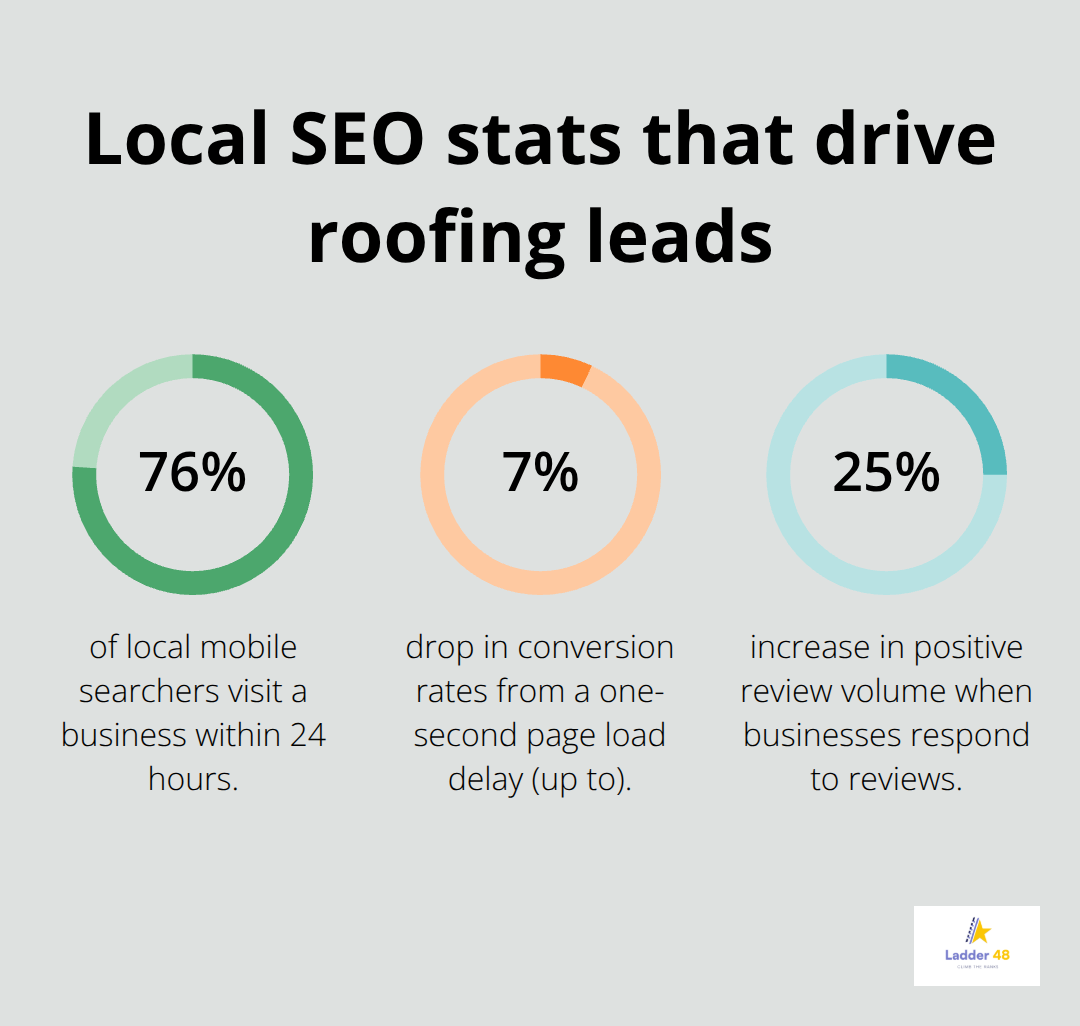
Studies show that 76 percent of people who search for local services on their phones visit a business within 24 hours. That’s not theoretical traffic-those are qualified leads actively looking to book your services.
Competition Intensifies for Local Visibility
The competition for these local search positions intensifies every year. Roofing contractors in your area already optimize their online presence, and falling behind means losing market share to competitors who show up first in search results. Google prioritizes businesses that demonstrate strong local signals: consistent business information across the web, quality customer reviews, active Google Business Profile updates, and location-specific content on your website (without these elements working together, your website becomes invisible noise in a crowded digital marketplace).
What Local Search Visibility Actually Means
Local search visibility isn’t about vanity metrics or ranking for random keywords. It’s about showing up exactly when homeowners need roofing services in your area. You capture their attention before they call a competitor and convert that visibility into booked jobs and revenue. The next section covers the technical foundations that make this local visibility possible.
Build the Technical Foundation That Search Engines Demand
Your roofing website lives in a competitive space where technical performance determines whether search engines rank you first or bury you on page three. Mobile optimization isn’t a nice-to-have feature anymore-it’s the baseline expectation. Over 50 percent of all web traffic comes from mobile devices, and Google’s mobile-first indexing means the search engine crawls and ranks your site based on its mobile version, not the desktop version. If your roofing site doesn’t load fast on a smartphone or displays poorly on smaller screens, you’re automatically penalized in rankings. Test your site on mobile right now using Google’s Mobile-Friendly Test tool. If buttons overlap, text gets cut off, or images stretch awkwardly, you’re losing leads before homeowners even read a single word about your services.
Speed Kills Slow Websites
Page speed directly impacts both rankings and conversions. Google confirmed that a one-second delay in page load time reduces conversion rates by up to 7 percent. For a roofing contractor averaging 50 leads per month, that’s 3-4 lost leads every 30 days just because your site loads slowly. Core Web Vitals, Google’s ranking signals for page experience, measure three specific metrics: how fast your largest content element appears, how quickly the page becomes interactive, and how much the layout shifts while loading. Compress images aggressively-a high-quality roof photo shouldn’t exceed 150KB. Minify CSS and JavaScript files. Use a content delivery network to serve your site faster from servers closer to your customers.
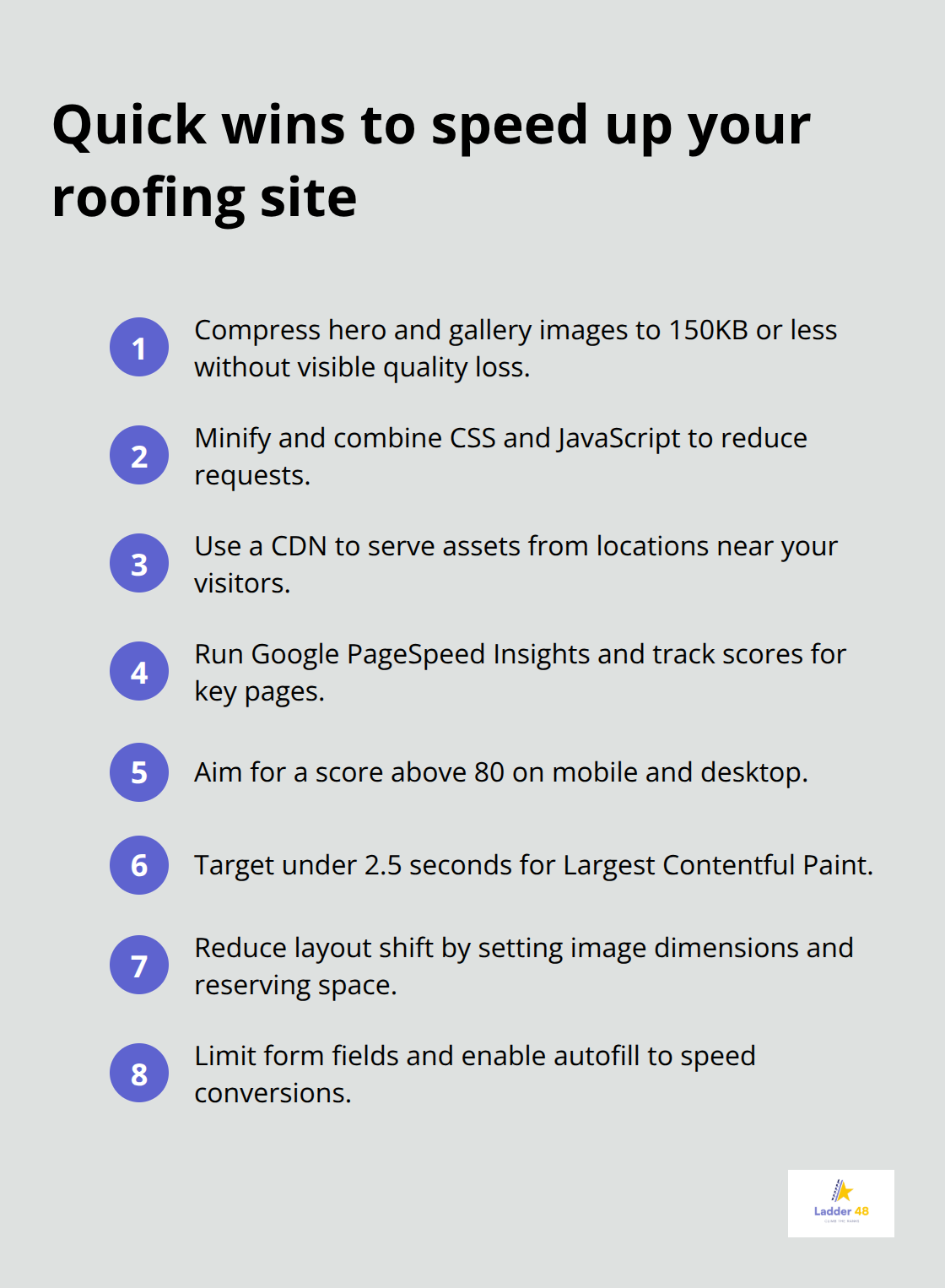
Test your speed using Google PageSpeed Insights and try for a score above 80. Most roofing sites load in 3-5 seconds, but your goal should be under 2.5 seconds. That speed difference converts into real jobs.
Structured Data Tells Search Engines What You Do
Structured data markup-also called schema-is code that tells Google exactly what your business does, where you operate, and what services you offer. For roofing contractors, LocalBusiness schema and Service schema matter significantly. When you implement proper schema, Google understands that you’re a roofing contractor in specific cities, offer roof repair and replacement services, and have real customer reviews. This clarity helps search engines match your site to homeowner searches with precision. Without schema, your content is just text to Google. With it, your site becomes searchable data. Add schema to your service pages, your about page, and your contact information. Tools like Google’s Structured Data Markup Helper make this accessible even if you’re not technical. The payoff is immediate: properly marked-up sites rank faster for local queries and appear more prominently in Google’s knowledge panels and Local Pack results.
Mobile Experience Determines Your Ranking Position
Mobile users expect instant results and seamless navigation. A roofing site that works perfectly on desktop but frustrates mobile visitors will lose leads to competitors who prioritize mobile experience. Responsive design adapts your layout to any screen size, ensuring that homeowners can read your service descriptions, view photos of completed jobs, and click your call-to-action buttons without pinching or zooming. Test every element on actual phones and tablets, not just browser simulators. Buttons should be large enough to tap without mistakes. Forms should require minimal typing. Images should load without pushing text around the screen. These details separate roofing contractors who capture mobile leads from those who watch them slip away to better-optimized competitors.
Local Signals Amplify Your Technical Foundation
Technical excellence alone won’t rank your roofing site if search engines can’t verify that you actually serve your local area. Schema markup works hand-in-hand with your Google Business Profile, customer reviews, and location-specific content to create a complete picture of your business. When all these elements align-fast mobile site, proper schema, consistent business information, and genuine customer feedback-search engines treat your site as a trusted local authority.
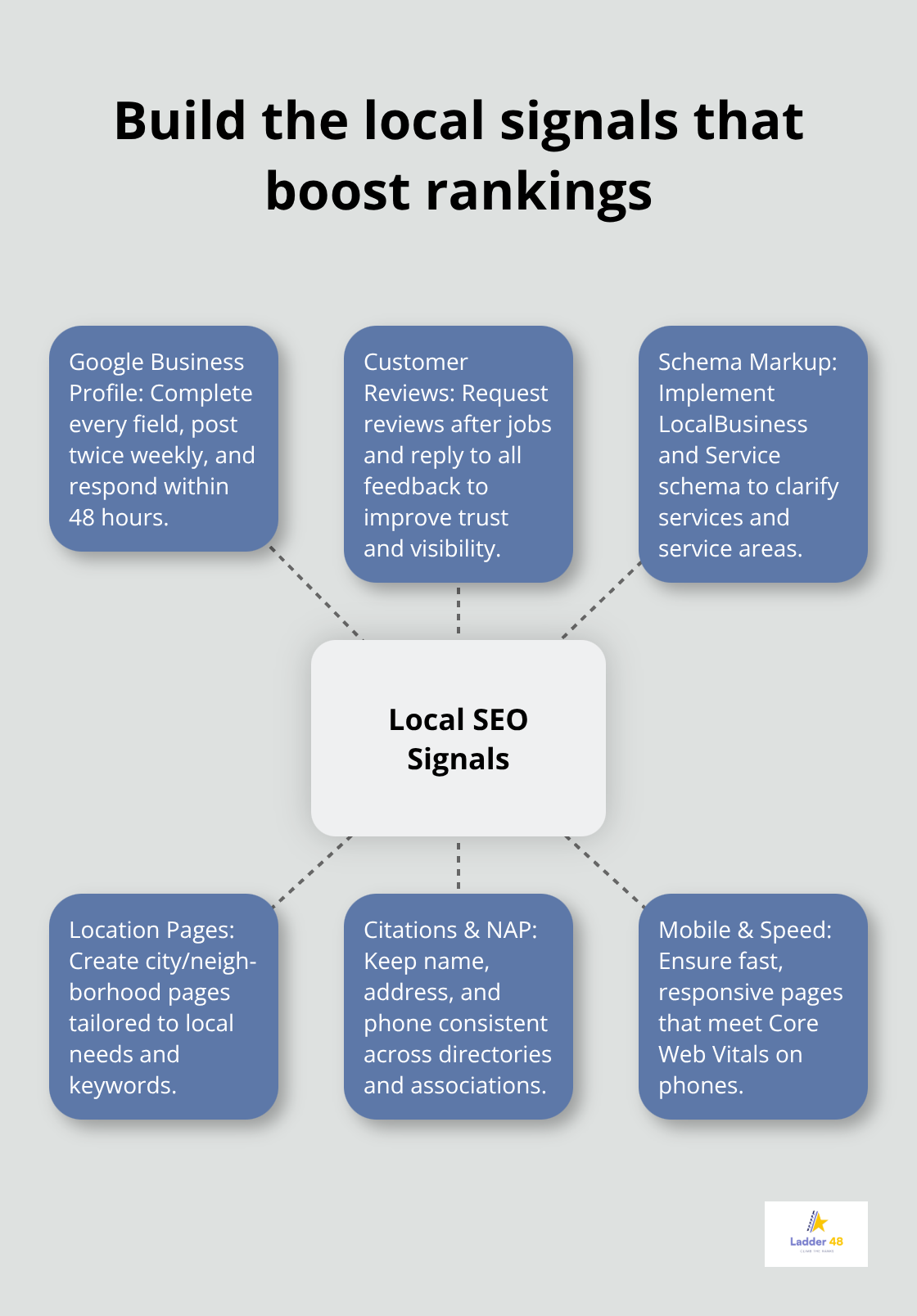
This combination is what pushes roofing contractors to the top of Local Pack results and converts visibility into phone calls and booked jobs. The next section shows you exactly how to optimize your Google Business Profile and build the local SEO signals that transform technical foundations into real revenue.
How to Build Local SEO Signals That Rank Your Roofing Site
Optimize Your Google Business Profile for Local Dominance
Your Google Business Profile controls local roofing visibility, and most contractors waste this opportunity by treating it like a forgotten listing. Complete your profile entirely: add your service areas explicitly by listing every city and neighborhood you cover, not just your main location. Upload high-quality photos of completed roof jobs, your team, and your office. Google prioritizes profiles with recent activity, so post updates at least twice per week about seasonal services, storm preparedness tips, or completed projects.
Service descriptions matter more than most contractors realize. Instead of writing “roof repair,” write “roof repair for storm damage, hail damage, and leaks in specific neighborhoods.” This specificity helps Google match your profile to homeowner searches with precision. Respond to every review within 48 hours, positive or negative. Research from BrightLocal shows that businesses responding to reviews see a 25 percent increase in positive review volume and higher local rankings. Your response time signals to Google that you’re an active, engaged business worth ranking at the top.
Build Citations Across Roofing Directories
Citations across roofing directories and local business platforms act as local authority signals that Google uses to verify your business legitimacy and service areas. NAP consistency (Name, Address, Phone) matters intensely. Your business name, address, and phone number must match exactly across Google Business Profile, your website, Yelp, HomeAdvisor, and industry-specific roofing directories. A single typo or variation in address format weakens your local authority.
Start with high-authority roofing directories like the National Roofing Contractors Association directory and regional roofing associations in your state. Then claim listings on Yelp and Facebook, then move to niche directories relevant to your trade. Each citation acts as a vote of confidence to Google that your business is real and serves your claimed service areas.
Leverage Customer Reviews for Social Proof
Customer reviews on Google Local Pack results drive more conversions than any other single factor. Studies show that 73 percent of consumers trust online reviews as much as personal recommendations. Encourage customers to leave Google reviews immediately after job completion by providing a direct link to your Google review page. Make it frictionless. The faster you collect reviews, the faster your local authority grows and your rankings improve.
Create Location-Specific Landing Pages
Location-specific landing pages target homeowners searching for roofing services in particular neighborhoods or cities. Create dedicated pages for high-demand areas within your service territory, optimized with local keywords and service details specific to that location. A Denver homeowner searching for roof replacement behaves differently than a Boulder homeowner with the same need. Separate landing pages for each area let you address local concerns like hail damage patterns, seasonal weather, or neighborhood-specific building codes. These pages rank faster for local queries and convert higher because they speak directly to each geographic audience’s specific situation.
Final Thoughts
Local SEO isn’t a one-time project-it’s the ongoing foundation that keeps your roofing site visible to homeowners actively searching for your services. The technical work you complete on your website, the local signals you build through Google Business Profile optimization and customer reviews, and the location-specific content you create all work together to push your roofing site to the top of search results. When these elements align, you stop competing on price and start winning on visibility.
Roofing site optimization requires consistent effort across multiple channels. Your mobile experience, page speed, and structured data markup create the technical backbone that search engines demand. Your Google Business Profile, citations, and reviews build the local authority that determines whether homeowners call you or your competitors. Each step you take compounds, and within 90 days you’ll see ranking improvements and increased lead volume from qualified leads who found you first in search results.
Partner with us at Ladder 48 to build the SEO strategies that drive real results for your roofing business. We help contractors climb higher in search rankings and attract more customers in their service areas.