
Most electricians rely on word-of-mouth referrals, but that approach leaves money on the table. Local search is where homeowners and businesses find service providers first, and if you’re not showing up in those results, your competitors are capturing your leads.
At Ladder 48, we’ve seen electricians double their local inquiries by making straightforward SEO changes. These electrician SEO tips focus on what actually works: optimizing your online presence where customers are already searching.
Where Should You Start With Local SEO?
Google Business Profile Optimization Anchors Your Local Presence
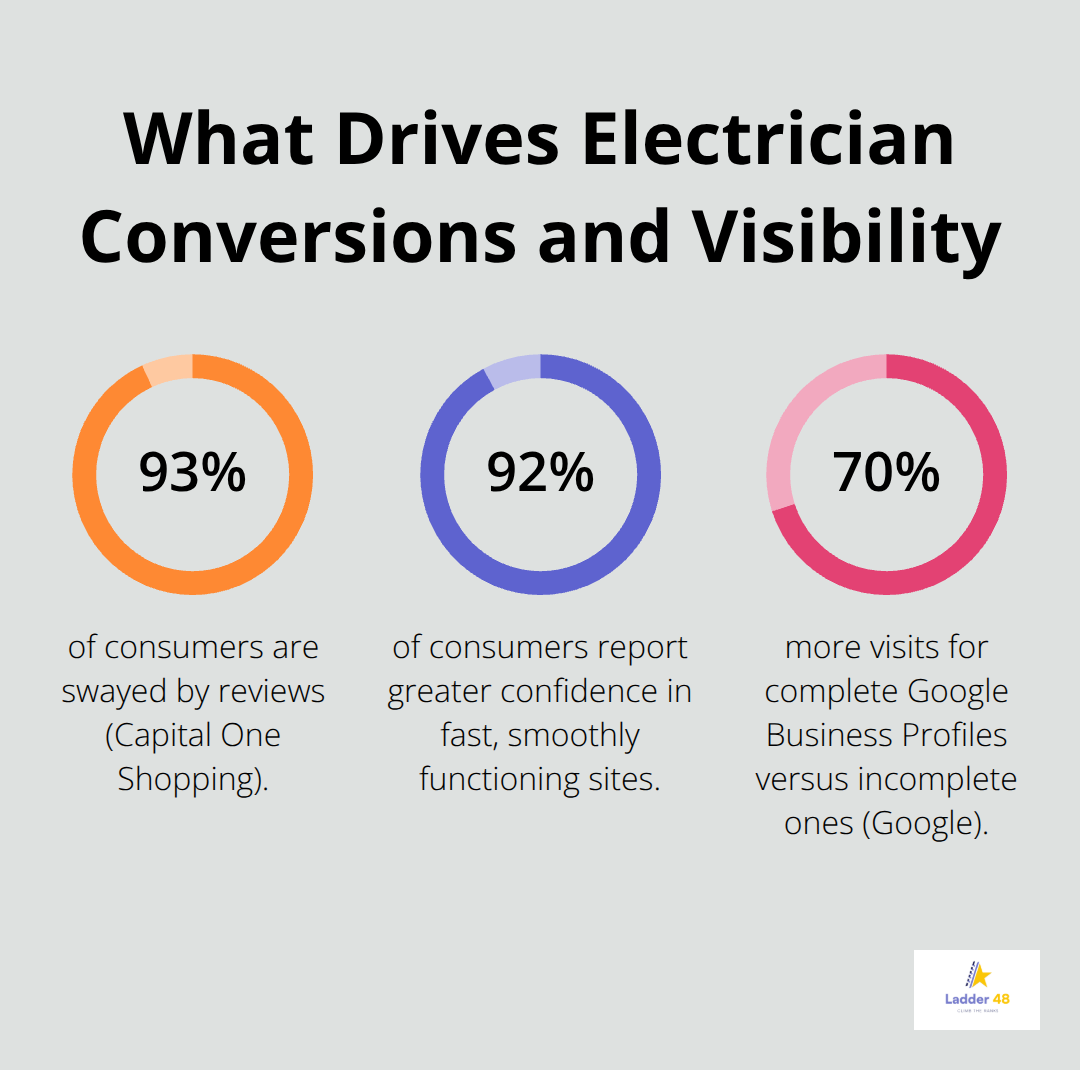
Google Business Profile optimization is non-negotiable. This single step generates 2.7 times more customer finds and 70% more visits compared to businesses without a complete profile, according to Google. Start by claiming your profile if you haven’t already, then verify ownership. Fill in every field accurately: your business name, phone number, and service area. Select Electrician as your primary category. Upload high-quality photos of your completed work, your team, and your business location. Write service-focused descriptions that answer what homeowners actually need-not generic boilerplate. Respond to every review, positive or negative, within 48 hours. This signals to Google that you’re actively managing your business and shows potential customers you care about feedback.
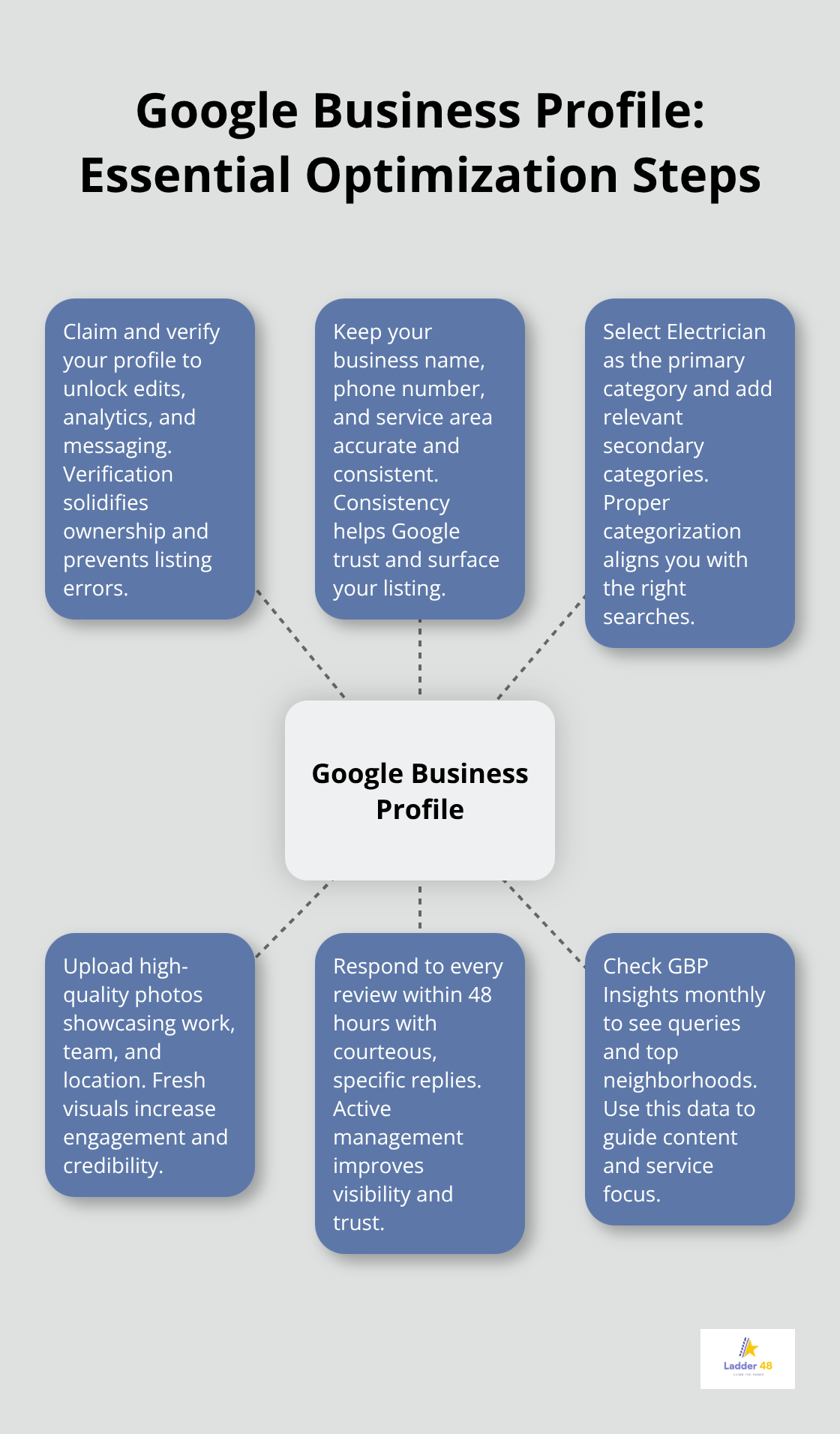
Check your GBP Insights monthly to see which search terms bring people to your profile and which neighborhoods generate the most clicks. This data tells you exactly where to focus your content efforts next.
Citations Build Trust Across Directories
Citations are mentions of your business name, address, and phone number across directories. Inconsistency across these platforms confuses Google’s algorithm and tanks your rankings. Add your business to Yelp, BBB, Angi, Thumbtack, and Checkatrade-these platforms carry heavy weight in local search. Use the same business name and phone number everywhere. If your address changes, update it simultaneously across all platforms within a week. Niche electrician directories matter too; directories specific to your region strengthen local authority. Check your citations quarterly using a link building tool or Semrush Local Business to catch inconsistencies before they damage your visibility.
High-Intent Keywords Convert Faster Than Broad Terms
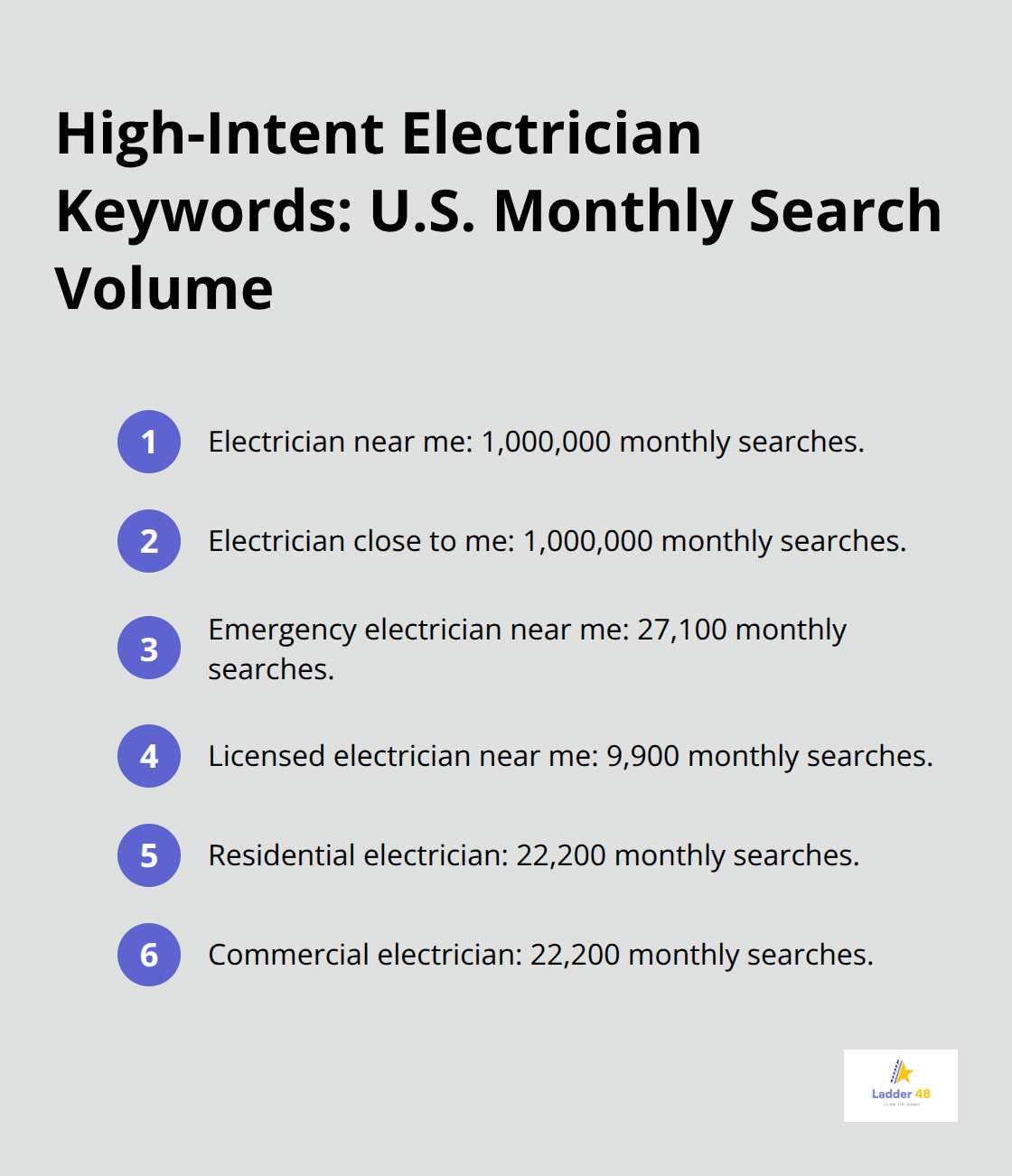
Search data from Google reveals that electricians chase the wrong keywords. Most optimize for broad terms like electrician, but the high-intent searches are location-specific: electrician near me pulls 1 million monthly searches, while electrician close to me generates another 1 million. Emergency electrician near me attracts 27,100 monthly searches from homeowners in crisis mode who convert quickly. Licensed electrician near me brings 9,900 searches from customers actively vetting credentials. Build dedicated service pages for high-volume local terms: create one page targeting residential electrician (22,200 monthly searches), another for commercial electrician (22,200), and separate pages for emergency services. Include the city name and nearby neighborhoods in page titles and headers.
A page titled Emergency Electrician in Phoenix and Scottsdale performs better than one simply called Emergency Services. Use Google autocomplete and AnswerThePublic to find the exact phrases your neighbors type into search engines, then answer those questions directly on your site. These keyword research insights form the foundation for the on-page SEO strategies that transform your website into a lead-generation machine.
On-Page SEO Strategies That Drive Electrician Leads
Service Pages Must Answer Specific Customer Questions
Service pages are where most electricians fail. They write generic descriptions like “We offer electrical wiring services” and wonder why they rank nowhere. Your service pages need to answer specific customer questions with concrete details. Create a dedicated page for each major service: one for residential rewiring, another for panel upgrades, a third for emergency repairs. On each page, include the actual cost range for that service in your area. Data shows that 4,400 monthly searches target electrician cost, and another 6,600 search for cost to rewire a house. Homeowners want pricing transparency before they call.
Include before-and-after photos of completed jobs, estimated project timelines, and the specific tools or safety standards you use. Write your page title to match high-intent searches: instead of Electrical Wiring, use Residential Rewiring in Phoenix and Surrounding Areas. Place your primary keyword in the first 100 words of your page, in your H2 subheadings, and in image alt text. Try 800 to 1,200 words per service page, answering the questions your customers actually ask. Use Google’s People Also Ask feature to find real questions, then structure your content around those answers.
Location-Specific Pages Outrank Generic Service Coverage
A single service page covering your entire service area will lose to competitors who create dedicated landing pages for specific services in specific locations. If you serve Phoenix, Scottsdale, and Tempe, create separate landing pages for each location. Each page targets that city’s name in the title and throughout the content, signaling to Google that you serve that specific area. Proximity-driven searches like electrician nearby and electrician in my area generate 12,100 and 8,100 monthly searches respectively.
Tailor each page to local details: mention neighborhood names, reference local electrical codes, or note typical home ages in that area. This localization approach works because homeowners search for electrician near me, not electrician nationwide. The specificity signals relevance to both search engines and potential customers in those exact neighborhoods.
Mobile Speed and Responsiveness Determine Your Rankings
Mobile speed and responsiveness cannot be an afterthought. Google reports that pages taking more than three seconds to load lose credibility and conversions. Compress your images aggressively, minify your CSS and JavaScript, enable browser caching, and choose hosting with a content delivery network (CDN). Test your site speed using Google PageSpeed Insights and try for scores above 80.
On mobile, your buttons must be large enough to tap without zooming, your text must be legible without pinching, and your layout must stack properly on small screens. About 92 percent of consumers report greater confidence in fast, smoothly functioning sites. Mobile-first indexing means Google crawls and ranks your mobile version first, so a slow or broken mobile experience tanks your rankings before desktop users even see your site. These technical improvements directly feed into the off-page strategies that amplify your authority and pull in qualified leads from across your service area.
Off-Page SEO and Link Building for Electricians
Local Directories Earn Links That Boost Your Authority
Off-page SEO separates electricians who dominate their local market from those who struggle to fill their calendar. Backlinks from credible sources signal to Google that your business is trustworthy and established. Local business directories carry significant weight; when you appear on Yelp, BBB, Angi, and Thumbtack with consistent information, you earn links that boost your domain authority. Most electricians treat these platforms as one-time listings rather than ongoing relationship-building opportunities. Update your profiles quarterly with new project photos and refresh your service descriptions to keep them current. Respond to every review on these platforms within 48 hours, just as you would on Google Business Profile. This activity signals active management and pushes your listings higher in directory search results.
Guest Posts on Complementary Trade Sites Drive Qualified Traffic
Guest posting on complementary trade websites works better than most electricians realize. Plumbers, HVAC contractors, and general contractors regularly publish content and welcome expert contributions. A well-placed guest post on a plumbing blog that links back to your electrical panel upgrade page introduces your business to homeowners already in buying mode for home improvements. Target guest posts on sites with strong local authority-regional contractor associations and community business directories outrank national platforms. Pitch specific article ideas that solve problems rather than generic promotional content. An article titled “Why Your Home Needs a Panel Upgrade Before Adding an EV Charger” attracts your natural audience and earns a contextual link that Google values more than directory citations.
Reviews Function as Social Proof and Trust Signals
About 93 percent of consumers are swayed by reviews (Capital One Shopping), and nearly 90 percent of global consumers consider trust critical (Edelman Trust Barometer). Actively collect reviews by including review request cards with every invoice and sending follow-up emails one week after job completion. Make the process frictionless-send a direct link to your Google review page rather than asking customers to search for your business.
Respond to negative reviews with professionalism and specifics; this shows potential customers you stand behind your work and address concerns seriously.
Showcase Reviews on Your Website and Third-Party Platforms
Showcase your best reviews on your website’s dedicated testimonials page, which serves as both conversion-boosting social proof and fresh content that Google crawls. Reviews from verified customers on established platforms like Checkatrade and Indeed carry more weight than unverified reviews. Encourage satisfied customers to post on these platforms specifically, as they reach homeowners searching for credible electricians. Track your review volume monthly and try to collect at least one new review per week; electricians with 50+ recent reviews rank significantly higher than those with 10 or fewer.
Final Thoughts
Most electricians see measurable results within 60 to 90 days of implementing these electrician SEO tips consistently. Your Google Business Profile optimization and citation cleanup drive visibility improvements in as little as 30 days, while service page rankings typically stabilize within 90 to 120 days as Google crawls and evaluates your new content. Review collection and response activity show results immediately by improving your conversion rate on existing traffic.
Start with your Google Business Profile this week, then move to citation cleanup across Yelp, BBB, and Angi. Create or refresh your top three service pages next, targeting the high-intent keywords your neighbors actually search, and set up a system to collect one review per week from satisfied customers. These foundational moves require minimal investment and deliver measurable lead increases within weeks.
If managing SEO in-house feels overwhelming, we at Ladder 48 specialize in helping contractors like you build stronger online presence and attract qualified local leads through transparent, results-driven strategies. Contact Ladder 48 to accelerate your results and focus on what you do best: running your electrical business.


