
Roofers who rank on Google’s first page get more calls and higher-quality leads. Most roofers skip basic SEO, which means your competitors aren’t optimizing either-giving you a real advantage.
We at Ladder 48 built this roofer SEO checklist to help you capture local demand in your service area. Follow these steps and you’ll have a solid foundation for ranking higher.
Local Keyword Research for Roofers
Roofers who rank on Google’s first page get more calls and higher-quality leads. Most roofers skip basic SEO, which means your competitors aren’t optimizing either-giving you a real advantage.
Target Location-Based Keywords with High Intent
Roof repair dominates search volume with 90,500 monthly searches, followed by the broader term roofing at 60,500 searches, according to Roofing Webmasters’ research of the 50 most-searched roofing keywords. Most roofers waste time chasing generic terms instead of the high-intent, location-based keywords that actually convert. You need to start with roof repair, roof replacement at 49,500 searches, and roofing contractors at 40,500 searches-these terms signal immediate need and buying intent.
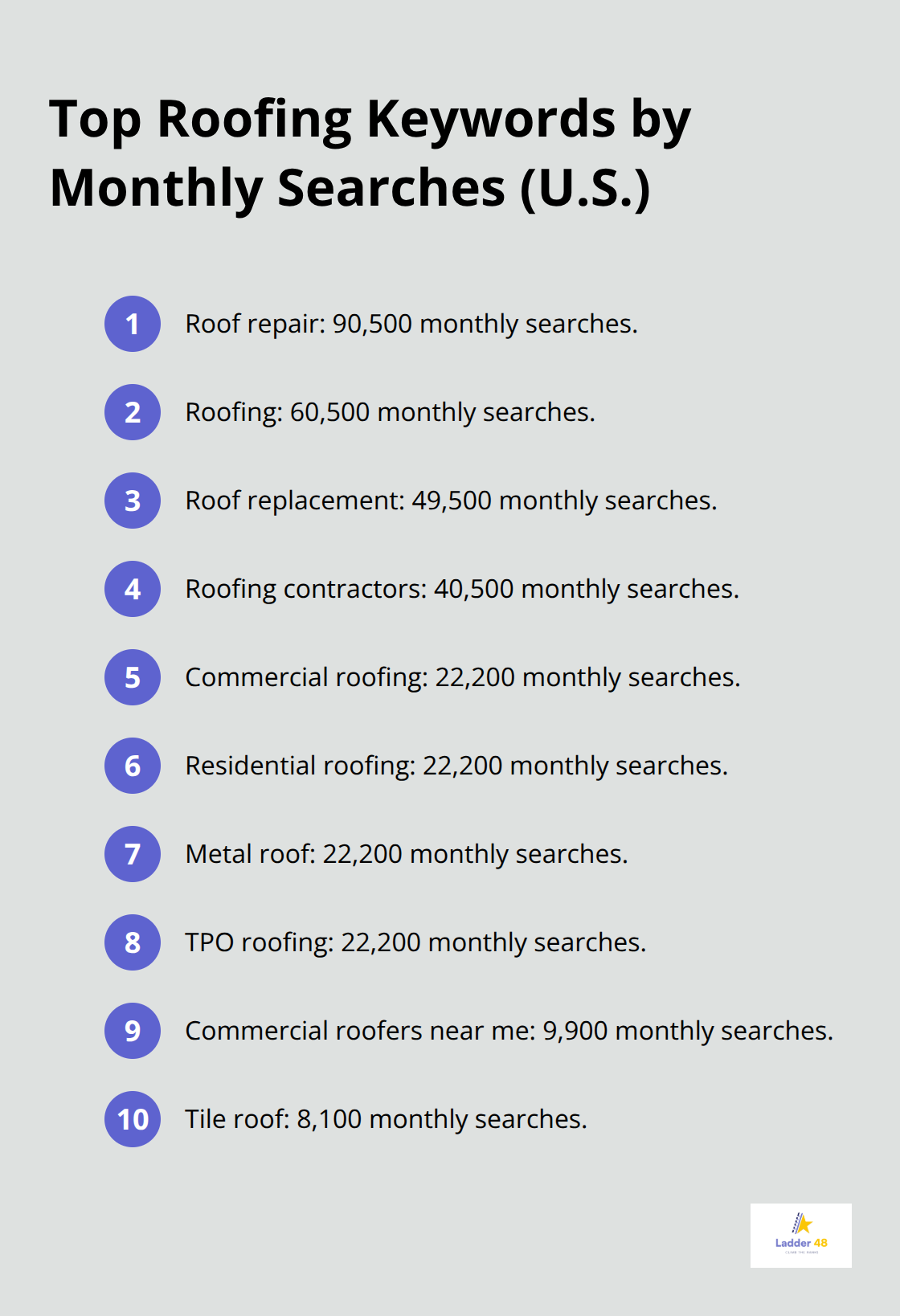
Then layer in your specific location: roof repair in Denver, emergency roof repair in Austin, or metal roof replacement in Phoenix. Local intent keywords like commercial roofers near me pull 9,900 searches monthly and capture homeowners ready to hire. A search for roof repair near me converts at a far higher rate than someone searching for roofing materials or DIY roof fixes. The mistake most roofers make is treating all keywords equally; they’re not.
Include Service-Specific Terms in Your Strategy
Commercial roofing and residential roofing each pull 22,200 searches, but they require separate pages and strategies because commercial clients and residential homeowners have completely different timelines and decision-making processes. Create individual pages for tile roof repair, metal roof replacement, TPO roofing, and EPDM roofing rather than cramming everything into one generic roofing services page. Roofing Webmasters data shows tile roof searches hit 8,100 monthly, metal roof at 22,200, and TPO roofing at 22,200-these aren’t small segments.
An inspection page targeting roof inspection at 22,200 searches becomes a lead magnet when positioned as free, with clear CTAs for booking. Emergency roofing pages should target storm damage queries and leak-related terms because homeowners search for these during crisis moments when they’re most likely to call immediately. A roofer in hail country should publish content around roof damage and hail damage before storm season peaks, not after.
Analyze Competitor Keywords in Your Service Area
Pull the top 10 ranking competitors in your area and check which keywords they target on their service pages, homepage, and blog. Use SEMrush or Ahrefs to see their keyword gaps-often you’ll find that local competitors rank for broad terms but ignore niche service keywords. If three competitors rank for roof repair but none rank for emergency roof repair or storm damage repair, that’s your opening.
Check Google Maps and your local directories to see which competitors appear for which location-based searches; you’ll spot underserved neighborhoods or service areas. The reality is most roofers optimize poorly, so even basic competitor research reveals easy wins. Build your keyword list by combining high-volume terms like roof repair with your specific locations and service types, then prioritize pages around terms where search volume exceeds 1,900 monthly and local competition is moderate, not saturated. With your keyword research foundation in place, the next step is making sure your website structure and technical setup actually support these keywords.
On-Page and Technical SEO Fundamentals
Optimize Title Tags and Meta Descriptions for Local Searches
Your keywords mean nothing if your website structure doesn’t support them. Title tags and meta descriptions are the first signals Google sees, and they directly impact click-through rates from search results. A title tag like “Roof Repair Services” should instead read “Roof Repair in Denver CO | Emergency & Storm Damage.” The specificity matters because Google crawlers and homeowners both need to see location and service type immediately.
Meta descriptions should answer the homeowner’s question in 155 characters or less: “Fast roof repair in Denver. Same-day emergency service for leaks, storm damage, and shingles. Licensed & insured. Call now or book free inspection.” This approach converts better than generic descriptions because it speaks directly to urgency and local trust. Test your current title tags and meta descriptions against your target keywords-if your location isn’t in the title tag, you’re losing local search visibility to competitors who included it.
Structure Your Website for Mobile Users
Mobile traffic now drives 63% of roofing searches according to industry data, yet most roofer websites fail basic mobile usability tests. Google’s mobile-first indexing means your site must load in under 3 seconds on 4G networks, or homeowners leave and call your competitor instead. Check your page speed with Google PageSpeed Insights and fix any Critical or High priority issues immediately-slow pages rank lower and convert fewer leads.
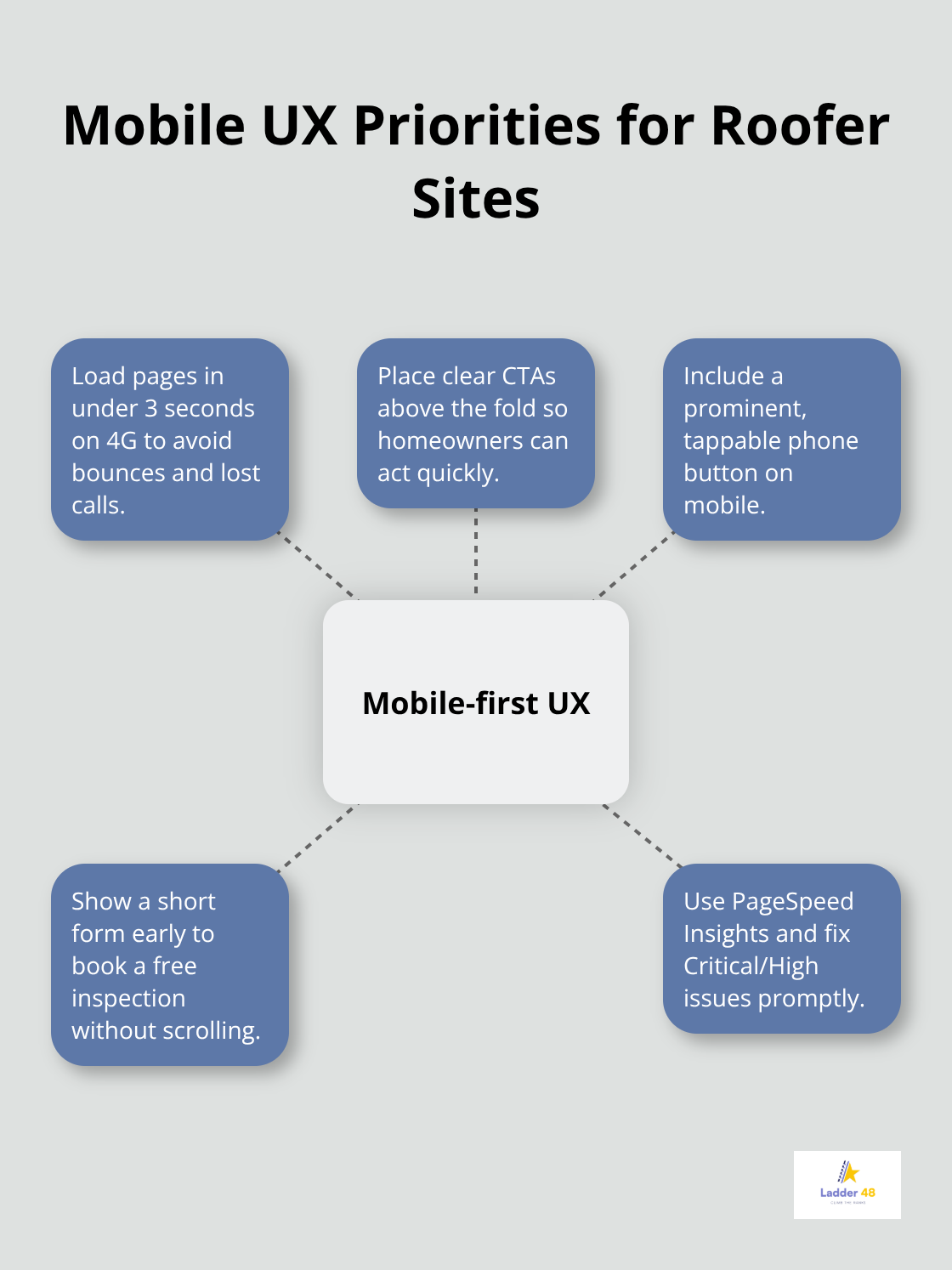
Your service pages need clear CTAs above the fold on mobile: a prominent phone number button and a form to book a free inspection should appear before any content. Homeowners searching for emergency roof repair on their phone won’t scroll through paragraphs of text to find your contact information.
Fix Technical Issues That Impact Rankings
Technical issues like broken internal links, missing alt text on images, and duplicate content silently kill rankings. Audit your site with Screaming Frog or SEMrush to identify crawl errors, then fix redirect chains, remove orphaned pages, and verify your XML sitemap includes all service and location pages. Schema markup for LocalBusiness and Service types tells Google exactly what you offer and where, improving your chances of appearing in Google Maps and AI-generated answers (without proper schema, your business data remains invisible to AI tools that now influence roofing searches).
These on-page and technical improvements create the foundation for local authority, which is where your next competitive advantage emerges.
Build Local Authority That Converts
Optimize Your Google Business Profile for Maximum Visibility
Your Google Business Profile stands as the single most important asset for roofing SEO in 2026, yet most roofers treat it like an afterthought. Claim your profile immediately if you haven’t already, then set your primary category to Roofing Contractor, not Roofer or Roofing Service. Google’s algorithm weights primary category heavily, so this single choice impacts visibility across Google Maps and local search results.
Define your service areas explicitly by city and zip code rather than leaving them blank or vague. Upload 10 to 15 photos monthly showing completed jobs, team members, and equipment, because Google prioritizes profiles with recent visual content. Respond to every review-positive or negative-within 24 hours because response velocity signals active management to both Google and potential customers.
Leverage Reviews as Your Primary Conversion Tool
According to Roofing by the Numbers 2025, 92% of consumers read online reviews before calling a roofer, and 74% say positive reviews increase local trust. This means review management isn’t optional; it’s your primary conversion lever. Request reviews from every completed job using email follow-ups, which drive 25.5% repeat business compared to calls at 13.6% and texts at 4.1%.

Automate these requests through your CRM or job management software so reviews happen consistently, not sporadically. The volume, velocity, and language of reviews all influence how AI tools rank your business, making this a critical ranking factor alongside traditional SEO signals.
Build Citations Across Local Directories
Local directory listings and citations amplify your authority across the web. Claim your business on Apple Maps, Bing Places, Angie’s List, HomeAdvisor, and industry-specific directories like Roofing Contractor directories, ensuring your name, address, and phone number match exactly across every platform. Inconsistent business data confuses Google’s algorithm and tanks rankings, so audit your citations quarterly using tools like Whitespark or SEMrush.
This consistency signals to Google that your business information is reliable and trustworthy, which directly impacts local search visibility.
Earn Backlinks from Local Sources
Backlinks from local sources carry significantly more weight than national links for roofing SEO. Pitch local news outlets, community blogs, and home improvement publications with newsworthy angles like storm damage prevention tips or seasonal roof maintenance guides. A single backlink from your city’s newspaper or a local real estate blog signals genuine local authority that generic directory links cannot match.
Build relationships with local roofing suppliers, material distributors, and complementary contractors like gutter companies or HVAC specialists-many will link to your site if you reference them first or offer reciprocal linking. This local link-building approach takes more effort than directory submissions, but it produces measurable ranking improvements because Google trusts local endorsements over paid citations.
Final Thoughts
You now have a complete roofer SEO checklist to capture local demand and rank higher on Google. The steps matter in order: keyword research informs your page structure, technical fixes enable those pages to rank, and local authority signals push you past competitors who haven’t done the work. Start this week by auditing your current title tags and meta descriptions against your target keywords, then claim or update your Google Business Profile with accurate service areas and recent photos.
Request reviews from your last five completed jobs using email follow-ups, which generate repeat business at 25.5% compared to other channels. Track your progress monthly using Google Analytics and Google Search Console to monitor which keywords drive traffic, which pages convert leads, and where your rankings improved. Adjust your content strategy based on what actually works in your market, not what you think should work.
Building sustainable SEO requires consistency over months, not weeks. We at Ladder 48 help roofers accelerate this process by handling keyword research, technical optimization, and local authority building while you focus on completing jobs. Get a transparent, results-driven roofer SEO strategy tailored to your service areas and competition level.


