
Concrete finishing contractors SEO isn’t optional anymore. Most homeowners and commercial clients search online before calling, and if you’re not ranking locally, your competitors are getting those jobs.
We at Ladder 48 built this guide to show you exactly how to dominate local search results and turn visibility into booked projects. The strategies here work because they’re based on what actually moves the needle for contractor businesses.
How to Own Local Search Results as a Concrete Contractor
Optimize Your Google Business Profile for Maximum Local Visibility
Your Google Business Profile is the front door to your local visibility. Most concrete finishing contractors treat it as a checkbox-claim it, add a photo, move on. That’s a mistake. Google processes about 5 trillion searches yearly, and a significant portion of those are local intent searches from homeowners looking for concrete work right now. The term “concrete contractors near me” alone generates 486,000 yearly searches with commercial intent ranging from $3–$10 per click. If your profile is incomplete or inaccurate, you’re handing those leads to competitors.
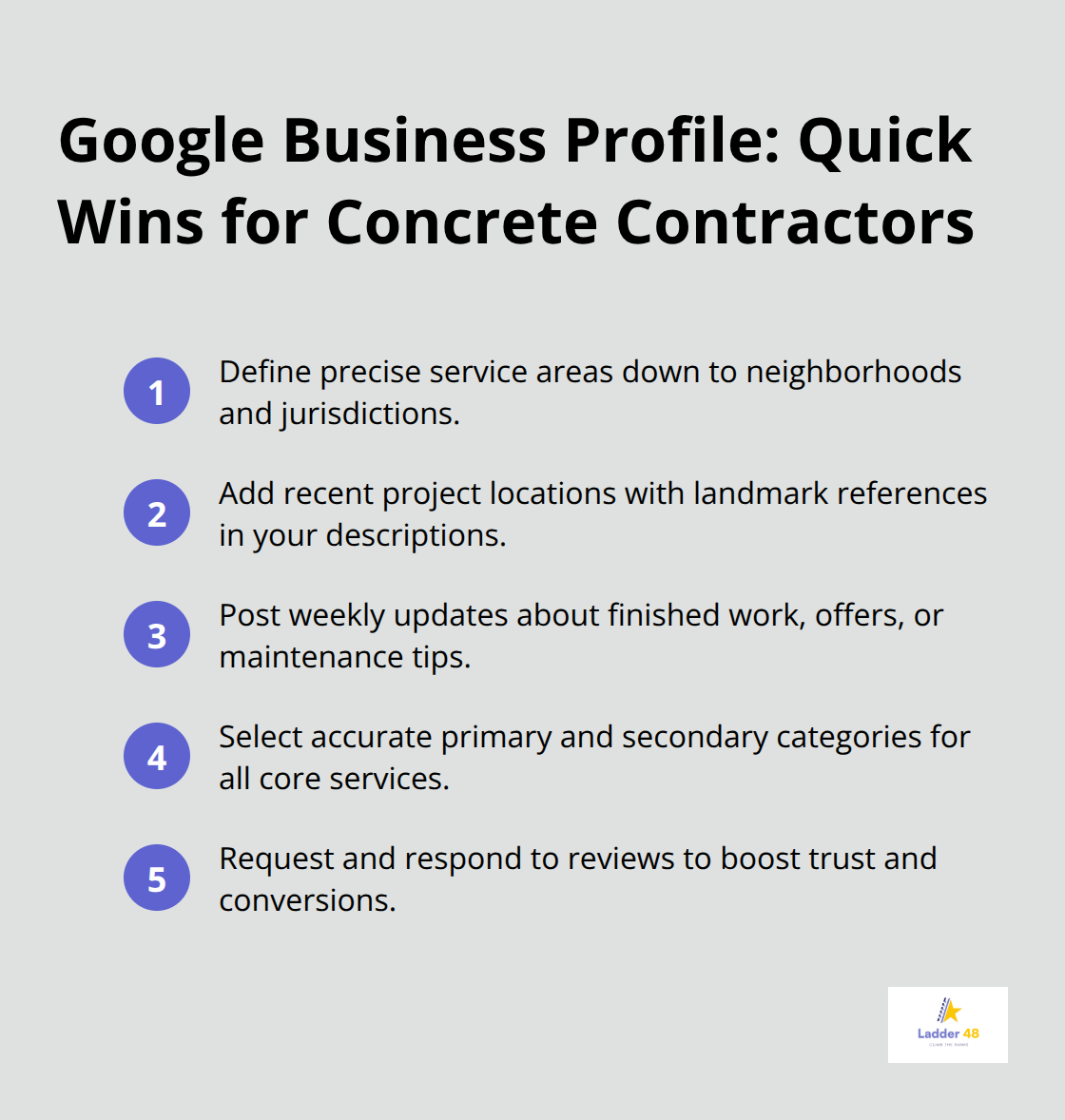
Start with service area information. Don’t just list your city-map out every neighborhood and jurisdiction you actually serve. Use the service radius feature in your profile settings, but go deeper. Add specific areas where you’ve completed recent work. Include local landmarks and neighborhood names in your service descriptions.
When someone searches “concrete driveway near me,” which gets about 28,800 yearly searches, Google needs to understand you operate in that exact location.
Update your profile weekly with posts about finished projects, seasonal offers, or maintenance tips. This activity signals to Google that you’re an active, current business. Consistency matters more than perfection-weekly posts outperform sporadic bursts of activity.
Build Citations Across Directories to Establish Legitimacy
Citations across industry directories tell Google you’re legitimate. Inconsistent business information across platforms-different phone numbers, addresses, or business names-actively hurts your rankings. Tools like BrightLocal help you monitor and fix these discrepancies across Yelp, Angi, Houzz, and local Chamber of Commerce listings. The concrete repair keyword cluster totals around 118,800 yearly searches, and platforms like Angi directly influence who gets those leads.
Respond to every review, positive or negative. Businesses that respond to reviews see higher conversion rates. This practice demonstrates that you value client feedback and remain engaged with your reputation.
Create Location-Specific Content That Ranks and Converts
Location-specific content is where most contractors fail. Don’t write one generic service page for “concrete driveways”-create separate pages for each area you serve. A page titled “Concrete Driveways in [Neighborhood Name]” with local landmarks, neighborhood-specific challenges, and testimonials from that area ranks higher than broad content. The keyword “concrete driveway cost” generates 52,800 yearly searches with strong buying intent. Create a dedicated cost guide page for each major service area with local pricing context.
Include FAQs answering “How thick should a concrete driveway be” (7,080 yearly searches) and “How much is a concrete driveway” (12,000 yearly searches) with location-specific answers. Hyperlocal content addressing climate conditions, local building codes, and neighborhood specifics captures featured snippets and drives qualified leads that are already primed to hire. This approach transforms your website from a general contractor listing into a trusted local resource that prospects actually want to visit.
Website Performance That Actually Converts Local Leads
Speed Matters More Than You Think
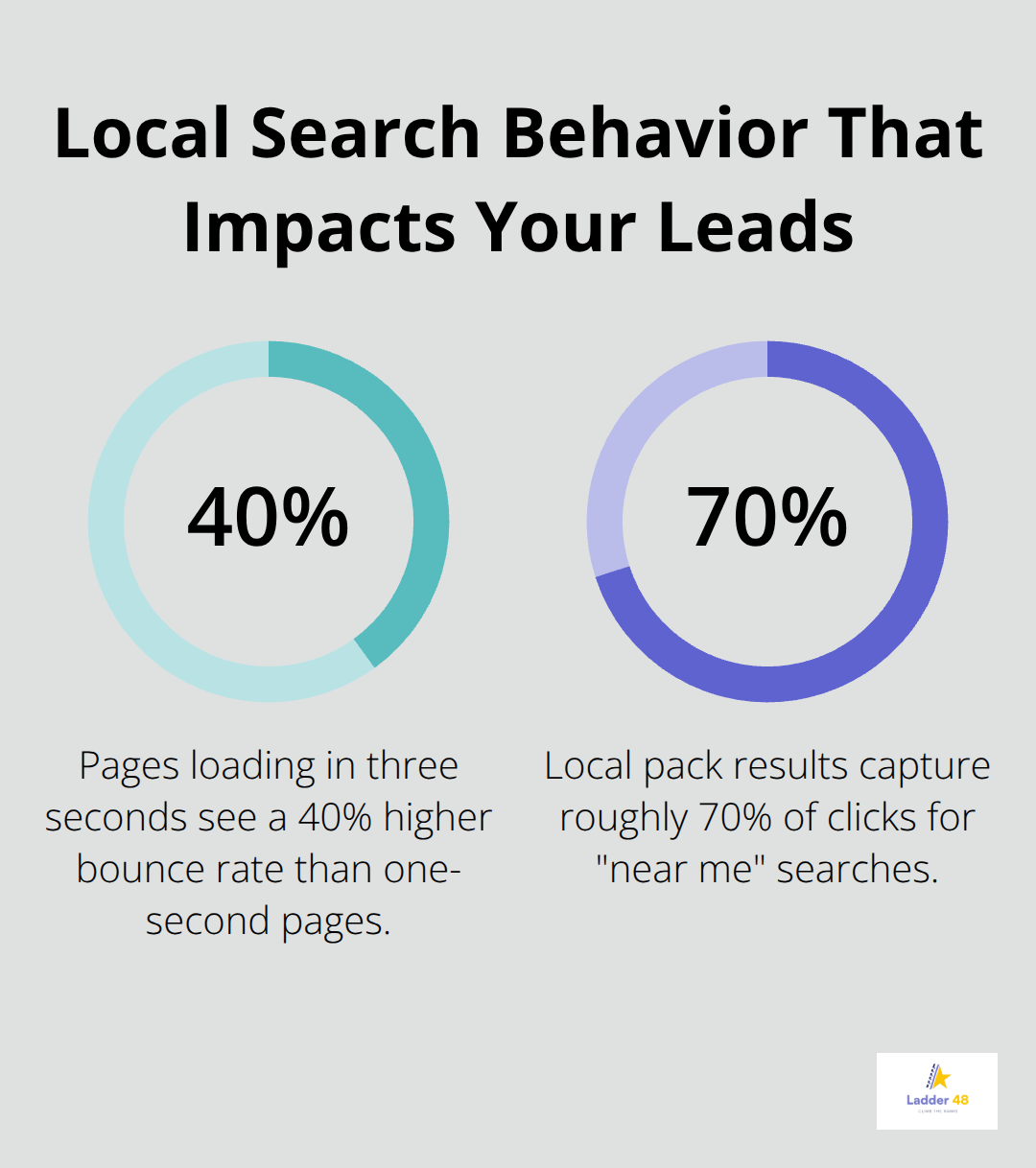
Your website speed directly impacts whether prospects call you or click to a competitor. Google’s research shows that pages loading in three seconds have a 40% higher bounce rate than pages loading in one second. For concrete contractors, this matters because homeowners researching “how to stain concrete patio,” which generates 145,200 yearly searches, won’t wait around for slow pages to load. Test your site speed using Google PageSpeed Insights, which provides specific recommendations. Focus on image optimization first-most contractor websites carry bloated, uncompressed project photos. Use WebP format instead of JPEG, compress images to under 200KB, and serve different sizes for mobile versus desktop.
This alone typically cuts load times by 30-50%.
Mobile Responsiveness Is Non-Negotiable
Mobile responsiveness isn’t a feature anymore-it’s mandatory. Over 60% of local searches happen on mobile devices, and Google ranks mobile versions separately from desktop. Your site must be fully responsive, meaning buttons are thumb-sized, text is readable without zooming, and forms work smoothly on small screens. Test this on actual phones, not just browser tools. Navigation should be simple-homeowners searching for “concrete contractors near me” should find your service area, portfolio, and contact information within two taps. If your current site requires more clicks, redesign the navigation structure immediately.
XML Sitemaps and Crawl Errors
XML sitemaps and crawl errors are invisible to visitors but critical for Google. Generate an XML sitemap that includes all service pages, blog posts, and location-specific pages, then submit it through Google Search Console. Check the Coverage report in Search Console monthly for crawl errors-404 pages, redirect chains, or blocked resources prevent Google from indexing your content. Concrete finishing contractors often have hundreds of service pages across different locations, so crawl errors multiply quickly. Fix them within 48 hours of discovery. Implement a robots.txt file that allows Google to crawl your entire site while blocking irrelevant pages like thank-you or checkout pages.
Structured Data Markup for Local Visibility
LocalBusiness schema markup tells search engines exactly where you operate, your phone number, hours, and service areas. This structured data appears in search results as rich snippets, including your star rating and service categories. Install schema markup using a plugin like Yoast SEO or add it manually to your site header. Include your service area radius, accepted payment methods, and business type as concrete contractor. When Google understands your structured data, you’re more likely to appear in local pack results, which receive roughly 70% of clicks for “near me” searches. Test your markup using Google’s Rich Results Test to confirm it’s valid before publishing.
The technical foundation you build now determines how effectively search engines crawl, index, and rank your content. With site speed optimized, mobile experience perfected, and structured data in place, your website becomes a machine that converts local visibility into actual phone calls and project inquiries. The next step is filling that optimized website with content that prospects actually want to read-content that answers their questions, showcases your work, and positions you as the concrete finishing expert in your area.
Content That Converts Concrete Finishing Prospects
Before-and-After Galleries That Showcase Local Expertise
Project galleries represent your biggest competitive advantage, yet most contractors squander it. You possess photos of finished work, but you likely upload them to a generic portfolio page without strategic structure. Before-and-after galleries organized by finishing technique and location perform dramatically better because they answer the exact question prospects ask: Can you complete the work I need in my area?
Structure galleries by service type-stamped concrete, decorative staining, repair work, driveway finishing-then create separate sections for each major location you serve. The keyword “how to stain concrete patio” generates 145,200 yearly searches, and homeowners searching this term want to see real examples of stained patios in their neighborhood, not generic images. Include multiple angles of each project, close-ups showing texture and color detail, and specific project information like square footage, finish type, and timeline.
Mobile users account for over 60% of local searches, so galleries must load quickly and display beautifully on phones. Use high-resolution images compressed to under 200KB each in WebP format. Each gallery image should include alt text with location and service keywords-for example, alt text like “stamped concrete driveway in Denver with slate pattern finish” helps Google understand what the image shows while improving accessibility. Projects with detailed descriptions and local context typically extend time-on-site by 40-60%, signaling to Google that your content holds value.
Service Pages That Target Specific Techniques and Neighborhoods
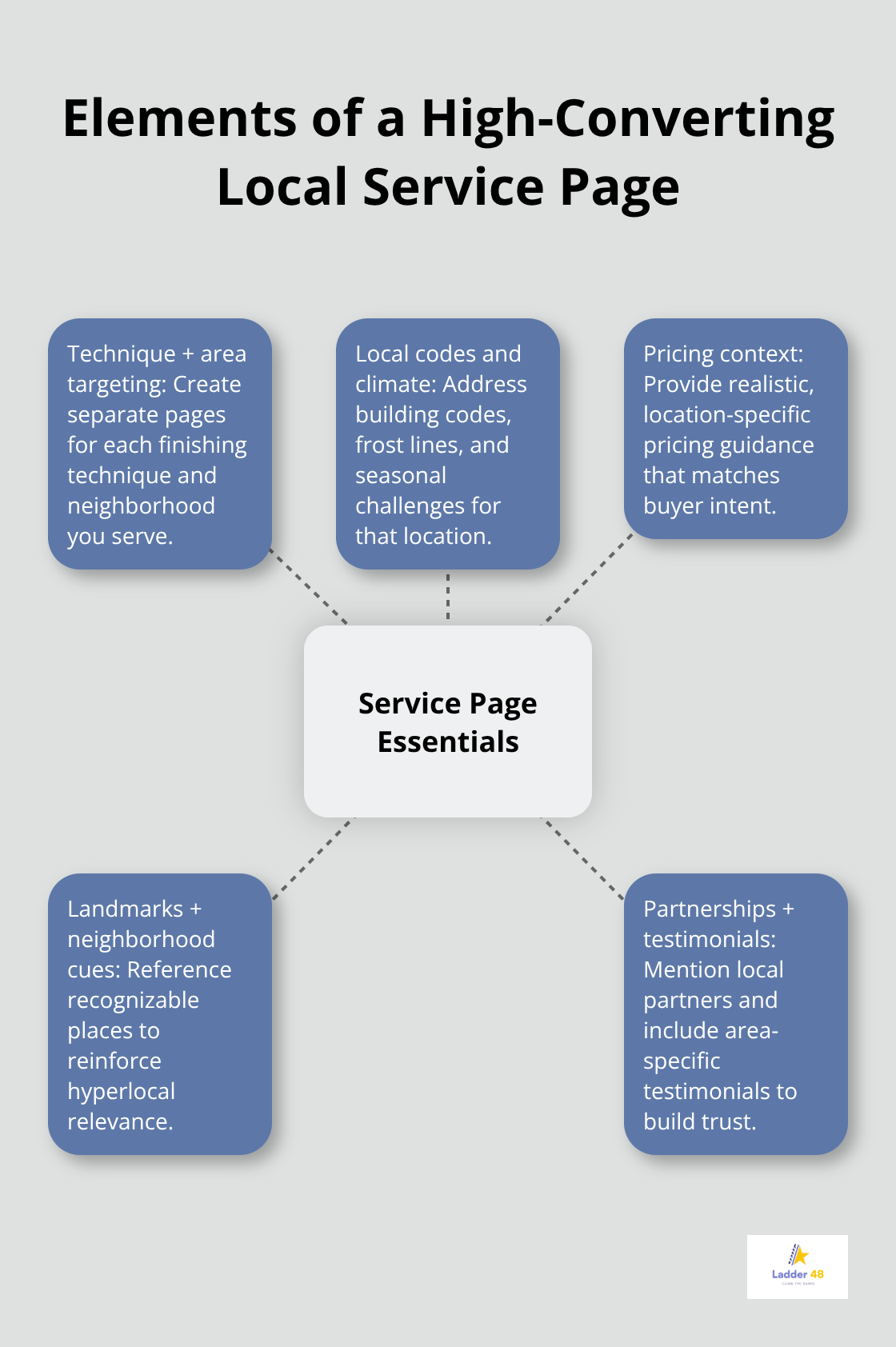
Content that converts prospects into paying customers requires service pages targeting specific finishing techniques and local areas. Don’t write one page about concrete driveway finishing-write separate pages for “concrete driveway finishing in [neighborhood],” each addressing local building codes, climate factors, and neighborhood-specific challenges. The keyword “concrete driveway near me” receives 28,800 yearly searches and ranks as hard to rank for, which means you need hyper-specific content to compete.
Include actual pricing context for that area, mention local contractors or builders you’ve partnered with, reference neighborhood landmarks, and answer location-specific questions like frost depth requirements or seasonal challenges. This approach transforms your website from a general contractor listing into a trusted local resource that prospects actually want to visit.
FAQ Content That Captures Featured Snippets
FAQ content addressing common client questions should live on service pages, not buried in a separate section. Questions like “how thick should a concrete driveway be” (7,080 yearly searches), “how much is a concrete driveway” (12,000 yearly searches), and “how long does concrete take to cure” (43,200 yearly searches) deserve direct, specific answers with local context.
If you serve multiple climate zones, answer these questions differently for each region because frost lines, curing times, and thickness requirements vary significantly. Answer in 150-200 words per question, providing specific numbers and actionable information rather than generic explanations. Structure your answer with a direct response in the first sentence, followed by location-specific details, then practical tips for the reader. This format captures featured snippets and positions you as the expert homeowners actually trust.
Final Thoughts
Local backlinks remain one of the most underutilized ranking factors for concrete finishing contractors SEO. Partner with architects, designers, real estate agents, and building material suppliers who already serve your target market, and these partners will mention your business on their websites or refer clients to you-Google interprets those mentions as votes of confidence. Local associations, chamber of commerce listings, and community sponsorships generate legitimate backlinks that improve your domain authority and help you rank for the concrete repair keyword cluster, which totals 118,800 yearly searches.
Reviews directly influence both rankings and conversion rates, so actively encourage satisfied clients to leave reviews on Google, Yelp, and Angi by sending follow-up emails with direct links to review pages. Respond to every review within 48 hours, addressing specific details from the project and thanking the client by name. Negative reviews require professional responses that acknowledge concerns and offer solutions without defensiveness, since prospects perceive responsiveness as a sign of reliability.
Performance monitoring separates contractors who maintain rankings from those who watch competitors climb past them. Use Google Search Console to track which keywords drive traffic, which pages convert visitors into leads, and where your rankings sit monthly, then review this data quarterly and adjust your strategy based on what’s working. We at Ladder 48 help contractors implement these strategies systematically through transparent, results-driven SEO that delivers measurable growth.


