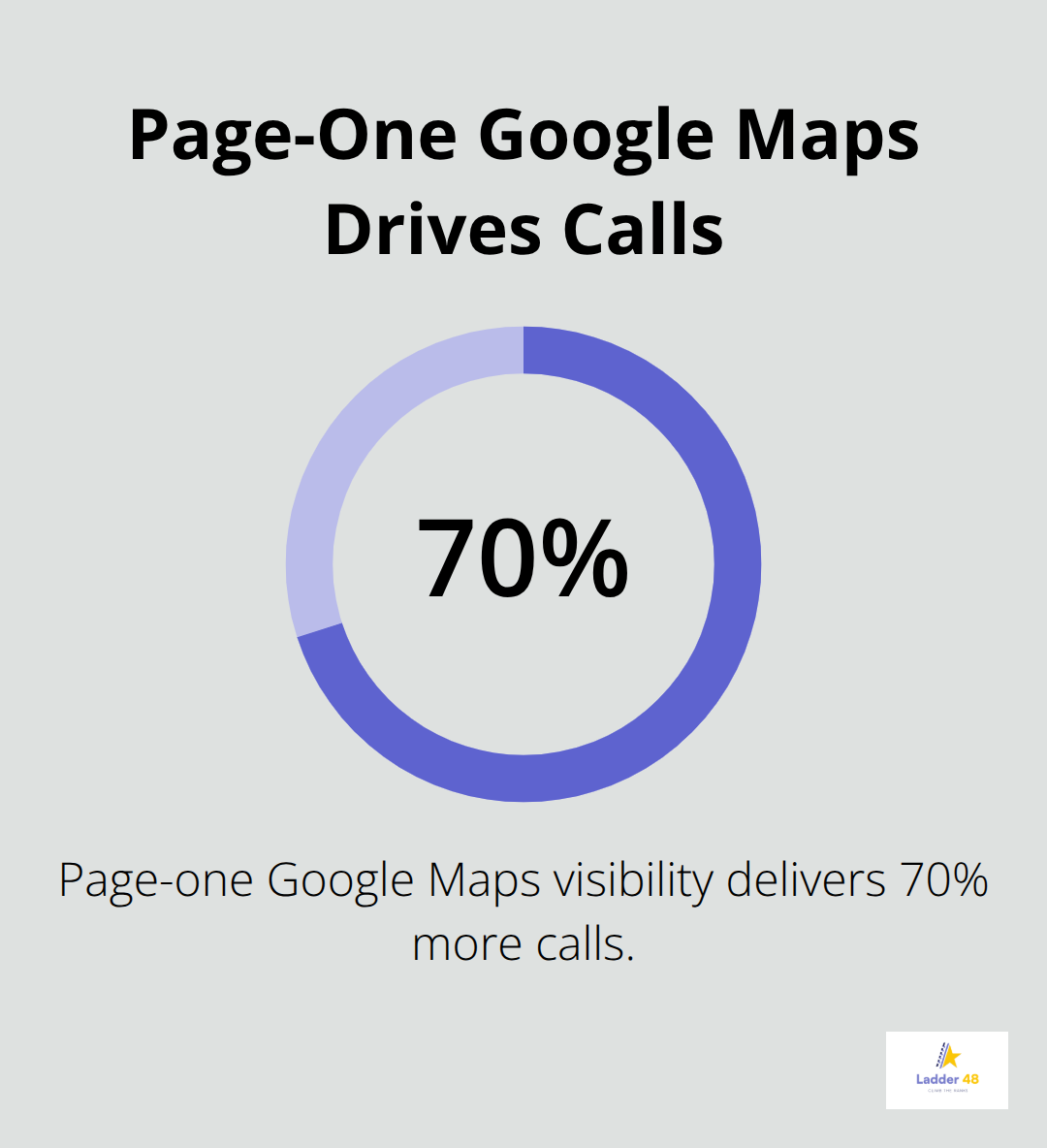
Concrete companies that rank on the first page of Google Maps get 70% more calls than those buried below. Local search visibility isn’t optional anymore-it’s what separates thriving businesses from struggling ones.
At Ladder 48, we’ve helped dozens of concrete contractors dominate their local markets. This guide covers the concrete company SEO tips that actually move the needle: keyword research that targets ready-to-buy customers, technical fixes that Google rewards, and content strategies that build authority in your service areas.
Which Keywords Actually Convert for Concrete Contractors
Concrete contractors lose deals to competitors every single day because they chase the wrong keywords. Searching for generic terms like “concrete contractor” brings traffic, but it doesn’t bring customers ready to pay. This pattern repeats constantly: contractors rank for broad keywords and wonder why their phones don’t ring. The real money sits in location-based keywords that signal immediate intent.
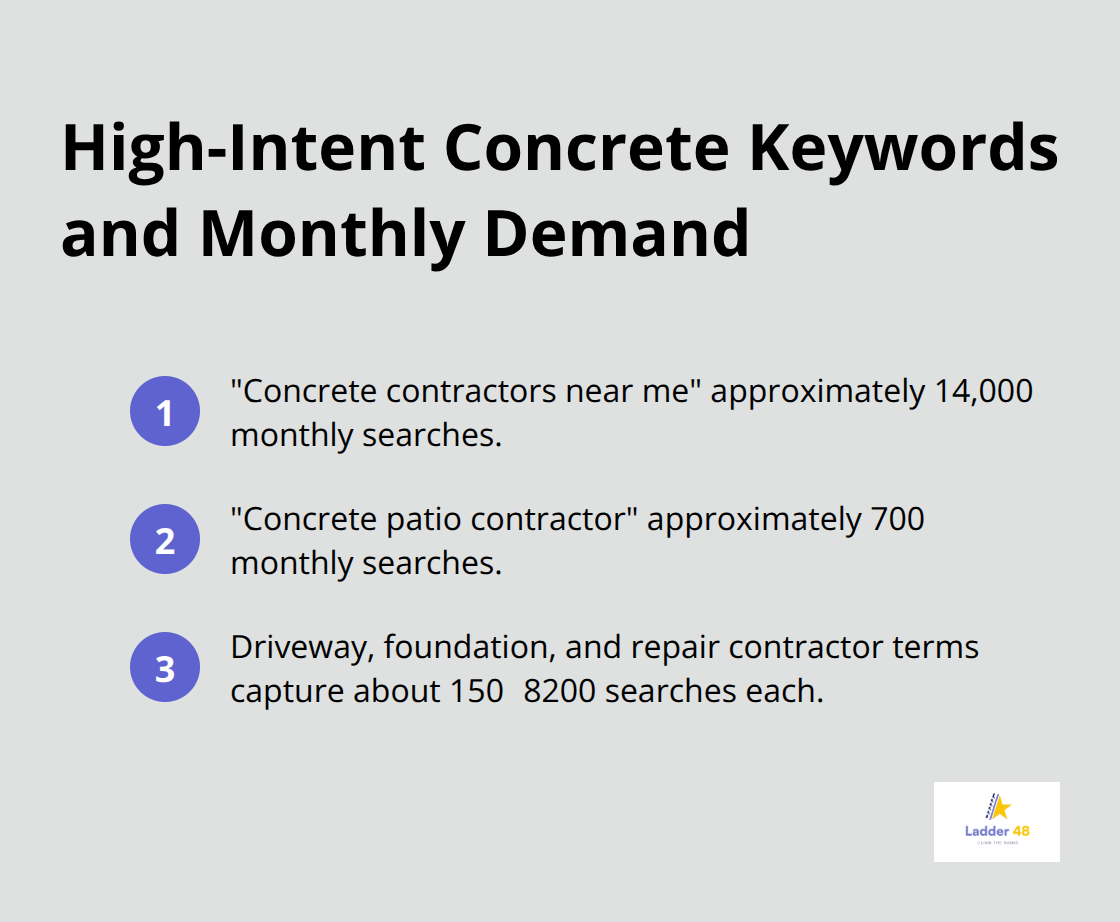
“Concrete contractors near me” generates roughly 14,000 monthly searches and represents homeowners actively looking for someone today. “Concrete patio contractor” pulls about 700 searches with low difficulty, meaning you can own that space without spending years building authority. “Concrete driveway contractor,” “concrete foundation contractor,” and “concrete repair contractor” each capture 150 to 200 monthly searches from people ready to request quotes. These aren’t vanity metrics-they’re customers in your service area typing into Google right now.
Where to Find Keywords Your Competitors Miss
Google Maps data reveals what local searchers actually want. When you pull up Google Maps and search “concrete contractors” in your city, look at the businesses that rank and the keywords they target on their service pages. If a competitor ranks for “concrete patios in Miami” but ignores “concrete driveways in Miami,” that’s your opening. Bing Places functions similarly and often ranks different businesses, giving you a second set of high-intent prospects.
Google Search Console shows the exact queries that drive impressions to your site-even queries you didn’t intentionally target. Many contractors ignore this goldmine of data. Check which location-based terms already send traffic your way, then double down on those keywords with dedicated service pages. City-targeted terms like “concrete contractors San Antonio” carry roughly 300 monthly searches with high competition, but they’re worth fighting for because they convert faster than national keywords. The keyword “concrete contractors in my area” captures persistent local intent and pulls around 300 searches monthly with medium difficulty.
Building Your Keyword Strategy Around Service Areas
Concrete contractors serve specific geographic zones, and your keyword strategy must match that reality. Stop thinking about ranking for generic terms nationwide. Instead, identify your top five service areas and create a keyword list for each one. For each location, target the main service types you offer: patios, driveways, foundations, repairs, stamped concrete. That gives you “concrete patio contractor Denver,” “concrete driveway contractor Denver,” and so on.
Long-tail terms like “concrete sidewalk contractors near me” pull around 200 monthly searches but face medium competition-far easier to rank for than the broad terms. These specific combinations capture customers searching for exactly what you do in exactly where you operate. Niche keywords like “stamped concrete contractor” carry roughly 200 monthly searches with high difficulty, but if stamped concrete is your specialty, that keyword becomes your best friend.
Measuring Keywords That Actually Drive Revenue
Track which keywords drive phone calls and form submissions, not just traffic. A keyword pulling 50 searches that converts three visitors into customers beats a keyword pulling 500 searches that converts zero. Set up call tracking on your website so you know which keywords lead to actual phone inquiries. Monitor your Google Business Profile for which search terms people use to find you, then reinforce those terms across your service pages and content.
This data-driven approach transforms your contractor marketing strategy from guesswork into a revenue-focused system. Once you identify your highest-converting keywords, you’re ready to optimize the pages that rank for them-which is where on-page SEO and technical improvements take over.
Getting Your Website and Local Listings Ready for Local Search
Your keyword research identifies what customers search for, but your website and local listings determine whether Google shows your business to those customers.
Write Title Tags and Meta Descriptions That Convert
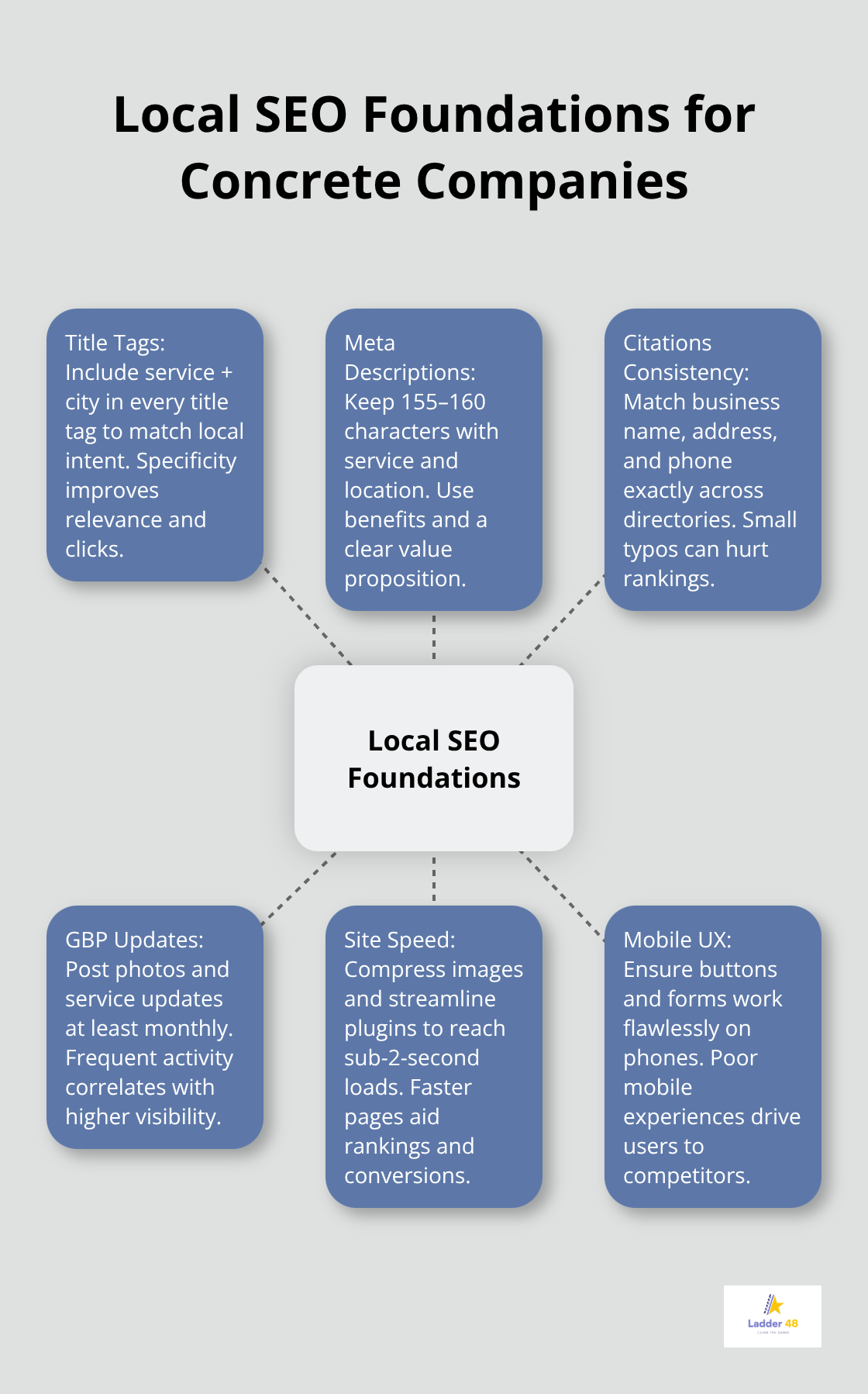
Title tags and meta descriptions form the first impression you make in search results, yet most concrete contractors treat them as afterthoughts. A title tag like “Home” or “Concrete Services” wastes prime real estate that Google uses to rank your pages. Instead, write title tags that include your service and location: “Concrete Driveway Contractor Denver” or “Foundation Repair in Austin Texas.” Google rewards specificity, and homeowners scanning search results instantly know you serve their area.
Meta descriptions should summarize what’s on the page in 155 to 160 characters, including your location and primary service. A meta description like “Expert concrete patio installation in Miami. Custom designs, fast turnaround, free quotes” tells Google and searchers exactly what they’ll find. These elements seem minor, but they directly influence click-through rates from search results. Test different title and meta description variations on your highest-converting pages to see which language drives more clicks.
Build Citations Across Local Directories
Citations and local business listings form the backbone of local SEO authority. Yelp, Google Business Profile, Angi, and the Better Business Bureau are non-negotiable, but niche directories matter too. If you specialize in stamped concrete, list your business on concrete-focused directories and home improvement platforms relevant to your service area. Consistency is non-negotiable: your business name, phone number, and address must match exactly across every listing. A single typo or variation signals to Google that your business information is unreliable, tanking your local rankings.
Update your Google Business Profile at minimum once monthly with project photos and service descriptions. Contractors who post weekly updates see measurably higher visibility than those who set it and forget it.
Accelerate Your Site Speed and Mobile Performance
Site speed affects rankings and conversions directly. Google’s Core Web Vitals measure how fast your pages load and respond to user interaction, and slow sites rank lower. Most concrete contractor websites load in 4 to 6 seconds, but top performers load in under 2 seconds. Compress your before-and-after project images, remove unnecessary plugins, and use a content delivery network to serve images faster to users across different regions.
Mobile responsiveness isn’t optional anymore. Over 60 percent of concrete contractor searches happen on phones, yet many contractor websites look terrible on mobile devices. Your site must display perfectly on all screen sizes, with buttons large enough to tap easily and forms that don’t require sideways scrolling. Test your website on actual phones, not just browser simulators, because real-world performance differs significantly. A slow, clunky mobile experience sends customers straight to your competitors’ websites.
With your website and listings optimized for local search, you’re ready to build authority through content that demonstrates your expertise and attracts links from other businesses in your community.
Authority Through Location-Specific Pages and Community Trust
Create Dedicated Pages for Each Service and Location
Service-area pages transform your website from a generic brochure into a lead-generation machine that Google rewards. Most concrete contractors create one generic services page and wonder why they don’t rank locally. Instead, build dedicated pages for each concrete service in each location you serve: Concrete Patios in Denver, Concrete Driveways in Denver, Concrete Patios in Austin, and so on. Each page targets a specific keyword combination that homeowners actually search for.
Your page for Concrete Patios in Denver should include photos of your actual patio projects completed in Denver, testimonials from Denver customers, and embedded Google Maps showing your service area. Add specific details about local conditions like freeze-thaw cycles that affect concrete longevity in Colorado. This hyperlocal approach signals to Google that you’re a legitimate authority in that specific market, not just another national contractor trying to rank everywhere.
Update these pages quarterly with new project photos and seasonal tips relevant to that location, which keeps your content fresh and gives Google reasons to re-crawl and re-rank your pages.
Leverage Reviews and Testimonials for Rankings and Trust
Google reviews and customer testimonials drive both rankings and conversions simultaneously. Concrete companies with 50 or more Google reviews rank significantly higher than those with fewer reviews, and customers trust businesses with substantial review volume far more than those with none. Implement a systematic review process: send review request emails or texts within 48 hours of project completion when satisfaction is highest, include a direct link to your Google Business Profile review page so customers don’t have to search for it, and train your team to ask for reviews in person when customers express satisfaction.
Display your top reviews prominently on your service pages and homepage, not buried in a reviews section nobody visits. Respond to every review within 48 hours, especially negative ones, because Google weights recency heavily and your responses demonstrate active engagement. This consistent attention to reviews signals to both Google and potential customers that you care about your reputation.
Build Local Authority Through Strategic Partnerships
Local link building accelerates your rankings faster than most contractors realize. Partner with complementary local businesses like landscape designers, real estate agents, and home improvement stores to exchange links or cross-promote services. Join your local chamber of commerce and get listed in their member directory, which provides both a backlink and local citation. Sponsor local youth sports teams or community events and request a link from their websites in exchange.
These local connections build domain authority faster than chasing links from irrelevant national websites, and they generate referral traffic from businesses already trusted by your target customers. The relationships you build in your community become assets that strengthen your online presence and your bottom line simultaneously.
Final Thoughts
Concrete company SEO tips work because they target customers actively searching for your services right now. You’ve learned how to identify high-intent keywords like “concrete contractors near me” and “concrete patio contractor,” optimize your website and local listings for Google’s ranking factors, and build authority through location-specific pages and community trust. These strategies compound over time, turning your website into a consistent source of qualified leads.
The concrete contractors winning right now aren’t the ones with the biggest advertising budgets-they’re the ones ranking on page one of Google Maps and search results because they invested in SEO that actually converts. Noticeable traffic growth typically appears within three to six months, and consistent organic leads often start flowing within 30 to 60 days (the contractors who see the fastest results combine keyword optimization with review generation, local citations, and regular content updates). This consistency signals to Google that your business is active and trustworthy.
If you’re managing SEO alone while running your concrete business, you’re dividing your attention between two demanding jobs. Ladder 48 specializes in helping contractors dominate local search through transparent, results-driven SEO strategies tailored to your service areas and target customers. We handle keyword research, local optimization, content creation, and monthly reporting so you can focus on completing projects and growing revenue.