
Concrete contractors lose leads every day because potential customers can’t find them online. At Ladder 48, we’ve built a concrete services SEO plan that gets local businesses ranking where it matters most.
This framework covers everything from optimizing your website to building the citations that Google rewards. You’ll learn exactly how to capture the searches happening in your service area right now.
Where Concrete Contractors Actually Get Found
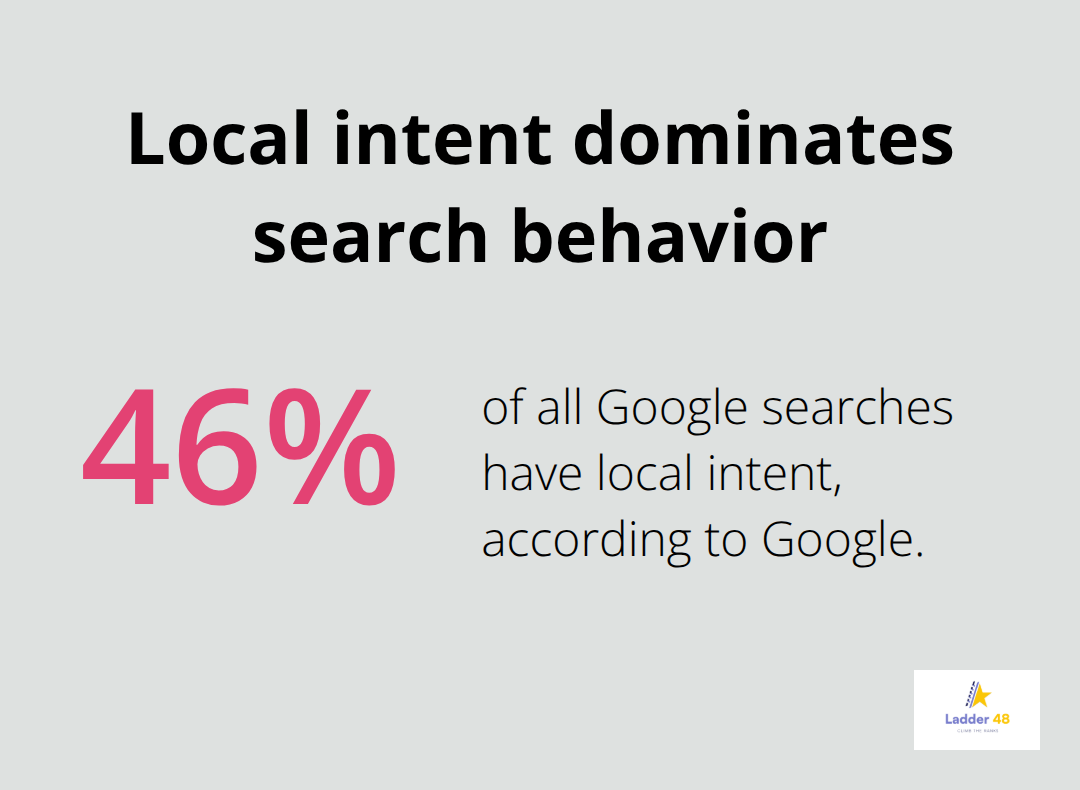
46% of all Google searches have local intent, according to Google itself. For concrete contractors, that number is even higher. When a homeowner’s driveway cracks or a commercial property needs foundation work, they search for concrete contractors near them, right now.
This is the reality of the concrete services market. Potential customers with active projects and ready budgets search in your service area every single day. If you don’t show up in those local results, a competitor captures that lead instead. The difference between ranking on page one of local results versus page two is staggering. Studies consistently show that the top three local results capture the majority of clicks and phone calls. A concrete contractor ranking fourth or fifth on Google Maps gets a fraction of the visibility. This isn’t theoretical-it’s the difference between a booked schedule and slow months.
Mobile Searches Drive Concrete Jobs
Most concrete service searches happen on mobile devices. A property manager notices a pothole in the parking lot. A homeowner sees water damage in the basement. They pull out their phone and search immediately.
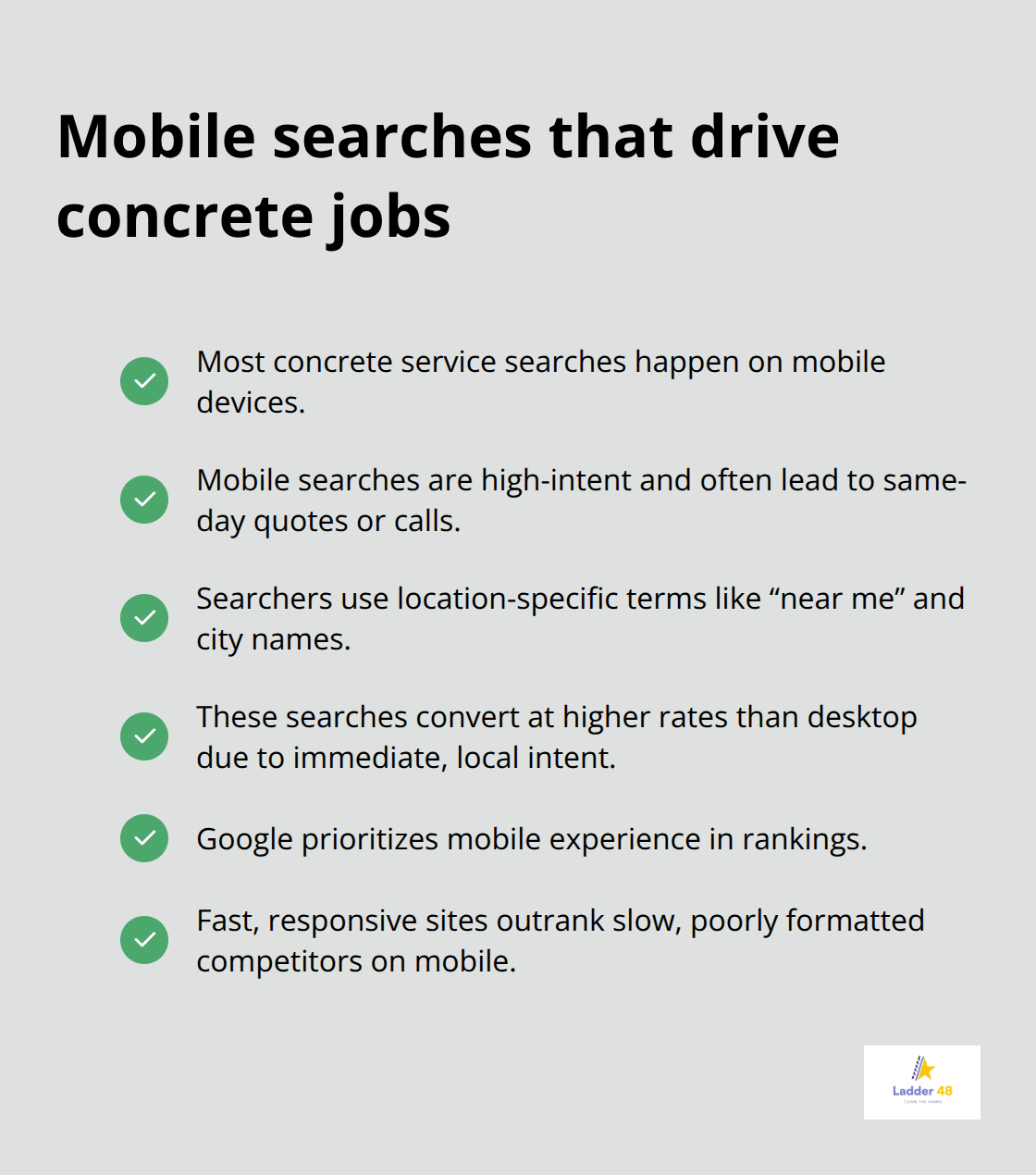
These mobile searches are high-intent-the person is often ready to get a quote or call someone that day. Mobile searchers also use location-specific terms like concrete contractors near me, best concrete company in Denver, or stamped concrete patio near me. These searches convert at higher rates than desktop searches because the intent is immediate and local. If your website isn’t mobile-optimized or your Google Business Profile isn’t fully set up, you’re invisible to these mobile searchers. Google prioritizes mobile experience heavily in its ranking algorithm, meaning a slow or poorly formatted mobile site will rank lower than a fast, responsive competitor.
Google Business Profile Is Your Fastest Win
Your Google Business Profile is the single most powerful local SEO tool available. It’s also the quickest to optimize. A complete, well-maintained profile with accurate name, address, phone number, service areas, hours, and high-quality project photos significantly boosts your visibility in local searches and Google Maps. Businesses with 50 or more positive reviews are perceived as more trustworthy than those with fewer reviews, and review count directly influences both rankings and conversion rates. You should post regular updates on your profile-new projects, seasonal promotions, job-site photos-to signal activity to Google and keep your listing fresh in the algorithm. The data is clear: concrete contractors with optimized Google Business Profiles consistently outrank competitors with incomplete or neglected profiles, even if those competitors have stronger websites overall.
Why Your Service Pages Matter Next
Once your Google Business Profile attracts attention, your website pages determine whether visitors convert into leads. Service pages optimized for location-specific keywords (like “stamped concrete patio in Denver” or “driveway repair near me”) connect searchers to exactly what they need. These pages should include city-specific headlines, area-relevant descriptions, project photos, location testimonials, and accurate local contact details. Each service area page you build reinforces your authority in that specific location and improves your chances of ranking for multiple local searches simultaneously.
Building Pages That Rank and Convert
Location-Specific Service Pages Drive Local Rankings
Your Google Business Profile attracts attention, but your website pages convert searchers into leads. Location-specific service pages are non-negotiable for concrete contractors who want to rank locally. A page titled “Stamped Concrete Patio in Denver” outranks a generic “Stamped Concrete” page because it signals relevance to both Google and searchers in that specific market.
Each service area page should target keywords with real search volume. “Concrete contractors near me” pulls 486,000 yearly searches, “concrete driveway” yields 118,800, and “how to stain concrete patio” attracts 145,200 yearly searches according to keyword research data. Your pages must match these search behaviors exactly.
Content Structure That Converts Visitors
Include city-specific headlines, area-relevant descriptions with natural keyword integration, project photos from actual jobs in that location, testimonials from customers in that area, and accurate local contact details. Avoid keyword stuffing-Google penalizes it, and visitors notice immediately. Instead, write for the person searching, then optimize the structure.
A page about concrete driveway repair in Denver should mention Denver naturally throughout the content, explain why concrete driveways fail in that climate, and showcase completed projects from that region. This approach signals to Google that you serve that specific market while helping searchers understand why your expertise matters for their local conditions.
Schema Markup Speaks Google’s Language
Schema markup is the technical foundation that makes your pages speak Google’s language. Local Business schema specifically tells Google exactly what your business is, where it operates, and how to contact you. Without it, Google guesses based on page content alone. With it, your address, phone number, and service areas appear directly in search results with rich formatting.
Implement schema using Google’s Structured Data Markup Helper or a plugin if you’re on WordPress. This step takes minimal effort but delivers measurable improvements in how search results display your business information.
Site Speed Separates Winners From Competitors
Site speed destroys concrete contractor rankings faster than poor content. Google’s research shows that page speed directly impacts both rankings and conversions. Most concrete service searches happen on mobile, and mobile users abandon slow sites instantly.
Test your site speed with Google PageSpeed Insights and prioritize fixes that impact mobile performance first-compress images, minimize JavaScript, enable browser caching. A fast mobile experience isn’t optional anymore; it’s the baseline expectation that separates contractors who capture leads from those who lose them to faster competitors. Once your pages rank and load fast, the next challenge becomes earning the local authority signals that push you past competitors who’ve already optimized their on-page fundamentals.
Local Authority Signals That Competitors Can’t Match
Citations Verify Your Business Legitimacy
Citations and backlinks separate contractors ranking fourth from those ranking first in your local market. Google treats citations as verification that your business exists and operates where you claim. A citation is your business name, address, and phone number listed on another website. When that citation appears on high-authority directories like Google Business Profile, Yelp, Angi, or the Better Business Bureau, Google gains confidence in your legitimacy. The more consistent citations across reputable platforms you build, the stronger your local authority becomes.
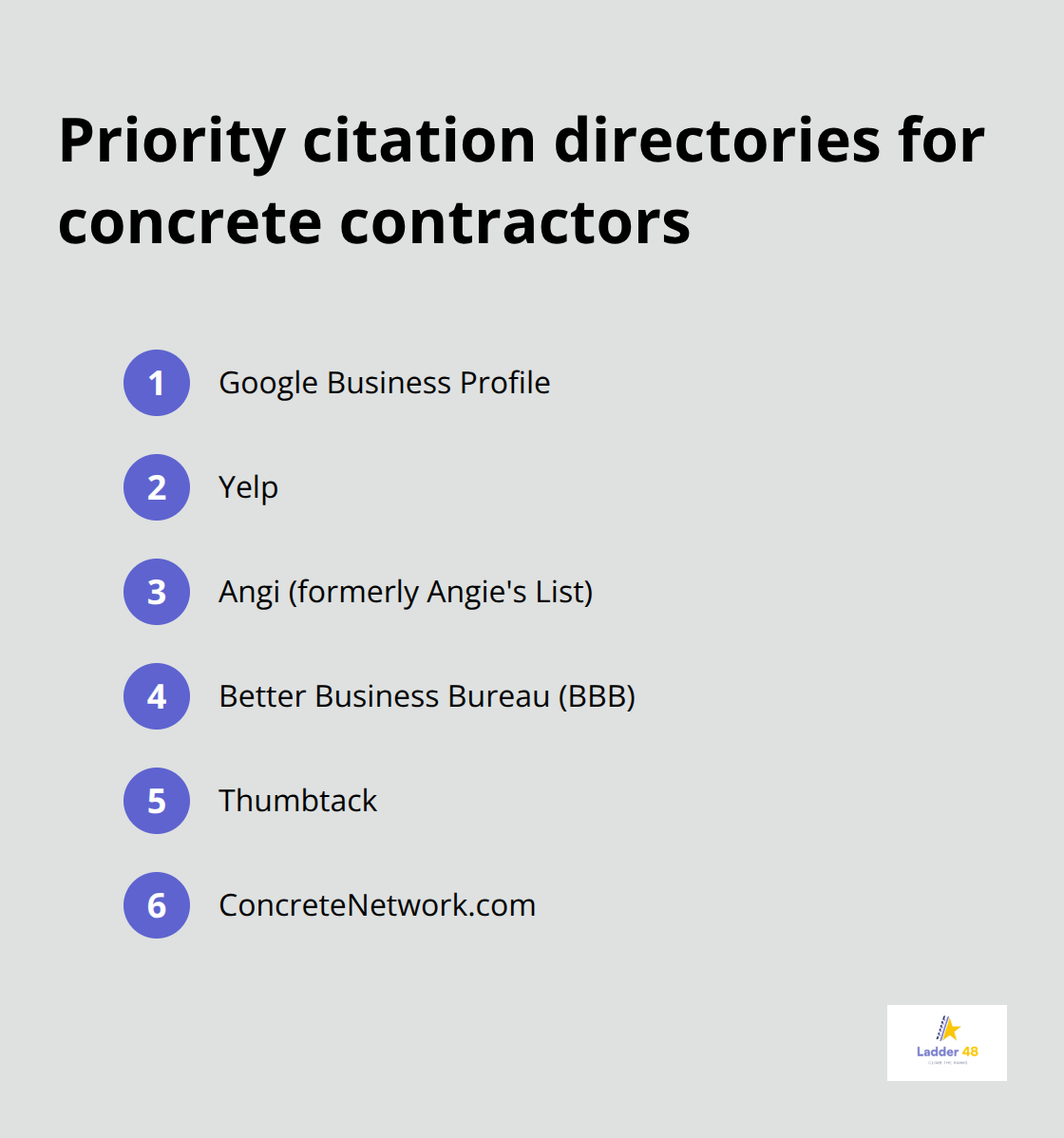
Start with directories that matter most to concrete contractors: Google Business Profile, Yelp, Angi (formerly Angie’s List), BBB, Thumbtack, and ConcreteNetwork.com. Match your name, address, and phone number exactly across every platform. Even a single inconsistency damages your rankings because Google interprets conflicting information as a red flag.
High-quality citations from industry-specific directories carry more weight than generic business listings. A citation from ConcreteNetwork.com tells Google you’re a legitimate concrete contractor more effectively than a citation from an unrelated business directory.
Backlinks Pass Authority and Drive Traffic
Backlinks operate differently than citations. A backlink passes authority from one website to yours and drives referral traffic. Joy Hawkins’ research at Sterling Sky shows that even a single high-quality local backlink boosts your organic rankings significantly. The most powerful local backlinks come from sources that already have credibility in your area.
Local Partnerships Create Link Opportunities
Join your local Chamber of Commerce and request they link to your website from their member directory. Sponsor a local youth sports team or community event and request acknowledgment on their sponsor page. Partner with complementary local businesses like architects, property managers, or real estate agents and create mutual recommendation pages that link back and forth. These relationships generate authority signals that isolated contractors never access.
Earn Links Through Content and Visibility
Approach local news outlets with press releases about completed projects or community involvement. Local bloggers and business associations need content and relationships; provide value first without immediately asking for links. When you contribute a guest article to a local publication or speak at a community event, request a link back to your website. Competitor analysis reveals untapped opportunities: use Moz Backlink Checker to examine which websites link to your top local competitors, then pursue those same sources. This approach identifies real link opportunities rather than chasing hypothetical strategies.
Build Authority Over Time, Not Overnight
The concrete contractors who dominate their markets have built citation and backlink profiles that took months to develop, not weeks. Start today and prioritize consistency over volume. Each citation and backlink you earn strengthens your position against competitors who haven’t invested in local authority signals.
Final Thoughts
The concrete services SEO plan outlined in this guide works because it mirrors how Google actually ranks local businesses. Your Google Business Profile delivers faster results than any other tactic, so complete every section, add project photos, and start collecting reviews-a business with 50 or more positive reviews outranks competitors with incomplete profiles. Next, build location-specific service pages that target keywords with real search volume, include city-specific headlines and project photos from actual jobs in your area, and watch these pages convert because they answer the exact question searchers ask.
Citations and backlinks form the final layer of your strategy. Start with high-authority directories like Yelp, Angi, and the Better Business Bureau, ensuring your name, address, and phone number match exactly across every platform. Then pursue local partnerships-join your Chamber of Commerce, sponsor community events, and build relationships with complementary local businesses that generate authority signals isolated contractors never access.
We at Ladder 48 help concrete contractors implement this exact framework through our concrete services SEO plan, which combines on-page optimization, local citations, content strategy, and backlink building into a cohesive approach designed to generate qualified leads in your service area. Start today, stay consistent, and watch your rankings climb.


