Most electricians focus on getting calls from their immediate area. But if you’re not showing up in search results across your entire service territory, you’re leaving money on the table.
Electrician service area SEO is how you capture high-intent customers searching for your services in every location you cover. At Ladder 48, we’ve seen electricians double their qualified leads by optimizing for multiple service areas instead of just their home base.
Why Service Area SEO Actually Matters
Local Searchers Convert Fast
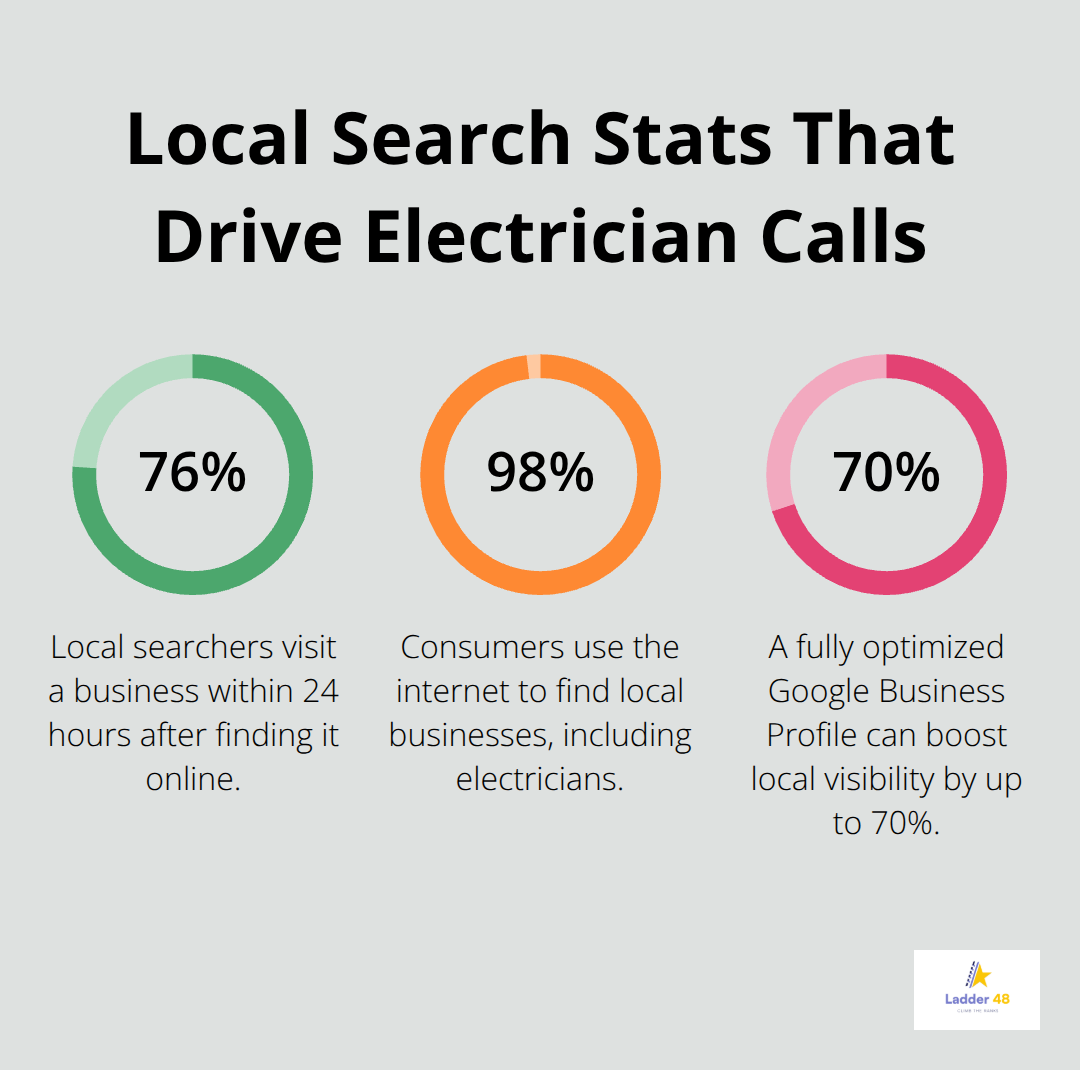
Google’s search data shows that 76% of local searchers visit a business within 24 hours of finding it online. This means electricians who rank in multiple service areas don’t just get more visibility-they get faster conversions. When a homeowner in a neighboring city searches for an emergency electrician, they expect to find someone local. If you’re not showing up in those results, a competitor is taking that call.
The U.S. Bureau of Labor Statistics reports there are approximately 250,000 electrical contracting businesses competing for local work, which means your service area strategy directly determines whether you capture high-intent customers or lose them to better-optimized competitors.
Search Distance Creates Geographic Demand
Most homeowners search for electricians within a specific radius of their location. Data from BrightLocal shows that 98% of consumers use the internet to find local businesses, and homeowners typically perform 3 to 5 online searches before hiring an electrician. Each of these searches happens in a different city or neighborhood if the homeowner checks multiple service areas. If your website only ranks for your home office location, you remain invisible during those other searches. Service area pages solve this problem-they signal to Google that you serve specific cities and neighborhoods. Energized Electric increased their service call volume by 70% year-over-year after implementing a comprehensive service area strategy, which directly reduced their cost per lead by 40%. This isn’t theoretical; it’s what happens when you optimize for the places customers actually search.
High-Intent Keywords Live in Service Area Pages
Electricians searching for emergency repair, panel upgrades, or EV charger installation are ready to hire immediately. These keywords perform best when paired with specific locations because the searcher has already decided they need help-they’re just looking for someone nearby. Service area pages let you target phrases like “emergency electrician in Portland” or “electrical panel upgrade near me” with dedicated content that ranks independently from your homepage. Ahrefs research shows that top-ranking electrician pages average 3.8 times more backlinks than lower-ranking pages, but equally important is having multiple pages optimized for the same service in different locations. This strategy doesn’t dilute your authority; it multiplies your chances of appearing in Google’s map pack, where most local searches end. A fully optimized Google Business Profile can boost local visibility by up to 70%, and having dedicated service area pages amplifies that effect across your entire territory.
Now that you understand why service area SEO matters, the next step is learning how to actually build these pages so they rank and convert.
Build Service Area Pages That Actually Rank
Create Unique Content for Each Location
The difference between a service area page that ranks and one that vanishes in search results comes down to specificity and local signals. Generic pages filled with identical content across multiple locations won’t work-Google sees through that instantly. Each service area page needs to feel like it was written specifically for that neighborhood, with unique details that prove you understand the local market.
Start by researching what electricians in each area actually encounter. A homeowner in Portland faces different electrical challenges than one in rural Oregon. One might need EV charger installation; another might struggle with an aging panel in a 1970s home. Your content should address these specific problems, not rehash generic electrical advice.
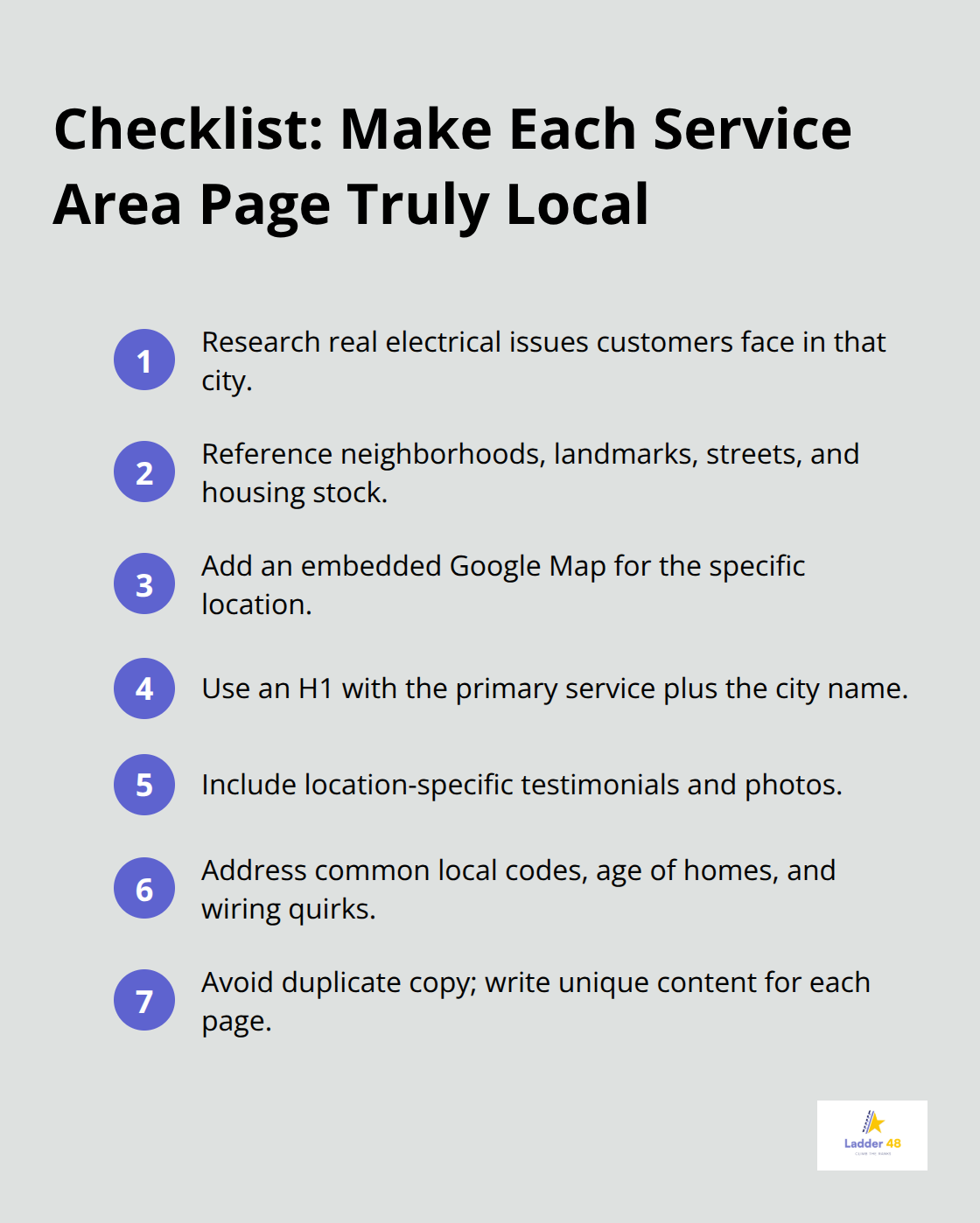
Include neighborhood names, local landmarks, and community-specific details throughout the page. A Brampton electrician who mentions local housing stock, common wiring issues in that area, and even nearby streets will signal relevance far better than a page that could apply to anywhere in the province. Whitespark’s 2024 Local Search Ranking Factors research found that Google Business Profile signals account for about 36% of local pack rankings, but your website content accounts for the remaining majority. That means the page itself matters enormously.
Add an embedded Google Map on each service area page, include locally relevant testimonials from customers in that specific city, and make sure your H1 tag contains both your primary service and the city name. A page titled “Emergency Electrician in Tacoma” performs differently than one titled “Emergency Electrical Services”-the first targets intent plus location, the second targets neither.
Build Local Citations and Earn Area-Specific Backlinks
Local citations and backlinks from area-specific sources give Google confirmation that you actually serve those locations. Citations aren’t a one-time task; they’re ongoing proof of your local presence. HomeStars, Thumbtack, Yelp, and BBB must have your business listed with consistent name, address, and phone information across all platforms. When you add a new service area, list yourself in local directories in that city specifically.
Tools like BrightLocal or Whitespark help you monitor citations across multiple locations simultaneously, which matters when you manage pages for five, ten, or twenty different areas. Backlinks from local sources carry more weight than you might expect. A link from the Tacoma Chamber of Commerce or a local real estate blog signals to Google that you’re genuinely embedded in that community.
Reach out to local HVAC contractors, plumbers, and general contractors in each service area-they often refer electrical work and will link to your site in exchange for reciprocal links or partnership mentions. Guest posts on local blogs, sponsorships of community events, and features on neighborhood-specific websites all generate these backlinks.
Implement Schema Markup to Signal Service Coverage
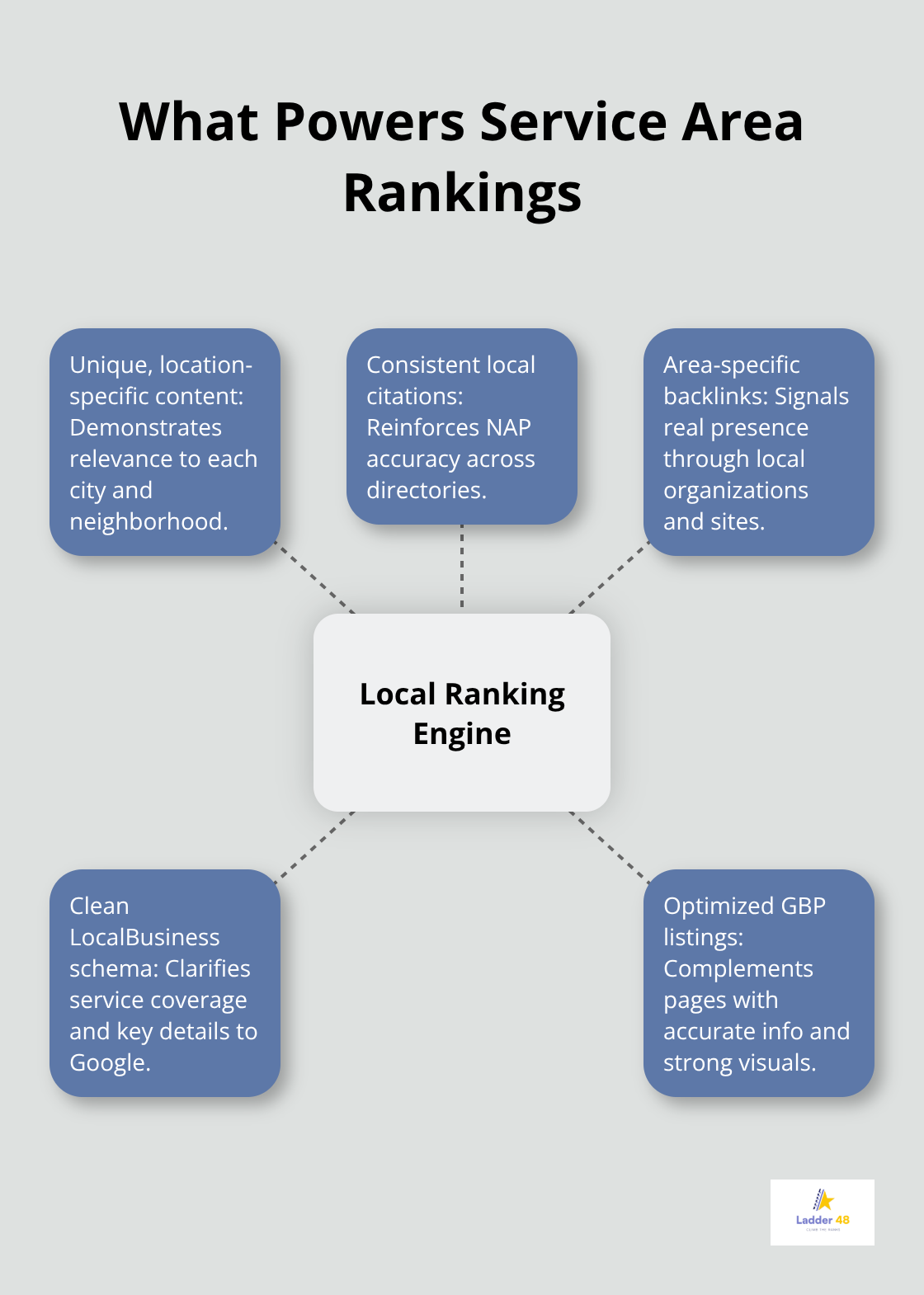
Schema markup ties everything together. Implement LocalBusiness schema on every service area page, specifying your service area, phone number, and the specific neighborhoods you cover. This structured data tells Google exactly which locations you serve, reducing ambiguity and improving your chances of appearing in map pack results.
Most electricians skip schema markup because it feels technical, but it’s one of the highest-ROI tasks you can complete. A properly implemented schema snippet takes thirty minutes per page and directly improves how Google interprets your service coverage. The combination of unique, location-specific content, consistent local citations, targeted backlinks from area sources, and clean schema markup transforms service area pages from invisible to competitive within three to six months.
With your service area pages now optimized for search visibility, the next step is making sure Google actually understands your service coverage across all these locations.
What Kills Service Area SEO Rankings Fast
Most electricians who fail at service area SEO don’t lack ambition-they lack execution discipline. The same three mistakes appear repeatedly, and each one tanks rankings faster than you’d expect.
Duplicate Content Destroys Your Rankings
The first mistake is copying and pasting content across location pages with only the city name changed. Google’s algorithms detect this instantly. A page titled “Emergency Electrician in Portland” that contains identical text to “Emergency Electrician in Seattle” signals low effort and gets buried in results. Each page needs genuinely different content that addresses local conditions, neighborhood-specific electrical challenges, and community details that prove you understand that specific market.
An electrician serving Portland faces different issues than one in Seattle-older housing stock, different climate impacts on wiring, distinct local regulations. Your content must reflect these differences. Thin content pages rank poorly, but duplicate content pages rank even worse because Google penalizes them for wasting user time. The penalty hits hard and lasts longer than most electricians realize.
Secondary Google Business Profile Listings Get Neglected
The second critical failure is abandoning Google Business Profile optimization once you expand beyond your primary location. Many electricians optimize their main GBP listing thoroughly, then create additional locations without the same rigor. Each service area location needs its own optimized GBP entry with complete information, current hours, high-quality photos specific to that area, and consistent NAP data.
Whitespark’s research shows GBP signals account for 36% of local pack rankings, which means neglecting secondary locations costs you visibility in those markets. Google’s data indicates that businesses with high-quality photos receive 42% more direction requests and 35% more click-throughs, yet most electricians upload generic company photos to all locations instead of area-specific images. This oversight compounds across multiple service areas.
Review Velocity Determines Local Authority
The third mistake electricians make is treating reviews as passive. They wait for reviews to arrive instead of systematically requesting them. BrightLocal’s 2024 research found that 87% of consumers read reviews before hiring a local service, and 48% won’t consider a business with fewer than four stars.
More importantly, review velocity-how quickly you accumulate reviews in each service area-signals to Google that you actively serve that location. An electrician with five reviews from one city ranks differently than one with zero reviews there, even with identical content and citations. Your process must include requesting reviews within 24 to 48 hours after completing jobs in each service area, sharing direct review links, and responding to every review with location-specific language that reinforces your local presence.
When you respond to a review in Portland, mention Portland details. When you respond to one in Seattle, do the same. This approach takes discipline across multiple locations, but it separates electricians generating 80 qualified leads per month from those stuck at 15. The combination of unique location-specific content, fully optimized secondary GBP listings with area-specific photos, and systematic review requests per service area transforms your rankings from scattered to dominant within four to six months.
Final Thoughts
Service area SEO puts your business in front of homeowners actively searching for electricians in the exact locations you serve. When you rank for emergency electrician in Portland, electrical panel upgrade in Seattle, and EV charger installation in Tacoma, you capture customers ready to hire instead of competing for generic traffic. The 76% of local searchers who visit a business within 24 hours become your customers, not your competitors’, when your service area pages rank higher.
Consistent optimization across all locations builds competitive advantage that compounds over time. An electrician managing five service areas with unique content, optimized GBP listings, area-specific citations, and systematic review requests generates significantly more qualified leads than one with a single homepage. The U.S. has approximately 250,000 electrical contracting businesses fighting for local work, which means electrician service area SEO separates those capturing 80 leads per month from those stuck at 15.
Start with your highest-priority service areas-the cities generating the most calls or where you have the strongest customer base. Once your top three to five service areas rank consistently, expand to the next tier, which builds momentum and prevents the common mistake of half-optimizing too many locations simultaneously. We at Ladder 48 help contractors implement electrician service area SEO strategies that generate measurable results and sustainable growth across your entire service territory.