
Local contractors lose thousands in revenue every year because they’re invisible in search results. We at Ladder 48 know that ranking in Google Maps and local search isn’t complicated-it just requires the right strategy.
This guide gives you actionable local contractor SEO tips you can start implementing today, from claiming your Google Business Profile to building authority through real projects and customer reviews.
How to Build a Dominant Local Search Foundation
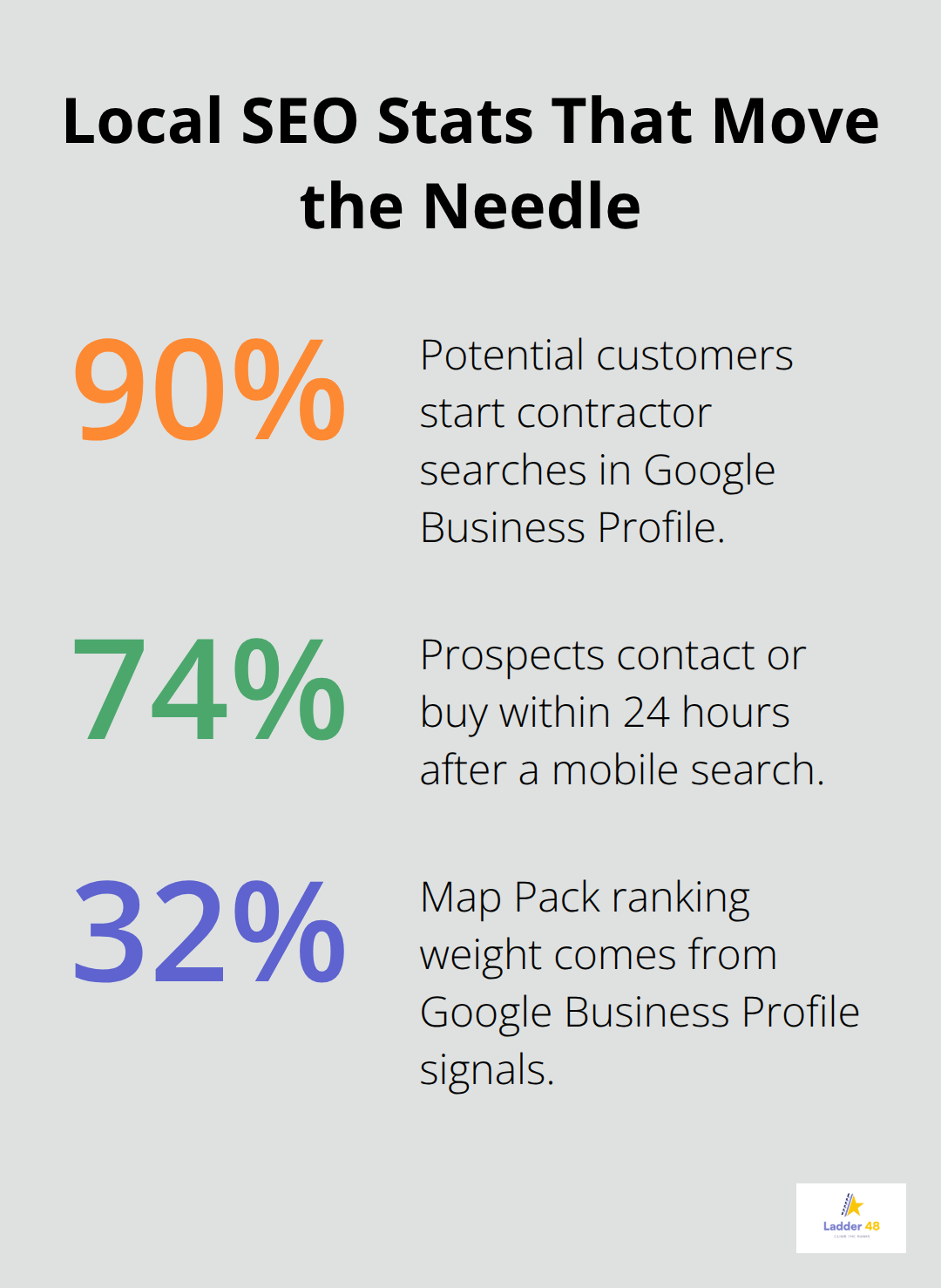
Your Google Business Profile is where 90% of potential customers start their search for contractors, according to Google data. If your profile is incomplete or outdated, you lose leads before they even see your website. Treat your profile like a micro-website rather than a secondary directory listing. Upload 10 to 15 geo-tagged photos of actual job sites in your service areas-not stock images-because fresh, location-specific images drive engagement signals that influence rankings more than star counts alone.
Optimize Your Profile for Maximum Visibility
Add around 22 services with keyword-rich descriptions like “emergency AC repair in Dallas” instead of generic terms. Post weekly updates tied to actual seasonal work or completed projects; meaningless posts won’t move rankings, but consistent activity tied to real business activity signals to Google that your profile is active and trustworthy. Google prioritizes reviews posted in the trailing 90 days over older ones, so develop a structured process to request reviews during final walkthroughs before payment discussions. In-person requests generate far higher response rates than email or invoice-based requests.
Citations Build Trust Across the Web
Citations-consistent listings of your name, address, and phone number across directories-matter less for volume and more for accuracy. Fix your presence on Google, Facebook, Yelp, BBB, and industry-specific directories first; ensuring consistent NAP across these critical sources prevents Google from questioning your legitimacy. Proximity still affects rankings, but Google now weighs relevance and authority more heavily, meaning a competitor slightly farther away with clearer signals can outrank you if their Google profile and citations are stronger.
Location Keywords Belong on Service Pages, Not Blog Posts
Location-specific keywords belong on your website service pages and dedicated landing pages, not scattered randomly across blog posts. Each major service should have its own page covering the problem, your process, timeline, cost guidance, local examples, and a direct call-to-action. Create neighborhood or city pages only if you serve those areas actively and can reference real local projects; duplicate content across multiple city pages tanks rankings rather than boosting them. These location pages should mention specific neighborhoods, local building codes, and climate considerations to prove you understand the local market, not templated city pages with swapped names.
Your foundation is now solid. Next, you’ll optimize the technical and on-page elements that tell Google exactly what services you offer and where you operate.
On-Page Technical Setup That Actually Converts
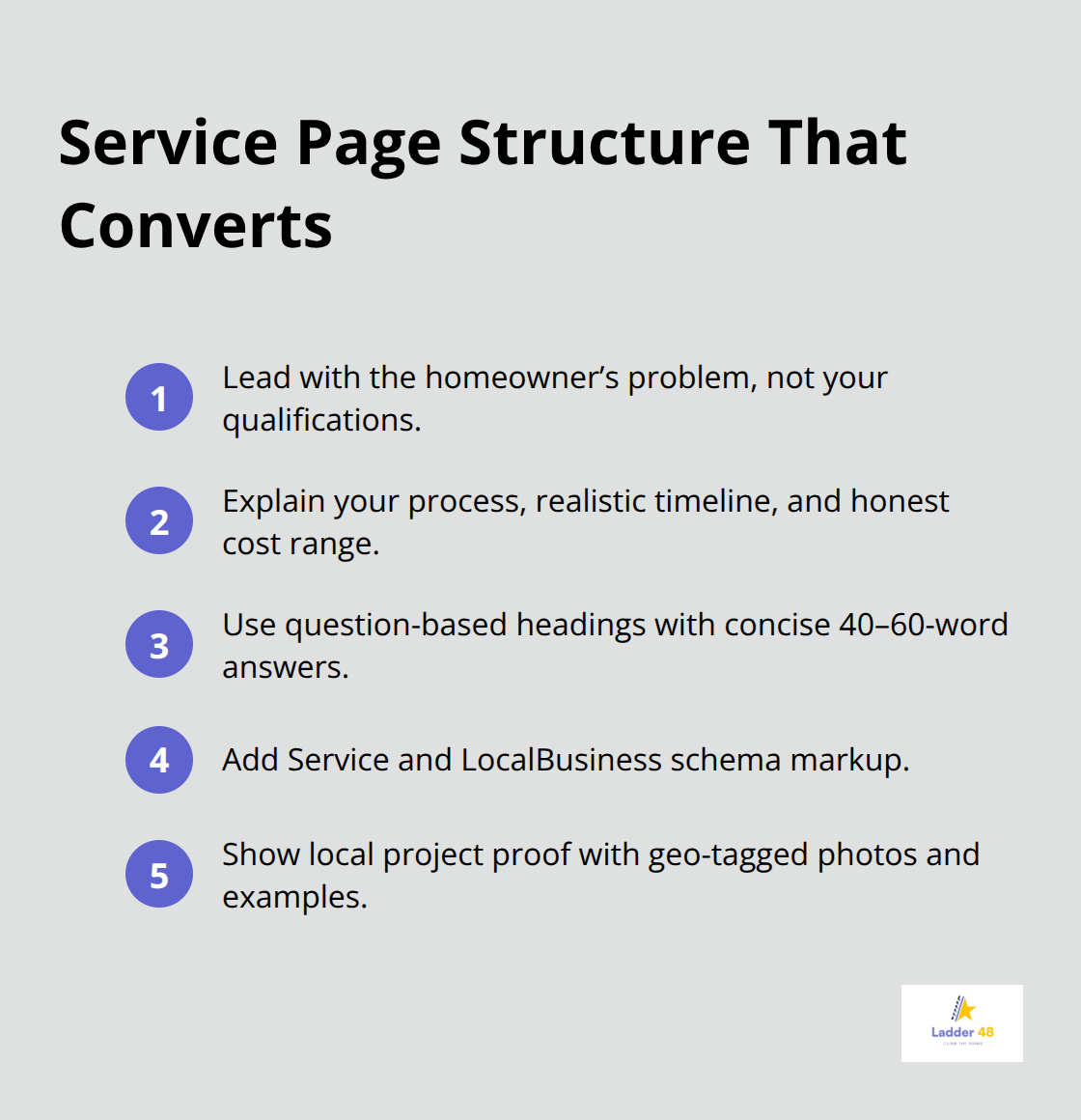
Service pages fail most contractors because they’re written for Google instead of for homeowners deciding whether to call. Your service page should start by explaining the problem a customer faces-not your qualifications-then walk through your exact process, realistic timeline, and honest cost range before asking for a quote. Google rewards pages that answer specific questions with 40 to 60 word direct responses using question-based headings, so structure your kitchen remodeling page with headings like “How long does a kitchen remodel take in Dallas?” followed by a concise answer that mentions local permit timelines and seasonal delays.
Structure Your Service Pages for Real Customers
Add schema markup for Service and LocalBusiness data to help Google understand your offerings; this structured data appears in AI-driven search answers and featured snippets, giving you visibility even when you don’t rank in the traditional top three. Each service page should reference real completed projects in your area and include geo-tagged photos from actual job sites because signal clarity-proving you’ve done this work locally-matters more than generic testimonials. Location pages differ from service pages and must prove you operate in specific neighborhoods; mention actual street names, reference local building codes, and link to service pages you’ve completed in that area.
Avoid Content Duplication Across Cities
Never duplicate content across multiple city pages; Google treats templated city pages as thin content and will penalize your rankings, so write unique location pages only for areas where you actively bid jobs and can reference real work. Each location page should feel lived-in with specific neighborhood references and local context rather than templated with swapped city names. This distinction signals to Google that you genuinely serve those areas and understand local conditions.
Speed Matters More Than You Think
Your website must load in under three seconds on mobile or you lose leads to competitors with faster sites. Google data shows 74% of potential customers contact or buy within 24 hours, meaning a slow mobile experience costs you jobs immediately, not eventually. Compress images aggressively-job site photos should be under 100KB each-use a content delivery network, and enable browser caching to hit the three-second target.
Optimize for Mobile Conversions
Test your actual mobile speed in Google PageSpeed Insights and prioritize fixing issues that impact Core Web Vitals: Largest Contentful Paint, First Input Delay, and Cumulative Layout Shift. A sticky call button on mobile that stays visible as users scroll is non-negotiable; one-click quote forms reduce friction and capture leads from people browsing on phones during lunch breaks or between appointments. Avoid auto-playing videos and intrusive pop-ups that slow load times and frustrate mobile users before they even read your content.
With your technical foundation in place, the next step focuses on building authority through the content and links that prove your expertise to both Google and potential customers.
Proof of Work Builds Authority Faster Than Words
Real Job Site Photos Drive Rankings More Than Reviews
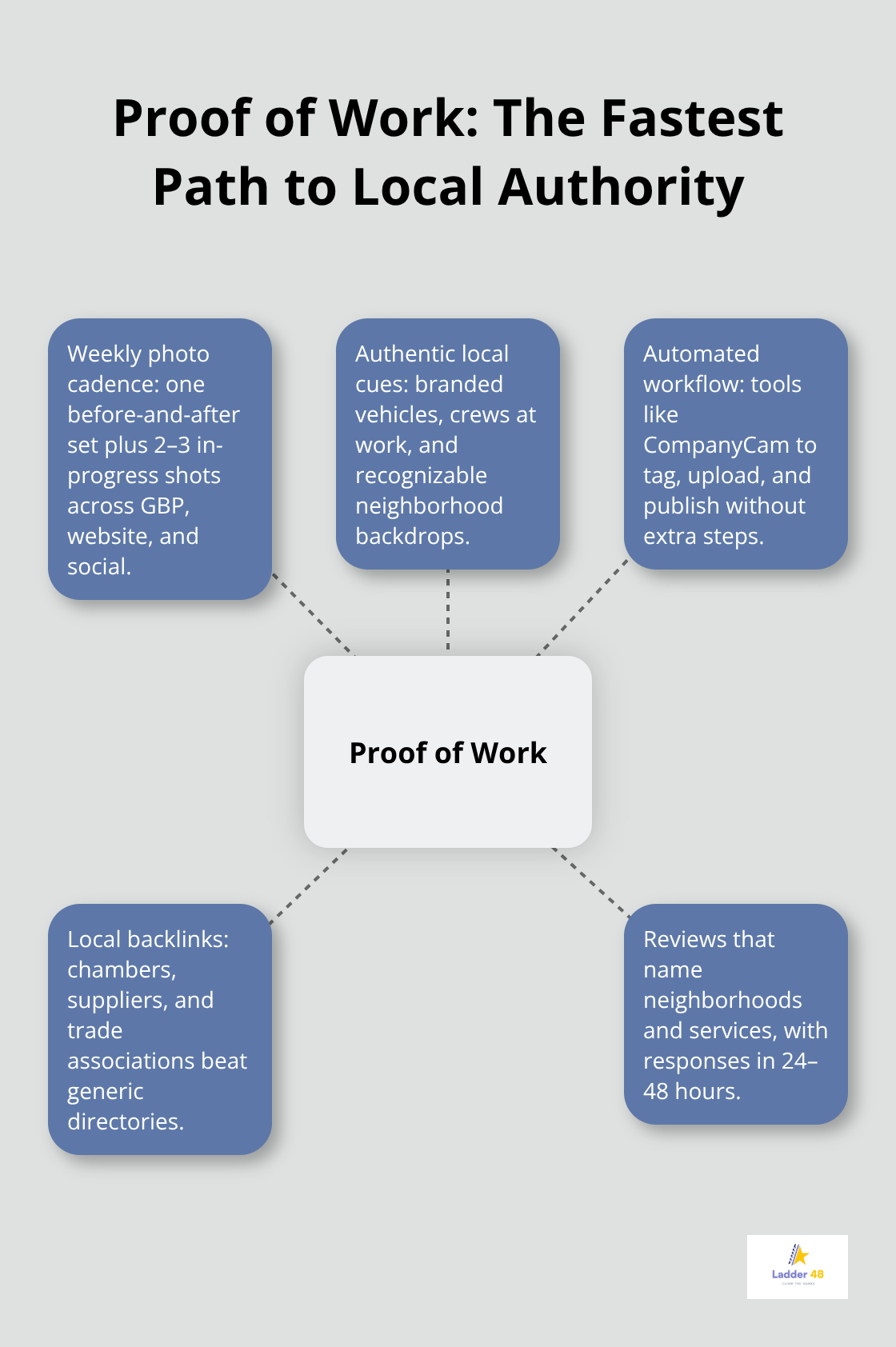
Project photography transforms your authority from claimed expertise into visible proof. You should publish one before-and-after set and two to three work-in-progress photos every week across your website, Google Business Profile, and social channels. Real job site images with your branded vehicles, crews actively working, and actual neighborhood backgrounds signal to Google that you operate locally and complete real work regularly. Whitespark’s 2026 Local Search Ranking Factors research shows Google Business Profile signals account for roughly 32% of Map Pack ranking weight, and fresh jobsite imagery drives engagement signals more effectively than high star counts alone. A contractor who publishes weekly project photos with geo-tags and neighborhood context will outrank a competitor with a 4.9-star rating who posts once monthly because signal recency and activity patterns matter more than historical review volume.
Automate Your Photo Workflow to Stay Consistent
Tools like CompanyCam let you tag photos as Before and After, then automatically upload them to your Google Business Profile and generate social media posts simultaneously, reducing the friction that stops most contractors from maintaining consistent visual proof. Stop relying on testimonials and stock images; homeowners in Dallas searching for roof repair want to see actual roofs repaired in Dallas neighborhoods, not generic praise from unnamed clients. Your crews should photograph every job site from multiple angles, including branded vehicles and neighborhood landmarks that prove you work locally.
Local Backlinks Outperform Generic Directory Links
Local backlinks from Chamber of Commerce partnerships, supplier catalogs, trade associations, and neighborhood business directories carry far more weight than links from generic directories. Relevance matters more than volume, so one quality link from your local Chamber of Commerce or a trusted supplier page outperforms ten links from irrelevant websites. These partnerships also create opportunities for co-marketing and referrals that extend beyond search rankings.
Reviews Need Specificity and Speed to Move Rankings
You should request reviews during final walkthroughs before payment discussions, and encourage customers to mention specific neighborhoods and services in their reviews because Google prioritizes review recency and detail over raw volume. A review stating “John replaced our roof in the Oak Lawn neighborhood and finished two days early” signals local relevance and service specificity more powerfully than ten five-star reviews saying “Great company.” You must respond to every review publicly within 24 to 48 hours, whether positive or negative, because Google interprets rapid responses as a signal of active business management and customer care.
Reduce Friction in Your Review Request Process
You should set up a structured review request process using QR codes or tap tags at the final walkthrough to reduce friction and capture reviews while satisfaction is highest; in-person requests generate response rates three to five times higher than email-based requests. Reviews posted within the trailing 90 days carry substantially more ranking weight than older reviews, so consistency matters more than accumulating hundreds of stale testimonials. You should track review volume and response rates monthly and adjust your request timing and method if response rates drop below 15% of completed jobs.
Final Thoughts
Local contractor SEO tips work only when you implement them consistently over time. The foundation you’ve built-claiming your Google Business Profile, optimizing service pages with real project proof, and earning local backlinks-creates a system that compounds month after month. Most contractors fail not because the strategy is wrong, but because they stop after two weeks or switch tactics before results appear. Local SEO timelines are real: expect initial visibility within three months, then trust-building through four to six months, and compounding advantage by month seven through twelve.
Your crews photograph job sites, your office staff manages review requests and Google Business Profile updates, and someone builds location pages and optimizes service content. Most contractors choose to focus on what they do best-completing quality work-and partner with an SEO specialist to handle the digital side. We at Ladder 48 help contractors implement these exact strategies without the guesswork, building Google Business Profile authority, creating service pages that convert, publishing weekly project proof, and earning local backlinks that move rankings.
Start today by claiming your Google Business Profile and uploading ten geo-tagged job site photos. Request reviews from your last five completed jobs using in-person requests during final walkthroughs. Create one service page with real local examples and schema markup, and these three actions alone will move your rankings within 30 days. If you want to accelerate results and remove the operational burden, Ladder 48 can build your local SEO system while you focus on running your business.
![Understanding Google Algorithm Updates for Roofers [2026]](https://ladder48.com/wp-content/uploads/emplibot/roofer-seo-algorithm-hero-1780186244-300x168.jpeg)
