Most concrete contractors lose jobs to competitors simply because they’re targeting the wrong keywords. You’re probably attracting visitors who aren’t ready to hire, while missing the ones actively searching for your specific services.
At Ladder 48, we’ve helped hundreds of contractors fix this problem through concrete contractor keyword research that actually converts. This guide shows you exactly how to find the high-intent keywords your customers use, analyze what your competitors are missing, and structure your website to win more jobs.
What Search Intent Really Means for Concrete Contractors
Search intent separates contractors who waste money on clicks from those who consistently convert leads into jobs. When someone searches for concrete services, they signal exactly what they need right now. Your job is recognizing which searches mean money and which ones don’t.
Local searches dominate concrete contractor demand
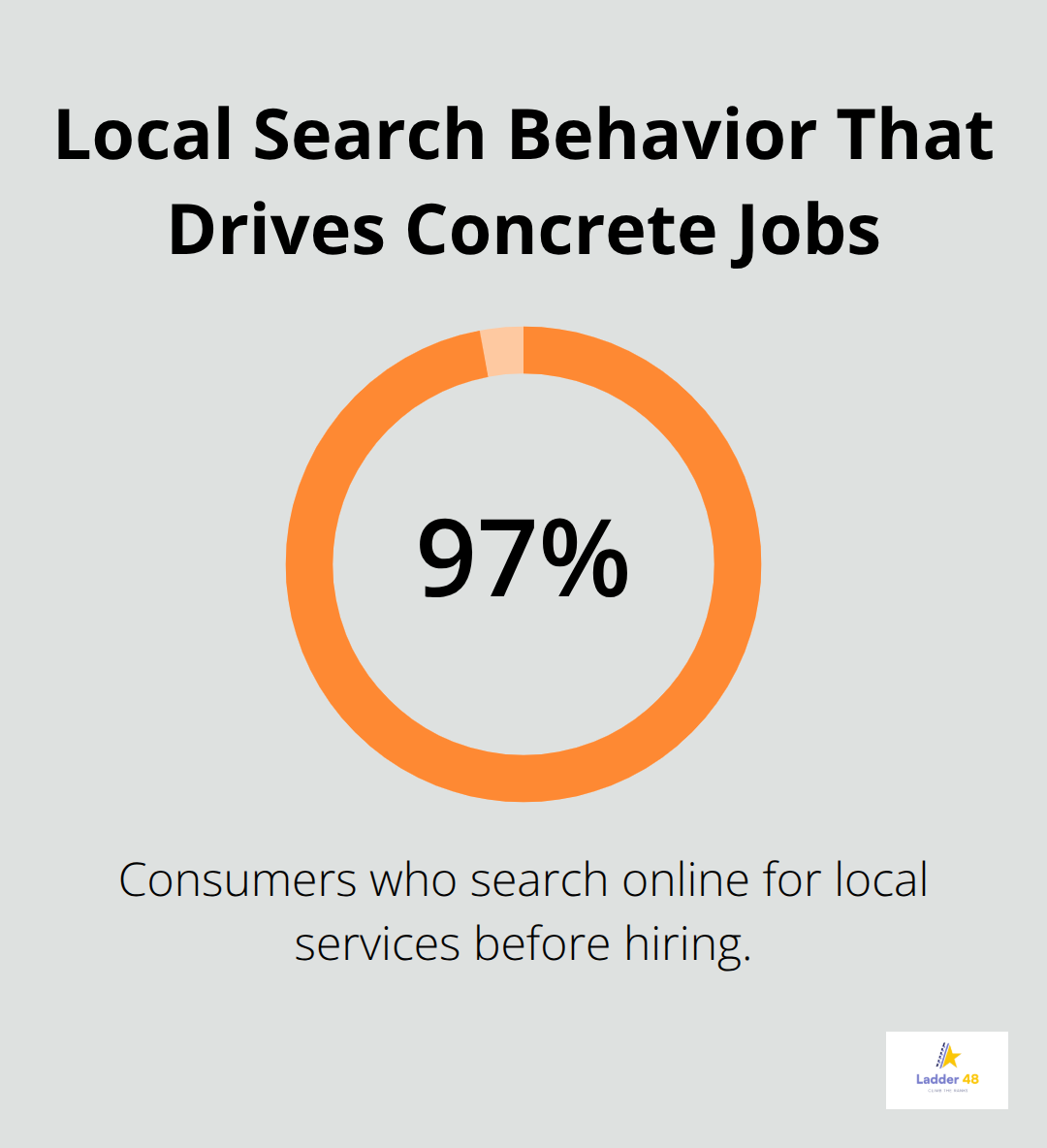
Local search queries dominate concrete contractor searches because homeowners and business owners search for services near them. Data shows that 97% of consumers search online for local services before hiring, and concrete contractors benefit directly from this behavior. When someone types “concrete contractor near me,” “concrete driveway repair near me,” or “concrete companies near me,” they actively look to hire. These local searches generate 33,100 to 325,200 monthly searches depending on the specific phrase, and they convert at much higher rates than generic searches.
The critical mistake most contractors make is treating all local searches the same. A search for “concrete patio ideas” differs completely from “concrete patio contractor near me.” The first person researches. The second person is ready to call. You need keywords that target people in the second group because they’re the ones who actually pay invoices.
Informational keywords waste your budget
Informational keywords like “how to stain concrete patio” or “how long does concrete take to dry” pull in high search volume, often exceeding 28,800 monthly searches, but these people aren’t hiring anyone. They solve problems themselves or gather general knowledge. Commercial keywords like “concrete driveway cost” or “concrete repair near me” indicate someone evaluating contractors and pricing. These searches have lower volume but dramatically higher conversion potential.
High-intent keywords combine location specificity with service clarity and urgency. “Concrete crack repair near me” has 64,800 monthly searches and signals someone with a broken driveway looking for solutions immediately. “Best concrete contractor in Denver” or “concrete foundation repair Houston” narrow the audience to people actively comparing contractors in specific areas. These keywords typically carry Google Ads costs between $3 and $10 per click because they convert so reliably.
Long-tail keywords outperform broad terms
Your strategy should prioritize high-intent phrases over broad terms like “concrete contractor,” which generates 325,200 yearly searches but costs $3 to $10 per click and attracts browsers, not buyers. Long-tail keywords with three or more words consistently outperform shorter phrases for concrete services. “Concrete driveway replacement cost near me” or “residential cement services in Houston” capture specific buyer intent at lower competition levels.
The data proves this approach works-contractors report 342% increases in website visitors and 52x ROI within 12 months by targeting high-intent keywords aligned with their service areas. This performance difference explains why your next step involves analyzing which keywords your competitors target and where gaps exist in the market.
Building Your Keyword Strategy Around Real Market Data
Start by studying what your direct competitors actually rank for, not what you assume they target. Open Google Search Console or SEMrush and pull the keywords that drive traffic to three to five competitors’ websites in your service area. You’ll see patterns immediately-which local modifiers they prioritize, which service combinations they own, and which high-volume terms they’ve completely ignored. Most concrete contractors skip this step and waste months targeting keywords their competitors already dominate. When you find terms with 15,000 to 30,000 monthly searches that competitors don’t optimize for, that’s your opening. For example, if competitors rank for “concrete driveway contractor Denver” but ignore “stamped concrete driveway Denver,” you’ve found a gap worth pursuing.
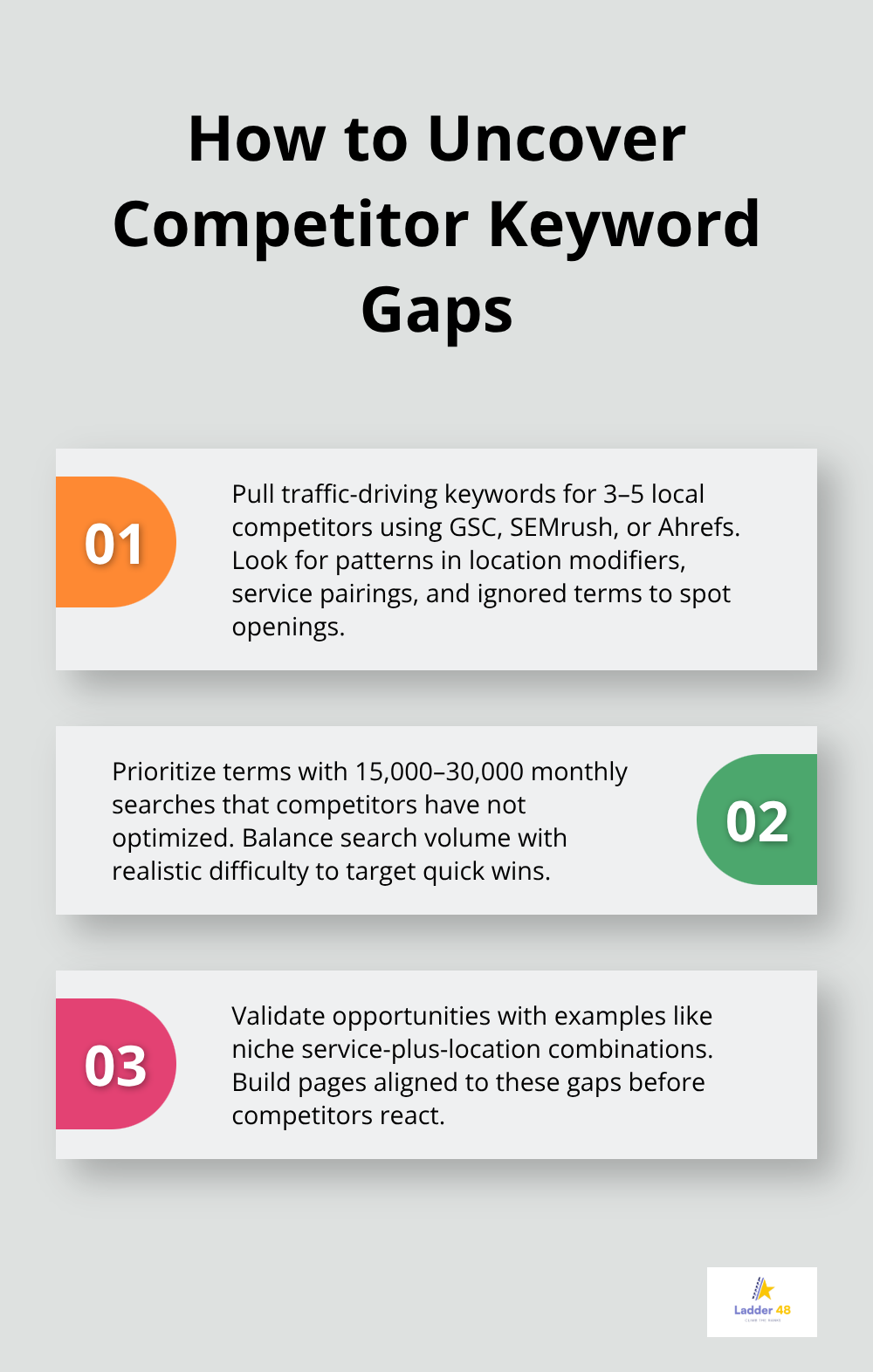
Use Ahrefs or SEMrush to check keyword difficulty scores-try for terms between 30 and 50 difficulty when starting out, as these offer realistic ranking timelines without requiring massive authority.
Finding keywords your competitors miss
Google Keyword Planner reveals search volume your competitors overlook because they only check broad terms. Filter for location-specific phrases with three to five words and sort by search volume. You’ll find combinations like “concrete foundation repair Houston residential” that pull 8,000 to 12,000 monthly searches with difficulty scores under 45. These long-tail variations convert better than short terms because they signal exactly what someone needs. Use Answer The Public to identify question-based keywords competitors ignore-searches like “how much does concrete repair cost near me” or “can you repair stamped concrete” show real customer concerns worth addressing. Seasonal variations matter too; “concrete patio installation spring” spikes March through May in most markets, yet contractors rarely create seasonal content around these terms. Track these patterns in Google Trends for your region over a full year to plan content timing.
Matching keywords to your actual service territory
Territory mapping prevents wasted effort on keywords outside your service area. If you operate in three counties, create separate keyword lists for each region rather than targeting one broad area. A contractor in Denver should pursue “concrete contractor north Denver,” “concrete contractor southwest Denver,” and “concrete contractor southeast Denver” as distinct targets because search volume concentrates locally. Google Ads keyword planner shows exact search volumes for city and neighborhood combinations-use this data to prioritize which areas produce the most searches relative to your capacity. Assign your highest-difficulty keywords to service areas where you already have strong reviews and completed projects, as local authority helps rankings. For specialized services like epoxy concrete repair or decorative stamped concrete, pair service keywords with location modifiers-“epoxy concrete repair near me” searches pull 15,600 monthly queries at much lower competition than generic repair terms. This combination approach ensures every keyword you pursue aligns with both market demand and your operational reality, setting the foundation for the next critical step: structuring your website pages to convert the traffic these keywords attract.
Converting Keyword Traffic Into Jobs on Your Website
Your keyword research means nothing if your website pages fail to convert the visitors those keywords attract. Most concrete contractors make the mistake of cramming keywords onto existing pages without restructuring how information flows or addressing what their customers actually want to know. When someone searches for concrete driveway repair near me and lands on your homepage, they need to see project photos, pricing information, and a clear path to request a quote within seconds. Your page structure determines whether that visitor becomes a lead or bounces to a competitor.
Create dedicated pages for your highest-intent keywords
Start with dedicated service pages for your highest-intent keywords rather than trying to rank for multiple services on a single page. A page targeting concrete driveway replacement should have that exact phrase in the title tag, H1 heading, and first paragraph because search engines reward tight alignment between keyword and content. Use your target keyword naturally two to three times throughout the page, focusing on the first 100 words where search engines weight relevance most heavily. Include your secondary keywords in H2 and H3 subheadings to organize content logically while capturing related searches. For example, a concrete driveway page might use H2 headings like Concrete Driveway Installation Process, Driveway Repair vs. Full Replacement, and Concrete Driveway Costs in Your Area. This structure helps both search engines and visitors understand your expertise while addressing the specific questions people search for when considering your services.
Address customer problems before promoting your company
Content that converts moves beyond describing what you do and focuses instead on solving the specific problems your customers face. Someone searching for concrete crack repair wants to know three things immediately: how much it costs, how long it takes, and whether they need to replace the entire surface. Address these concerns in your opening paragraphs before introducing your company background. Include real pricing ranges based on your service area rather than vague estimates, as searches like concrete driveway cost or concrete repair price near me pull 52,800 and 34,800 monthly searches respectively because people actively compare expenses. Add before-and-after project photos throughout your content because visual proof of quality matters more than written descriptions when someone evaluates contractors.
Test page layouts and track actual conversions
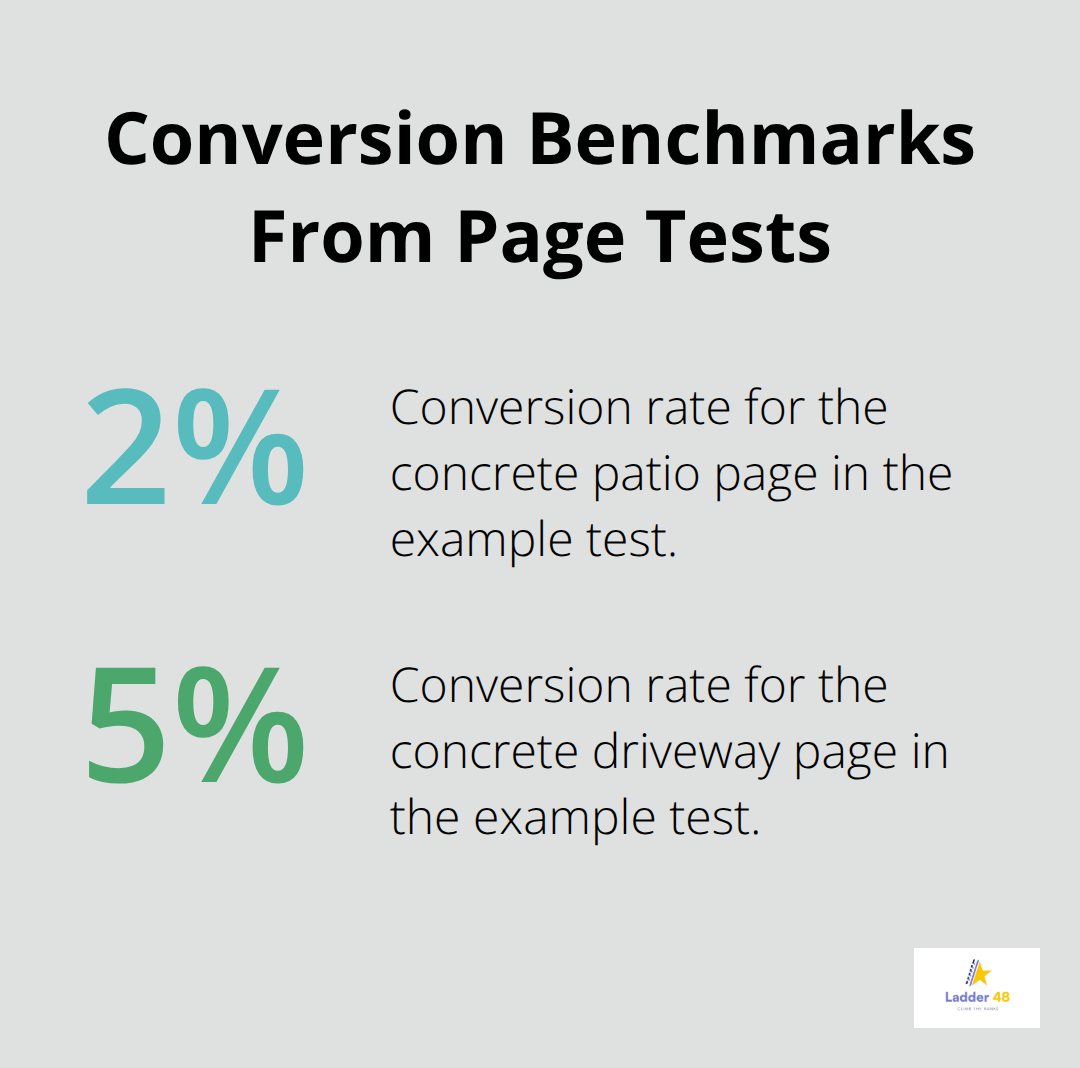
Test different page layouts by measuring conversion metrics in Google Analytics, specifically tracking phone calls and quote request submissions from each page. If your concrete patio page converts at 2% while your driveway page converts at 5%, analyze the differences and apply the higher-converting structure to underperforming pages. Most contractors never test their pages systematically, which leaves significant revenue on the table.
Set up conversion tracking in Google Analytics for phone calls using call tracking software like CallRail, which assigns unique phone numbers to different pages and traffic sources so you see exactly which keywords and pages generate actual phone inquiries.
Prioritize leads over rankings
Monitor your keyword rankings monthly using SEMrush or Ahrefs, but prioritize tracking actual leads and jobs over ranking position since a keyword ranking 15th that converts regularly outperforms a keyword ranking 3rd that attracts browsers. Adjust your content based on what visitors search for when they land on your pages by reviewing Google Search Console quarterly, looking for queries where you rank positions 4 through 10 that could move to the top three with minor content improvements. This data-driven approach ensures your keyword strategy produces real business results rather than vanity metrics.
Final Thoughts
Concrete contractor keyword research that converts requires you to target high-intent local searches where customers actively hire, structure your website pages to address specific customer problems, and measure actual conversions rather than ranking positions. Most contractors waste months chasing broad keywords that attract browsers instead of buyers, while the contractors who win focus on long-tail phrases with location specificity, analyze competitor gaps, and build dedicated pages that convert visitors into phone calls and quote requests. Your immediate next step is auditing your current website against the keywords your competitors rank for using SEMrush or Ahrefs, then identifying the high-intent terms they’ve missed so you can create a 90-day content plan targeting those gaps.
Set up conversion tracking in Google Analytics and CallRail to measure which keywords and pages actually generate phone inquiries, not just traffic (this data reveals which searches truly matter for your business). Assign your highest-difficulty keywords to service areas where you already have strong reviews and completed projects, since local authority helps rankings significantly. Review your data monthly and adjust underperforming pages based on what visitors search for when they land on your site, ensuring every keyword effort produces real business results.
We at Ladder 48 help contractors dominate local search by combining concrete contractor keyword research with transparent, results-driven SEO strategies tailored to your specific service areas and specialties. Contact Ladder 48 to build a stronger online presence and achieve sustainable growth for your contracting business.