Concrete companies lose thousands in revenue every month because potential customers can’t find them online. At Ladder 48, we’ve helped dozens of concrete contractors dominate their local search results and attract qualified leads consistently.
This guide walks you through concrete company optimization strategies that actually work-from claiming your Google Business Profile to earning backlinks from local publications. You’ll learn exactly what separates concrete companies that thrive from those that barely survive.
Local SEO Fundamentals for Concrete Companies
Your Google Business Profile is where 46% of all searches with local intent begin. That’s not a suggestion to optimize it-that’s an instruction. Concrete contractors who claim and fully optimize their profile see significantly higher visibility in Google Maps and local search results. When you claim your profile, you tell Google that your business is real and verified. Fill out every single field: your business name, address, phone number, website, hours of operation, and a detailed service description that lists everything you offer, from stamped concrete to foundation work. Choose Concrete Contractor as your primary category and add secondary categories like Ready-Mix Concrete Supplier or Concrete Paving Contractor if they apply. Upload high-quality photos of your work, your team, and your equipment-not generic stock images. Post weekly updates on your profile to keep it active and signal to Google that your business is current. This isn’t optional.
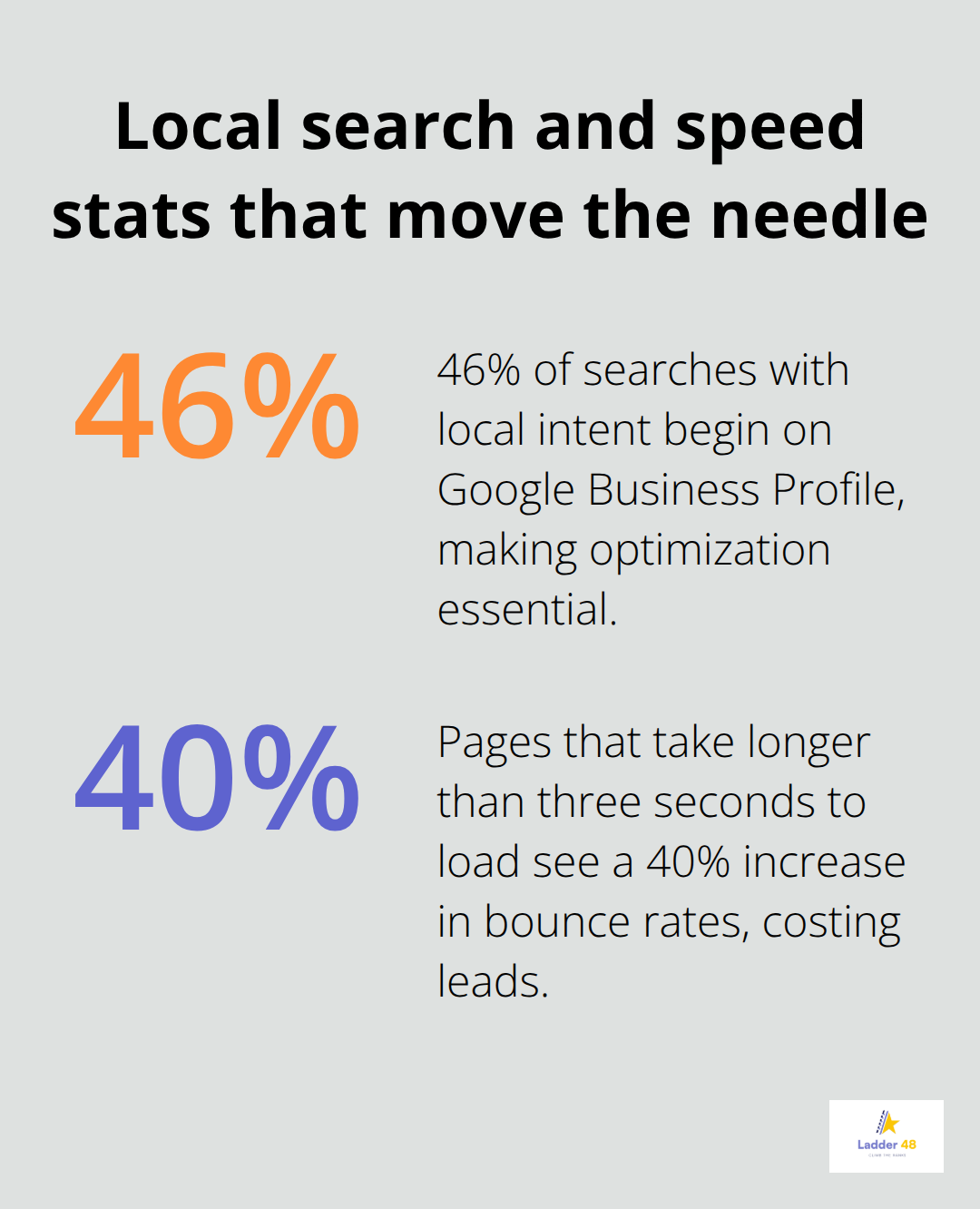
Studies show that complete Google Business Profiles with photos and regular posts get 10 times more clicks than incomplete ones.
Citations Build Authority Across the Web
Google Business Profile alone won’t dominate your local market. You need citations-consistent mentions of your business name, address, and phone number across directories like Yelp, Angi, the Better Business Bureau, your local chamber of commerce, and industry-specific sites like ConcreteNetwork.com. Inconsistencies in your NAP data across platforms confuse Google’s algorithm and tank your rankings. Conduct an audit of your current online presence and identify every discrepancy. If your address appears as 123 Main Street on one site and 123 Main St. on another, fix it immediately. A listing management tool syncs your information across dozens of platforms at once instead of forcing you to manually update each one. This approach saves hours of work and prevents costly mistakes that damage your local visibility.
Reviews Convert Faster Than Paid Ads
Customer reviews convert faster than any advertisement you’ll run. Concrete companies with 50+ Google reviews see dramatically higher quote request rates than those with fewer. Most contractors wait passively for reviews to come in. Instead, build a system that works. After a project completes, send your customer a text message or email with a direct link to your Google review page within 24 hours-that’s when satisfaction peaks. Make the process frictionless. Don’t ask them to search for your business; give them the link. Train yourself and your team to ask satisfied customers for reviews in person while you’re still on the job site. Respond to every single review, positive or negative. Thank people for positive reviews and address concerns in negative ones professionally and quickly. Negative reviews that sit unanswered signal to potential customers that you don’t care about feedback.
What Comes Next
Your Google Business Profile, citations, and review system form the foundation of local visibility. But these tactics alone won’t fill your pipeline with qualified leads. The next chapter covers the content strategy that turns visibility into actual phone calls and quote requests from homeowners and contractors who actively search for your services.
How to Target Customers Actually Searching for Concrete Work
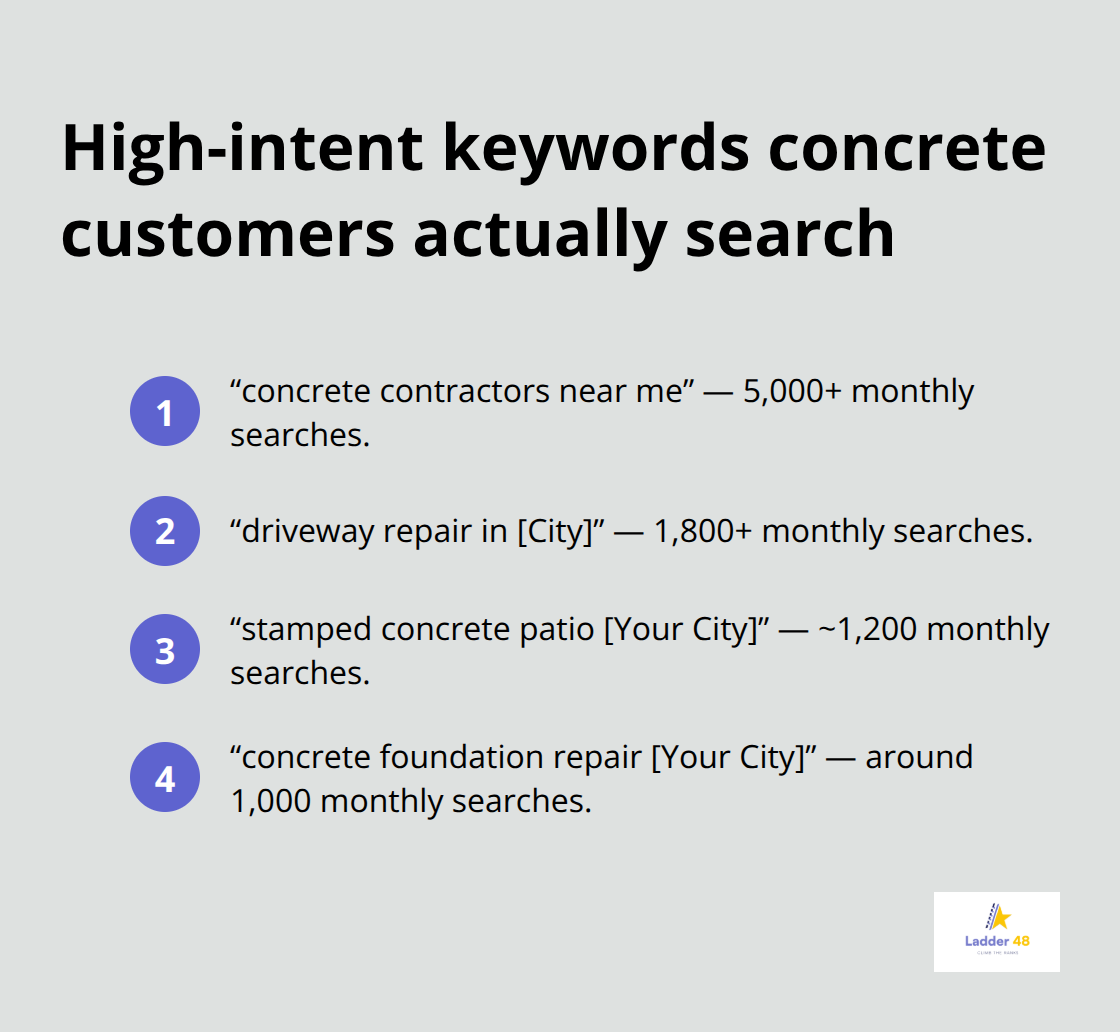
Visibility means nothing if you’re not visible to the right people. The concrete contractors generating consistent leads rank for high-intent keywords that match what homeowners and contractors actually type into Google when they need work done. Searches like “concrete contractors near me” pull 5,000+ monthly searches, while “driveway repair in [City]” attracts 1,800+ searches per month. These aren’t vanity metrics-they’re potential jobs. Most concrete companies target keywords that are either too broad or completely irrelevant to their service area. If you pour concrete in Fort Collins but your website targets “concrete contractors in Denver,” you waste ranking effort on markets you don’t serve.
Match Keywords to Your Service Area
Start with five to seven keywords that match your actual service area and the specific work you do. If you specialize in stamped concrete patios, target “stamped concrete patio [Your City]” which pulls roughly 1,200 monthly searches. If foundation repair is your bread and butter, go after “concrete foundation repair [Your City]” with around 1,000 monthly searches. These keywords convert because they show intent-someone searching for “driveway repair in Loveland” actively looks to hire, not just research.
Build Location-Specific Pages That Rank
Create dedicated pages on your website for each service area you actually serve. One page targets Fort Collins, another targets Loveland, another targets Windsor. Each page needs a city-specific headline, a description of your local work, testimonials from customers in that area, and your contact information. Google rewards specificity, and homeowners trust contractors who demonstrate deep knowledge of their neighborhood. Include photos of projects you’ve completed in each city, not generic concrete work from somewhere else. If you’ve poured foundations in the same neighborhood, state it clearly. Local relevance matters more than most contractors realize.
Develop Case Studies That Convert Prospects
Your best marketing asset sits in your completed projects. Create detailed case studies for your three to five best jobs-the ones that showcased your skill and solved real problems for customers. Don’t write generic before-and-after descriptions. Instead, explain the challenge the customer faced (maybe their old driveway was cracking and creating a safety hazard, or they wanted a patio that could handle Colorado’s freeze-thaw cycles). Describe your solution and why you chose it. Include multiple photos from different angles, showing the work at various stages. Add the customer’s testimonial if they’re willing.
These case studies accomplish two things simultaneously: they rank for long-tail keywords like “concrete patio installation in [City]” because they contain specific details Google values, and they build trust with potential customers who see exactly what you can deliver. Place these case studies on your service pages and link to them from your homepage. When someone lands on your site and sees a detailed case study of a project similar to theirs, they’re far more likely to request a quote than if they only see generic photos.
What Drives Qualified Leads to Your Phone
Concrete contractors who invest time in location-specific pages and detailed project case studies see measurable increases in local search visibility and qualified leads within three to four months. But ranking for the right keywords and converting visitors into leads requires more than just content. The next chapter covers the technical foundation that makes your website fast, mobile-friendly, and trustworthy-the factors that separate contractors who capture leads from those who watch prospects click away to competitors.
Technical SEO and Local Link Building
Your website could rank perfectly for every local keyword, but if it loads in four seconds instead of two, you lose customers to competitors. Google prioritizes fast websites in search rankings, and more importantly, visitors abandon slow sites before they even see your work. A Google study found that pages taking longer than three seconds to load see a 40% increase in bounce rates. Concrete contractors operate on thin margins, so losing 40% of potential leads to slow page speed is unacceptable.
Fix Site Speed and Mobile Performance
Test your current site speed using Google PageSpeed Insights and identify the specific culprits-oversized images, unoptimized code, or poor hosting. Most concrete company websites feature massive project photos that look beautiful but cripple performance. Compress your images before uploading them; tools like TinyPNG reduce file sizes by 50-80% without visible quality loss.
Mobile responsiveness matters just as much. Over 60% of searches for local services happen on mobile devices, and Google now ranks mobile versions of websites first. If your site doesn’t display properly on phones, you’re invisible to the majority of people searching for concrete contractors in your area. Navigate your site on a phone and note every element that feels clunky or slow. Hire a developer to fix these issues now rather than waiting.
Implement Schema Markup for Local Authority
Schema markup tells Google exactly what information on your page means. For local concrete contractors, Local Business Schema is non-negotiable. This structured data displays your phone number, address, hours, and reviews directly in search results, giving potential customers immediate confidence and a reason to call.
Google’s Structured Data Markup Helper generates the code you need without requiring deep technical knowledge. Ask your web developer to implement this markup across your site, particularly on your homepage and location-specific pages. This single step improves your visibility in rich results and builds trust with prospects before they even click your listing.
Earn Backlinks from Local Sources
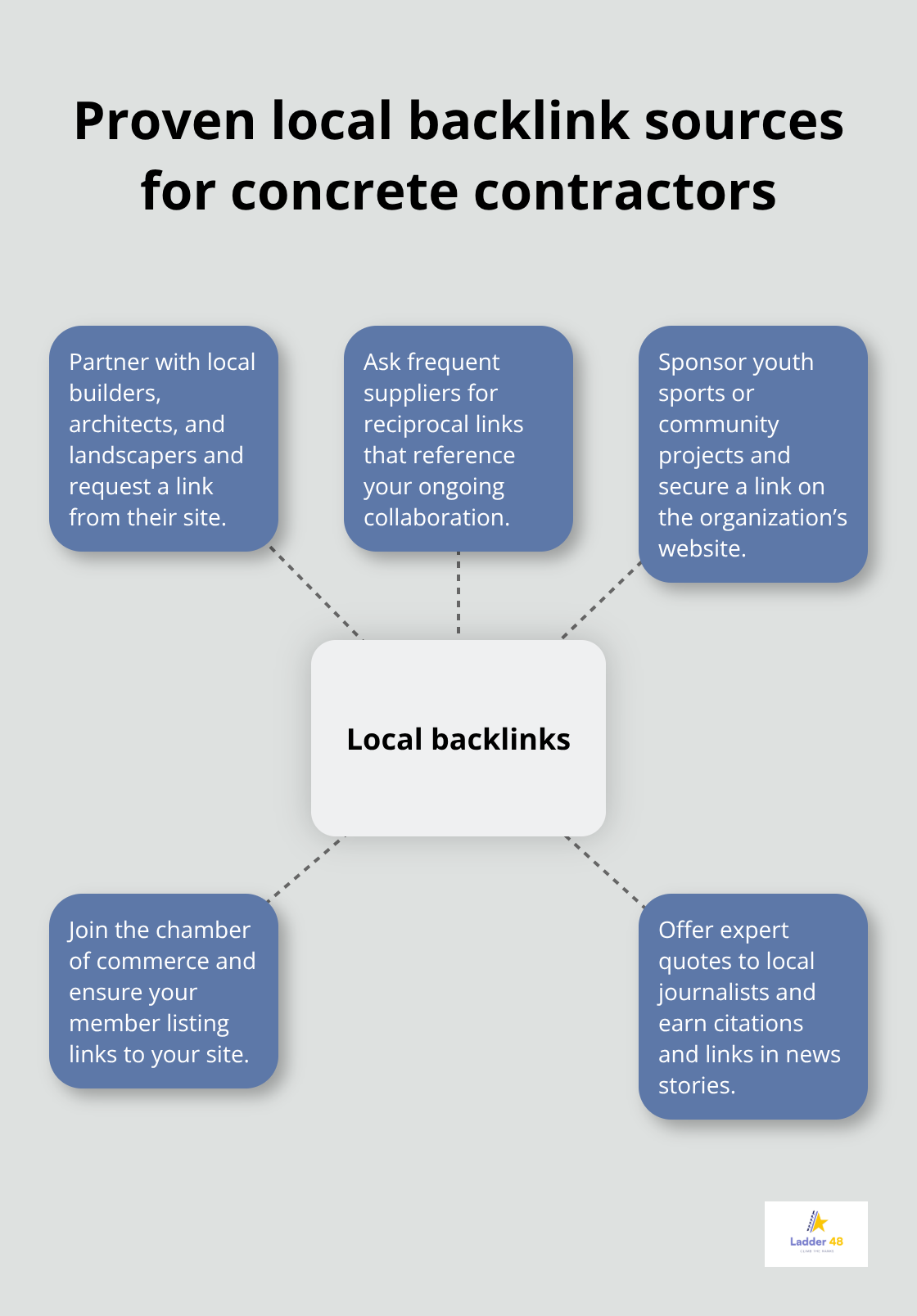
Local backlinks accelerate your rankings faster than nearly any other tactic. Partnerships with local builders, architects, and landscapers who link to your site signal to Google that your business matters in your community. Reach out to suppliers you work with regularly and propose reciprocal linking arrangements. Sponsor a local youth sports team or community project and ask them to feature your business on their website.
Join your local chamber of commerce and verify they link to your site from their member directory. Respond to local news stories about construction projects in your area-if a new development breaks ground in your city, contact the journalist and offer your expertise as a quote source. When they publish the article and mention your company with a link, you gain authority. These backlinks from trusted local sources carry more weight than generic directory listings and improve your rankings in your specific service area significantly faster than passive waiting.
Final Thoughts
Concrete company optimization requires consistent effort across multiple channels, but the payoff justifies the work. You’ve learned how to claim and optimize your Google Business Profile, build citations that establish authority, and gather reviews that convert faster than paid advertising. You’ve targeted the exact keywords your customers search for, created location-specific pages that rank, and developed case studies that showcase your best work.
These tactics work together to build momentum. Your Google Business Profile attracts local searchers while your location pages and case studies convert them into leads. Your schema markup and site speed keep them engaged, and your reviews and backlinks build the credibility that makes them call instead of clicking to a competitor. The contractors who dominate their local markets committed to local SEO as an ongoing program, not a one-time project-they optimized their profiles, maintained them, created content, updated it, and gathered reviews consistently, month after month.
Start with your Google Business Profile this week by claiming it, verifying it, and filling out every field completely. Next week, conduct a citation audit and fix NAP inconsistencies across directories. If you want expert guidance tailored to your specific market and service offerings, we at Ladder 48 specialize in helping contractors build stronger online presence through results-driven SEO strategies that generate qualified leads and sustainable growth.