Contractor SEO for startups isn’t optional anymore. Local search drives 46% of all Google searches, and most homeowners find contractors through Google Maps or local results.
We at Ladder 48 know that new contractor businesses can’t compete on budget alone. That’s why we’ve built this guide to show you exactly how to rank locally in your first 90 days, without expensive agencies or long-term contracts.
Build Your Foundation: Google Business Profile, Citations, and Local Pages
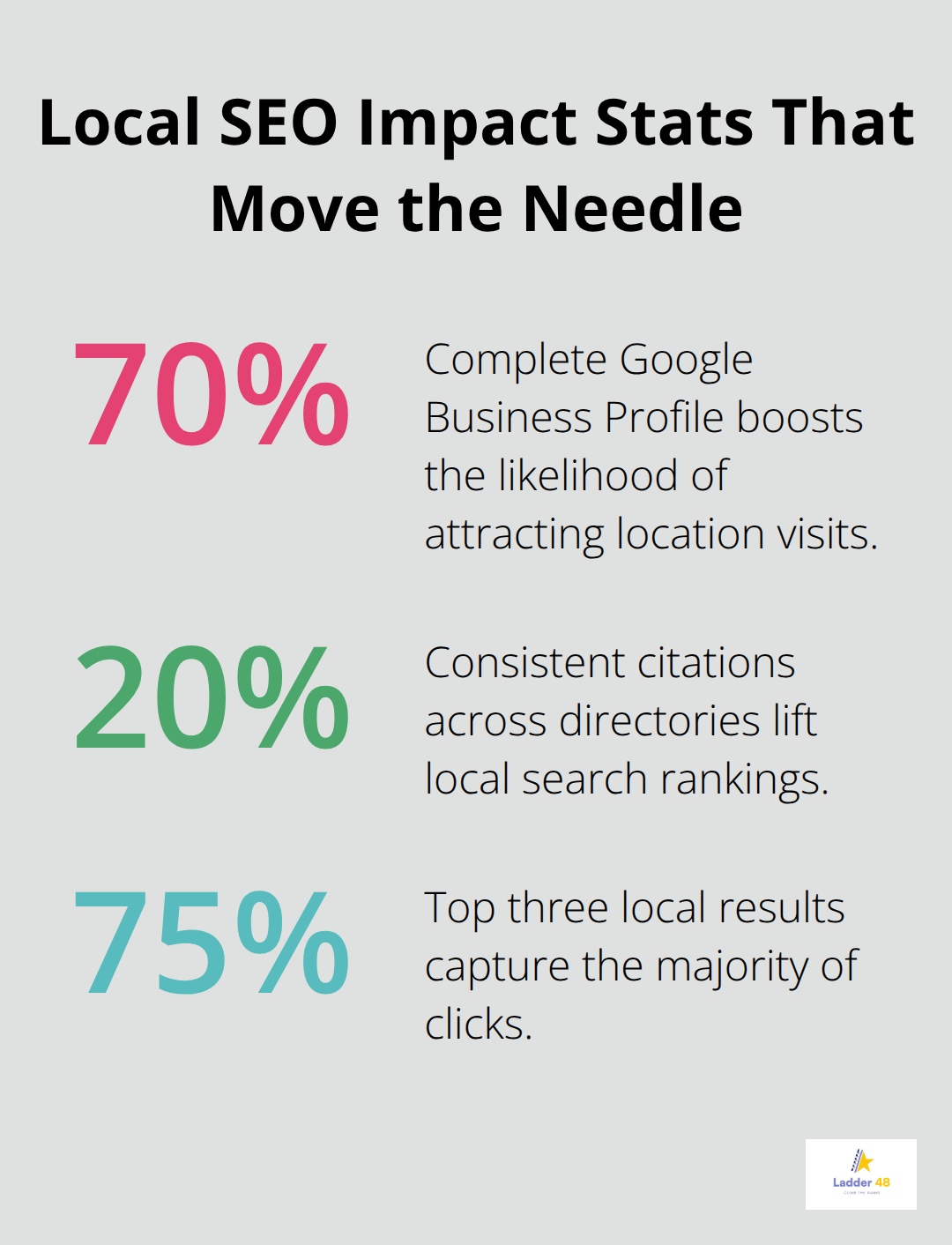
Your Google Business Profile is where local SEO begins. Claim it immediately if you haven’t already, then fill every field with accurate information. The profile name must match your actual business name exactly as it appears on your invoices and contracts. Add your service areas precisely-don’t just list your city. If you work in three neighborhoods, name them. Upload high-quality photos of your completed projects, your team, and your office or truck. Google rewards profiles with recent activity, so post updates weekly about new services, seasonal offers, or project completions. A complete profile increases the likelihood of attracting location visits by about 70 percent.
Citations Build Trust Across the Web
Citations are mentions of your business name, address, and phone number across directories like Yelp, Angi, and Houzz. Consistency matters enormously. If your profile says you’re at 123 Main Street but another directory lists 123 Main St., Google sees conflicting signals and ranks you lower. Maintain uniform data across every directory where you appear. Tools like BrightLocal simplify managing citations across multiple platforms at once. Consistent citations across directories yield about a 20 percent increase in search rankings. The real power comes from relevance-get listed on directories where homeowners actually search for contractors in your field. A plumber needs different directories than an electrician. Prioritize the platforms your customers use, not every directory available.
Service Area Pages Drive Local Relevance
Generic homepage content won’t rank you locally. Create separate pages for each city or neighborhood you serve, optimized with local landmarks, street names, and specific service descriptions. Don’t copy and paste. A service area page for Springfield should mention local schools, parks, and neighborhoods by name, then explain exactly what you offer there. Include proof you work locally-photos of projects in that area, testimonials from Springfield customers, and local phone numbers if possible. These pages signal to Google that you’re genuinely local, not a national company trying to capture every search. Link these pages internally from your homepage and service pages to build authority. The top three local search results receive roughly 75 percent of all clicks, and service area pages are how you earn that position in your specific markets.
Now that your foundation is solid, you’re ready to identify the quick wins that move the needle fastest. The next section shows you exactly which keywords to target and where to list your business to see measurable results within 90 days.
Quick Wins to Boost Rankings in Your First 90 Days
Long-tail keywords are your unfair advantage as a startup. While established contractors compete for generic terms like plumber or electrician, you target phrases like emergency drain cleaning in Springfield or licensed roofer near downtown. These phrases have lower search volume but far less competition, and they attract homeowners ready to hire. Type your service plus city name into Google’s search bar and note the suggestions that appear. The People Also Ask sections on Google show actual questions homeowners type in your area. Tools like Google Ads Keyword Planner and SEMrush reveal search volume and competition scores.
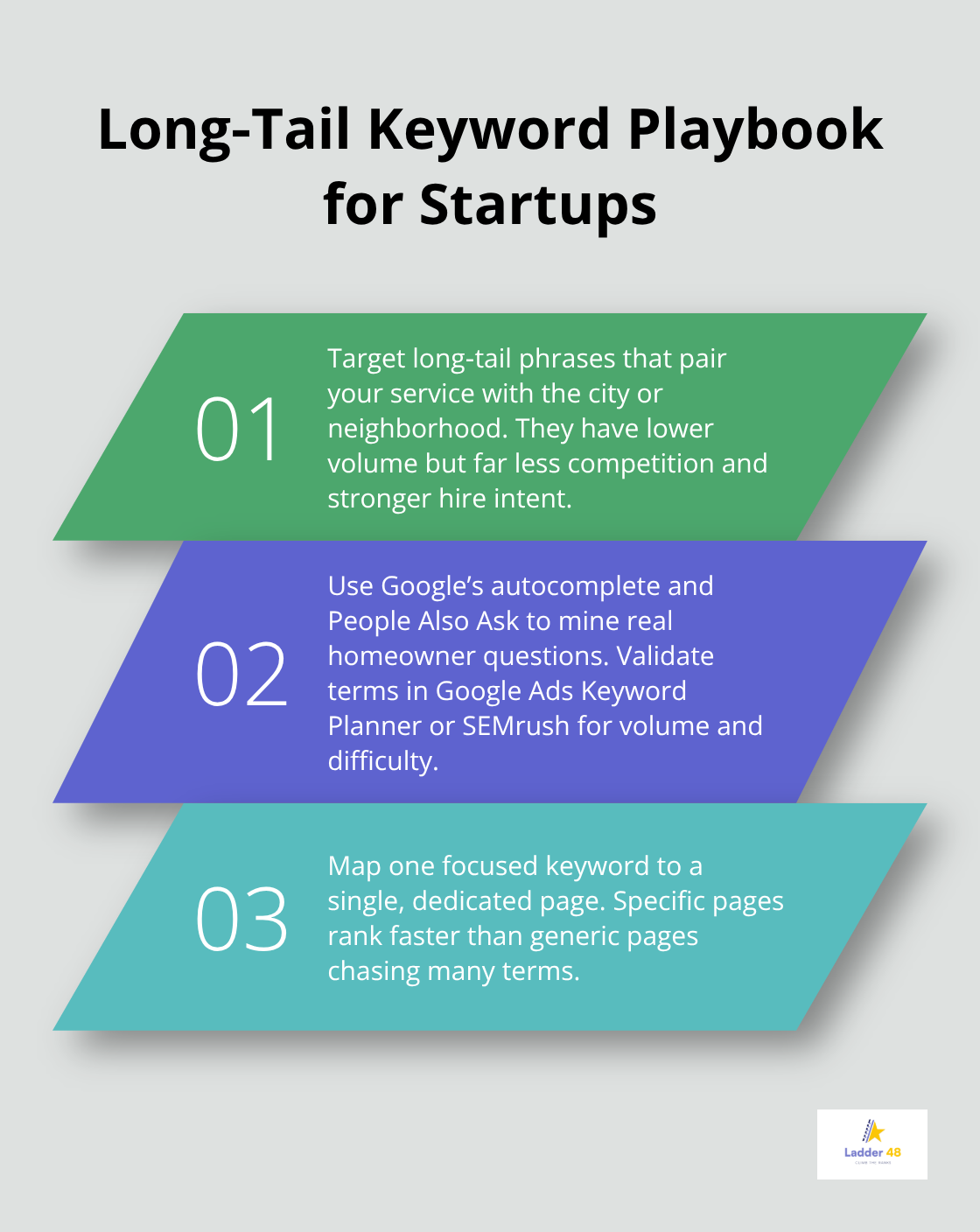
Target keywords with at least 20 monthly searches but competition scores below 30. Map these keywords to specific service pages, not your homepage. A page optimized for one specific long-tail keyword ranks faster than a generic page trying to rank for ten terms at once. According to Google, 72 percent of marketers say relevant keyword optimization is their top SEO priority. You don’t compete on budget, so compete on precision instead.
Industry Directories Drive Real Customer Traffic
Yelp, Angi, and Houzz are where homeowners actually search for contractors. Google rewards citations from authoritative, industry-specific directories more than generic business listings. Get listed on platforms where your customers spend time. A plumber should prioritize Angi and Yelp before trying every directory online. Houzz matters for renovations and home improvement work. Your local Chamber of Commerce and trade associations count too. Each citation sends a trust signal to Google that you’re a real, established business. Consistent listings across these directories yield about a 20 percent increase in search rankings. Complete your profiles fully on each platform. Upload project photos, respond to messages quickly, and keep hours and contact information current. Don’t spread yourself thin across fifty directories. Focus on five to seven high-authority platforms where homeowners in your area actually search.
Reviews Improve Rankings and Convert Leads
Reviews accomplish two critical goals simultaneously: they improve your local search rankings and convince homeowners to call you. A complete Google My Business profile with regular reviews increases the likelihood of attracting location visits by about 70 percent. Positive reviews boost search visibility by about 31 percent according to industry research. After every completed job, ask customers to leave reviews on Google and Yelp. Send a text link or email link directly to the review page to make the process frictionless. Respond to every review, positive or negative, within 24 hours. Negative reviews handled professionally actually build trust-homeowners know that perfect five-star ratings are fake. A business with 50 reviews, including some three-star reviews with thoughtful responses, ranks higher and converts better than a business with five perfect reviews. Review velocity matters too. Google rewards steady growth in reviews month over month. Try for three to five new reviews weekly, not fifty reviews in one week then nothing for two months. This consistency signals that your business is active and generates real customer experiences.
Now that you’ve claimed your foundation and identified quick wins, you’re ready to sidestep the mistakes that hold back most contractor startups. The next section reveals the three critical errors that tank local rankings and how to avoid them.
Common SEO Mistakes Contractor Startups Make
Most contractor startups tank their SEO without realizing it. You can claim your Google Business Profile and build citations perfectly, but one critical mistake wipes out all that work.
Mobile Performance Kills Rankings Fast
Mobile performance is the first mistake that kills rankings, and it’s non-negotiable in 2026. Nearly 60 percent of all online searches happen on mobile according to industry data, and for contractors, that number runs even higher. A one-second delay in page load reduces conversions by 7 percent.
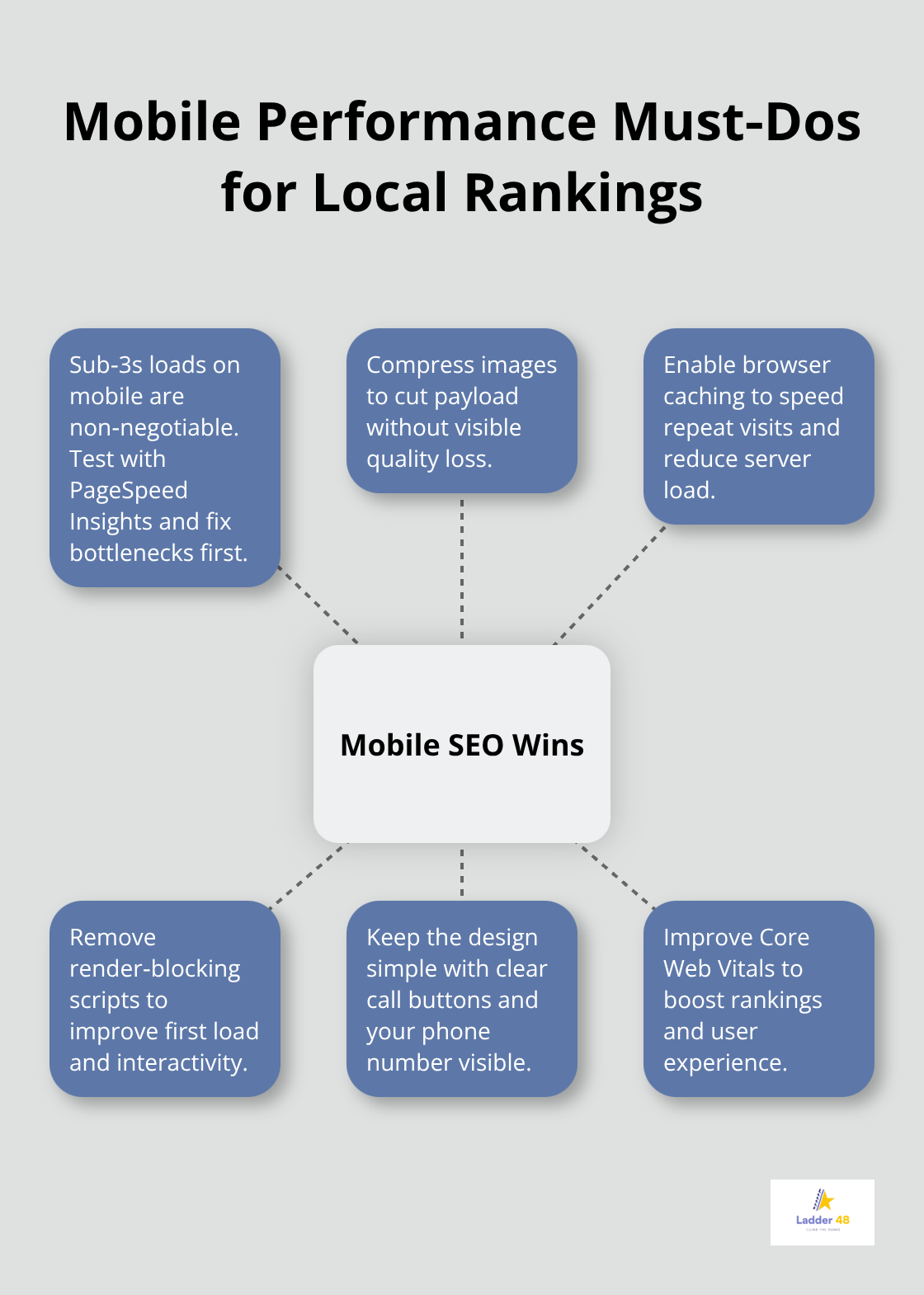
Your site must load in under three seconds on mobile networks. Test your site speed using Google PageSpeed Insights and fix the biggest bottlenecks immediately. Compress images aggressively, enable browser caching, and remove render-blocking scripts.
Most contractor sites load slowly because they embed heavy photo galleries or video backgrounds. Cut that.
A fast, simple mobile site with clear contact buttons and a phone number converts far better than a slow site with fancy design. Google’s Core Web Vitals measure loading speed, visual stability, and interactivity, and they directly impact rankings. If your site isn’t mobile-fast, you lose to competitors who invested the time.
Local Link Building Separates Winners From the Rest
Local link building separates contractors who rank from those who don’t, yet most startups ignore it completely. Websites with strong backlink profiles are 3.8 times more likely to rank in top results according to industry research. You don’t need hundreds of links. Try for 10 to 15 high-quality local backlinks in your first year.
Get listed on your local Chamber of Commerce website, trade association directories, and local business partnerships. If you sponsor a local sports team or donate to a community event, request a link from their website. Reach out to local newspapers and trade publications when you complete notable projects. A link from your city’s newspaper carries far more weight than a link from a random business directory.
Service area pages must link internally to each other strategically. If you have pages for Springfield, Riverside, and Oak Park, link between them contextually. Don’t create orphaned pages that stand alone.
Vague Service Area Descriptions Tank Local Rankings
Vague service area descriptions destroy your ability to rank locally. Generic pages that say you serve the greater metro area don’t work anymore. Google rewards specificity. Your Springfield page should mention specific neighborhoods, schools, parks, and streets by name.
Include actual project addresses if customers approved you to share them. Write 300 to 400 words per service area page, not thin 100-word descriptions. Add customer testimonials that mention the neighborhood specifically. Photos of completed work in that exact area matter more than generic photos.
Google’s algorithm understands local intent better than ever, and vague descriptions signal that you’re not genuinely local. Specificity wins in 2026.
Final Thoughts
Local SEO for contractor startups works when you execute the fundamentals consistently. Claim your Google Business Profile, build citations on platforms where homeowners search, and create service area pages that prove you’re genuinely local. Target long-tail keywords with low competition, get listed on industry directories, and collect reviews systematically.
Your first 90 days matter most. During this window, focus on foundation-building and quick wins rather than chasing vanity metrics. Track what actually moves the needle: qualified calls, form submissions, and map pack visibility. Measure your progress monthly and adjust based on real data, not guesses.
Contractor SEO for startups doesn’t require expensive agencies or long-term contracts-it requires consistency, specificity, and attention to what homeowners actually search for in your area. If you’re ready to accelerate your local growth beyond what you can handle alone, we at Ladder 48 help contractors build stronger online presence and achieve sustainable growth through transparent, results-driven SEO.