Contractors who rank on the first page of local search results get more calls, more quotes, and more jobs. Yet most contractors we work with at Ladder 48 are invisible in Google’s local results, buried beneath competitors who understand SEO basics.
Contractor SEO for rankings isn’t complicated. It’s about fixing the fundamentals: claiming your Google Business Profile, building citations, optimizing your website for local intent, and earning real customer reviews.
How to Dominate Local Search in Your Service Area
Google processes over 8.5 billion searches daily, and 90 percent of potential customers use Google to find home services. Yet most contractors ignore the three systems that actually control whether they show up in those results. Your Google Business Profile, local citations across directories, and location-based keywords on your website are not optional extras. They are the foundation that determines whether homeowners in your area can find you at all.
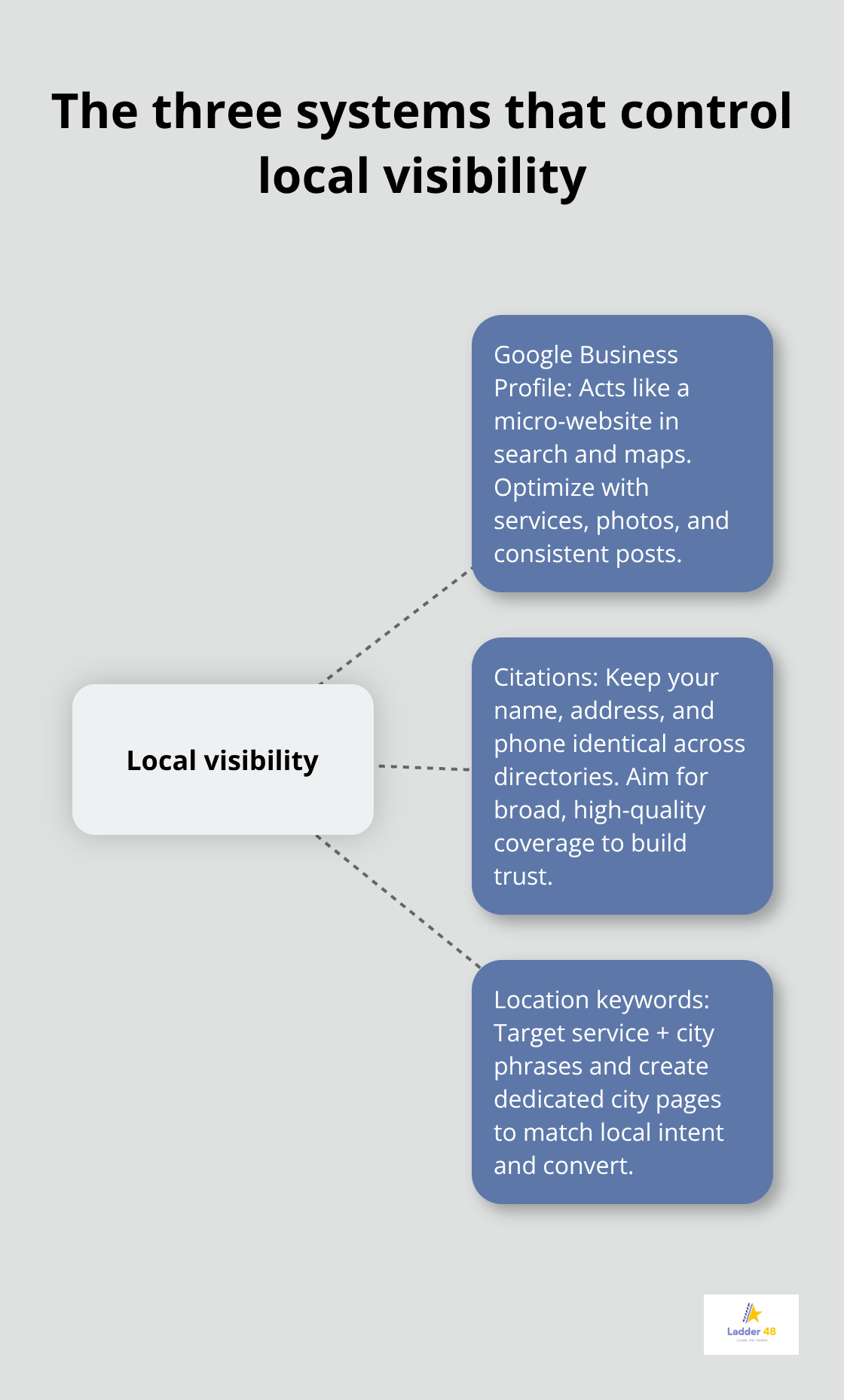
Without these three elements working together, you are essentially invisible to the customers actively searching for your services right now.
Your Google Business Profile Is Your First Lead Machine
Your Google Business Profile functions as a micro-website that appears directly in search results and maps. Most contractors treat it as a one-time task, but 85 percent of local searchers click one of the top three results in Google’s Map Pack, and 74 percent of those who click actually contact or buy within 24 hours.
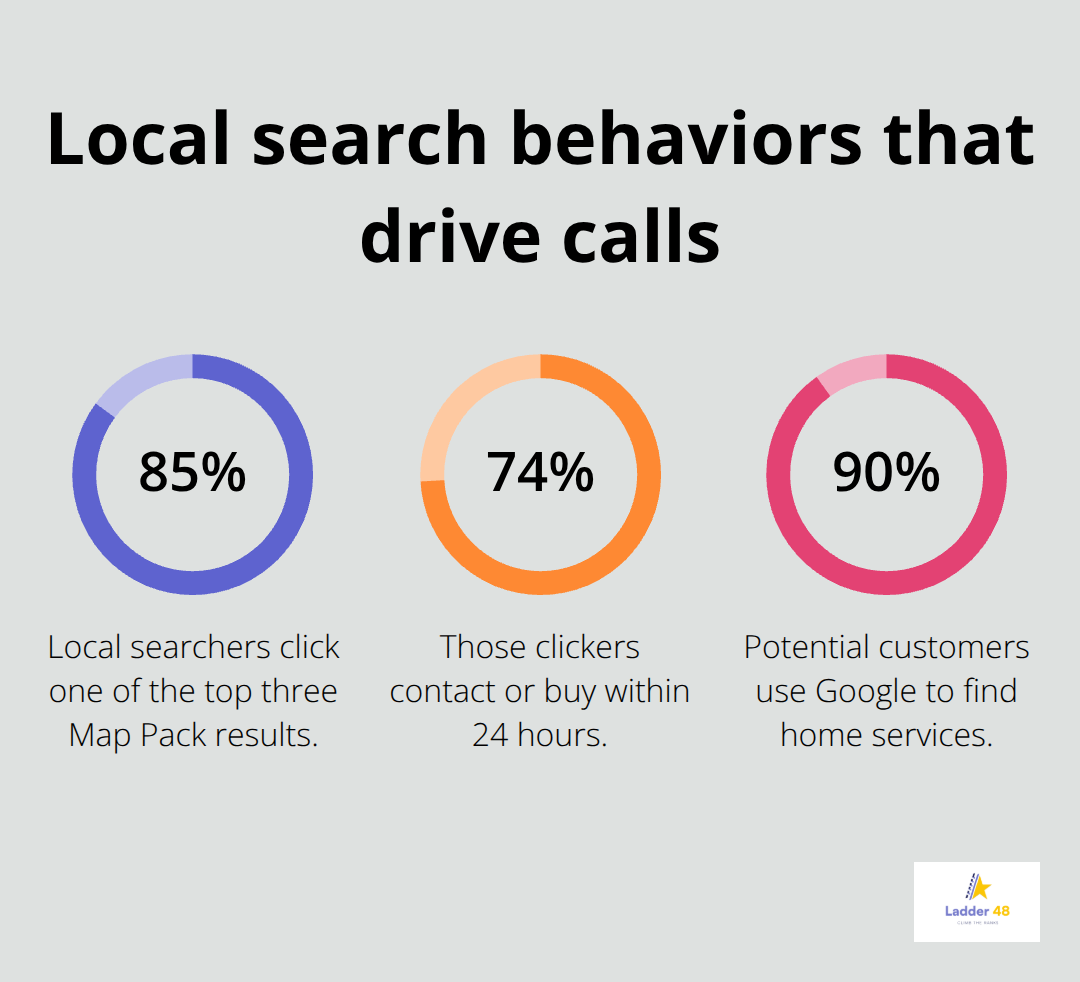
This means your GBP directly influences whether you receive calls.
Start by claiming your listing and verifying it through Google, then add a robust service catalog with approximately 22 services and detailed descriptions so Google understands what you actually do. Upload geo-located photos and videos every week, not sporadically. Google rewards consistent activity, and photos from actual job sites prove you work in the area. Post updates to your GBP every one to two weeks with project announcements or seasonal offers. This ongoing engagement signals to Google that your business is active and trustworthy.
Citations Build Trust Across the Web
Local citations are listings of your business name, address, and phone number across directories like Yelp, Angi, HomeAdvisor, and BBB. Contractors often skip this step because it feels tedious, but inconsistent or missing citations cost you rankings. Build and standardize your presence across 60 or more directories to boost trust signals, with potential ranking improvements around 20 percent.
The critical rule: your business name, address, and phone number must be identical everywhere. If your Google Business Profile says John’s Plumbing LLC but Yelp says Johns Plumbing, Google gets confused and ranks you lower. Claim your profiles on major platforms first, then use tools to audit and fix discrepancies twice per year. Remove duplicate listings that hurt your credibility. Citations act as votes of confidence to Google, telling the algorithm that your business is real, established, and worth ranking.
Location-Based Keywords Win Real Customers
Generic keywords like plumber or electrician attract searchers from everywhere and rarely convert. Contractors who rank for high-intent local phrases like emergency roof repair in Phoenix or commercial epoxy flooring contractor Dallas receive calls from ready-to-hire homeowners. Include specific service areas by city names rather than broad regions to capture more localized searches and appear in results that actually convert.
Create dedicated service pages for each city you serve, with that specific service-city combination in your H1 heading, page title, and meta description. Include actual pricing ranges, job timelines, and references to local neighborhoods or landmarks to prove you work there. Link these location pages internally from your homepage so Google understands your service area. This approach creates multiple entry points for local searches and helps lead volume grow as much as 50 percent compared to generic pages.
With your Google Business Profile optimized, citations standardized, and location pages live, you have established the local foundation that Google rewards. The next step is making sure your website itself performs at the technical level that search engines demand.
Technical SEO and On-Page Strategies
Website Speed and Mobile Performance Win More Calls
Your website speed directly determines whether homeowners contact you or click to a competitor. Google’s algorithm ranks faster sites higher, and conversion data shows that a one-second delay reduces conversions by approximately seven percent. Most contractor websites load in four to six seconds on mobile, which means you lose calls before homeowners even see your service descriptions.
Keep your mobile load time under three seconds. Optimize images to WebP format at under 200KB each, use a content delivery network, and lazy-load non-essential elements like videos. Run a Lighthouse audit monthly through Google’s PageSpeed Insights to identify which pages slow down your site, then fix the worst performers first. Mobile matters most because 90 percent of home service searches happen on phones, and Google prioritizes mobile speed as a ranking factor.
Local Schema Markup Tells Google Your Service Area
Most contractor websites lack structured data, which means Google has to guess what your business does and where you serve. Implement LocalBusiness schema markup in JSON-LD format on your homepage with your exact business name, address, phone number, hours, and service areas. Add Service schema to each dedicated service page listing what you offer, pricing ranges, and service area coverage.
Include FAQ schema on pages that answer common questions like emergency repair costs or permit requirements. This helps you appear in featured snippets and voice search results. After you add schema markup, validate it using Google’s Rich Results Test to confirm Google reads it correctly. Schema markup acts as a translator between your website and Google’s algorithm, making it far easier for the search engine to understand your location, services, and qualifications. Without it, even well-written content ranks lower because Google cannot confirm what you actually do.
Service Pages Built for Buyers, Not Search Engines
Service pages that rank highest include specific pricing ranges, job timelines, and references to neighborhoods you serve. Write your H1 heading as an exact match to your target keyword, such as Emergency Roof Repair in Phoenix or Commercial Epoxy Flooring Contractor Dallas, because Google weighs this heavily in local rankings. Include a table or section that breaks down service types with typical durations and cost ranges for your area.
Add a map embedded directly on the page showing your service radius, then link internally from your homepage to these service pages so Google understands your geographic focus. Most contractor websites use generic language like “We serve the greater metro area,” which tells Google nothing about where you actually work. Instead, name specific neighborhoods, zip codes, and landmarks to prove local expertise. This specificity attracts homeowners searching for services in their exact location and signals to Google that you are a real local business, not a national aggregator trying to rank everywhere.
Your website now moves faster, communicates clearly with Google through schema markup, and targets the exact neighborhoods where you work. The next step is building the authority signals that convince both Google and homeowners that you deserve their trust.
Building Authority Signals That Drive Rankings and Calls
Customer Reviews Accelerate Local Rankings
Customer reviews rank as the fastest way to climb local search results. Google’s algorithm now treats review velocity and response quality as ranking factors, which means a steady stream of fresh reviews from real customers outweighs almost every other tactic. Most contractors collect zero reviews per month, then wonder why competitors rank higher.
Start collecting reviews within 24 hours of project completion, not weeks later when the customer has forgotten the experience. Send an SMS with a direct Google review link rather than asking customers to search for your business and find the review button themselves. This friction reduction increases review submission rates dramatically. Contractors who systemize review collection with SMS requests and follow-ups see 5 to 10 new reviews monthly, compared to those who rely on word-of-mouth and get one or two per month.
Respond to every review within 24 hours, even negative ones, because Google tracks response velocity and uses it as a ranking signal. Your responses should mention specific services or neighborhoods to reinforce local relevance, not generic thank-yous that add no value. A response like “Thank you for choosing us for your kitchen remodel in Scottsdale” tells Google far more than a template message. Reviews act as both ranking signals and conversion tools, so treat them as a core SEO asset rather than a nice-to-have.
Backlinks from Local Sources Build Trust Authority
Citations from local directories and industry partners send authority signals that Google rewards with higher rankings. Claim your business on Yelp, Angi, HomeAdvisor, and BBB because these platforms carry significant domain authority, and links from them boost your credibility in Google’s eyes. Supply directories like your plumbing or HVAC vendor websites often include contractor directories where you can earn a link with just a few minutes of effort.
Local chambers of commerce, trade associations, and business improvement districts offer free or low-cost listings that generate both links and citations. The strongest links come from local news coverage, real estate blogs, and community websites that mention your business by name with a link back to your site.
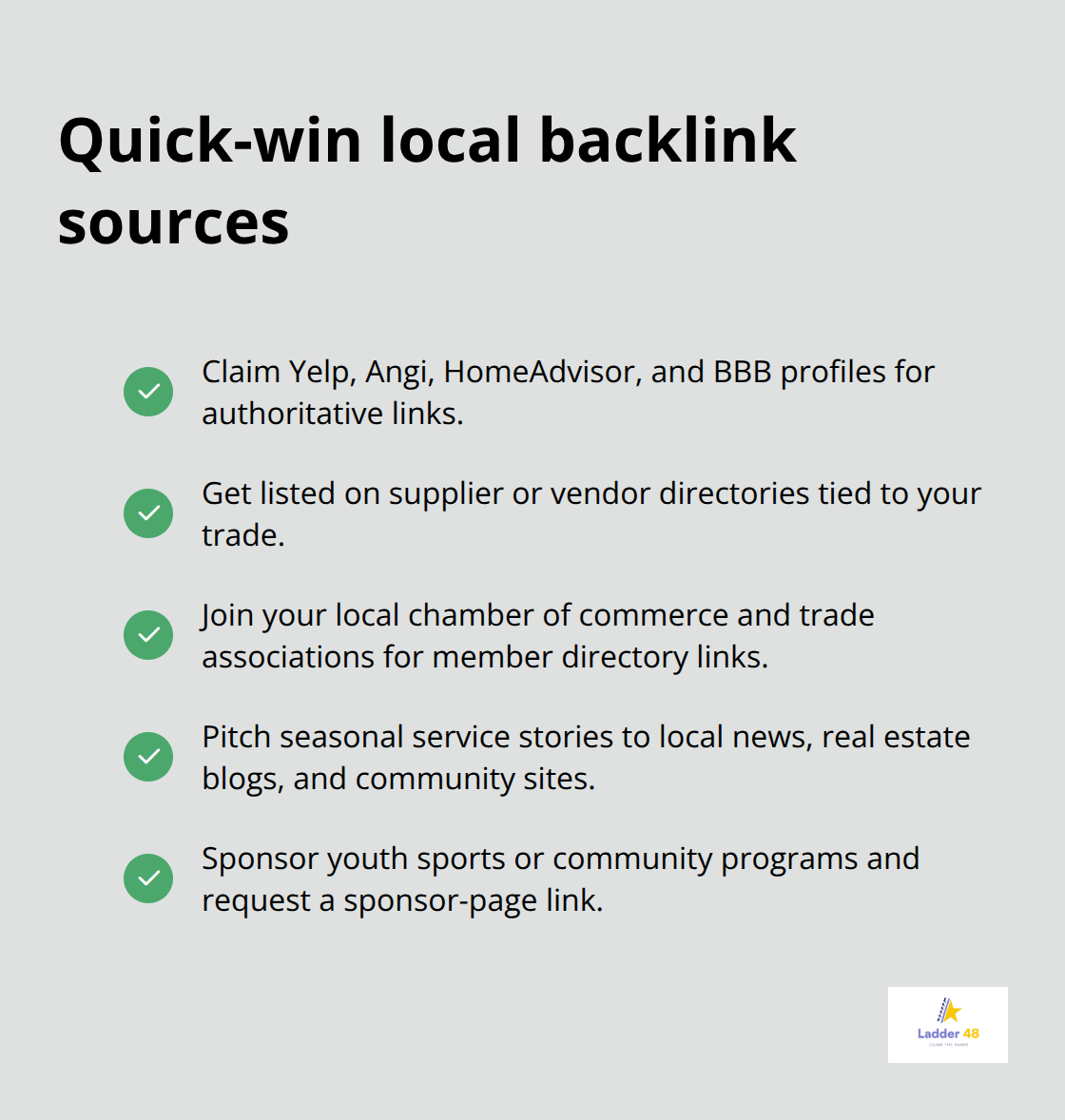
Pitch local outlets with stories tied to seasonal demand (winter heating emergencies or spring roof inspections) because these stories attract coverage and backlinks.
Sponsor local youth sports teams or community programs and ask the organization to link to your website from their sponsor page, turning a community investment into an SEO asset. Most contractors ignore these opportunities because they seem small, but consistent backlinks from 15 to 20 local sources create a trust network that outranks competitors relying solely on citations and reviews.
Final Thoughts
Contractor SEO for rankings works because it aligns what homeowners search for with what your business actually delivers. You now understand the three systems that control local visibility: your Google Business Profile as a lead machine, citations and location pages that prove you serve specific areas, and technical performance that keeps homeowners on your site long enough to call. These mechanisms determine which contractors appear first in search results, and they reward businesses that execute them consistently.
The contractors who dominate local search built their visibility through systematic action. They claimed their Google Business Profile and updated it weekly with photos and service details. They standardized their business name, address, and phone number across 60 or more directories so Google could trust their information. They built dedicated service pages for each city they serve, with specific pricing and neighborhood references that prove local expertise. They collected reviews systematically within 24 hours of project completion and responded to every single one. They optimized their website speed to load in under three seconds on mobile and added schema markup so Google understood exactly what they do and where they work.
This foundation takes time to build, but once it is in place, it generates calls month after month with minimal ongoing cost. Unlike paid advertising, where you stop paying and leads stop coming, local SEO compounds over time. Each new review, each citation, each backlink from a local source strengthens your authority in Google’s eyes. We at Ladder 48 help contractors build sustainable local SEO strategies that turn visibility into calls and jobs, and your next step is to measure where you stand today so you know exactly what to fix first.